
If you’re in crisis right now — if you’re thinking about hurting yourself — call or text 988 (the US Suicide & Crisis Lifeline), any hour, any day. This article is about new research on loneliness and frailty, and it isn’t a substitute for emergency mental-health support.
The short version: new research links loneliness and frailty more tightly than most people expect — and staying connected is one of the few protective steps that costs nothing. How To Beat Loneliness runs a free phone line at 877-638-1122 where a real person answers, no crisis required.
Loneliness and frailty tend to get filed in different drawers — one is a feeling, the other is a medical word your doctor might use somewhere past seventy. A research team just published numbers suggesting the two belong in the same drawer after all. I want to walk you through what they found, plainly, because it changes how seriously the quiet weeks deserve to be taken.
Loneliness and frailty: what the new analysis found
Researchers writing in Archives of Gerontology and Geriatrics pooled eight long-running cohort studies — 78,769 people in total — to ask one question: are adults who are lonely or socially isolated more likely to become frail?
The answer was yes, and by a wide margin. People experiencing social isolation — few contacts, few regular interactions — had about 31% higher odds of developing frailty. People experiencing loneliness — the painful feeling itself, regardless of how many people are around — had about 83% higher odds.
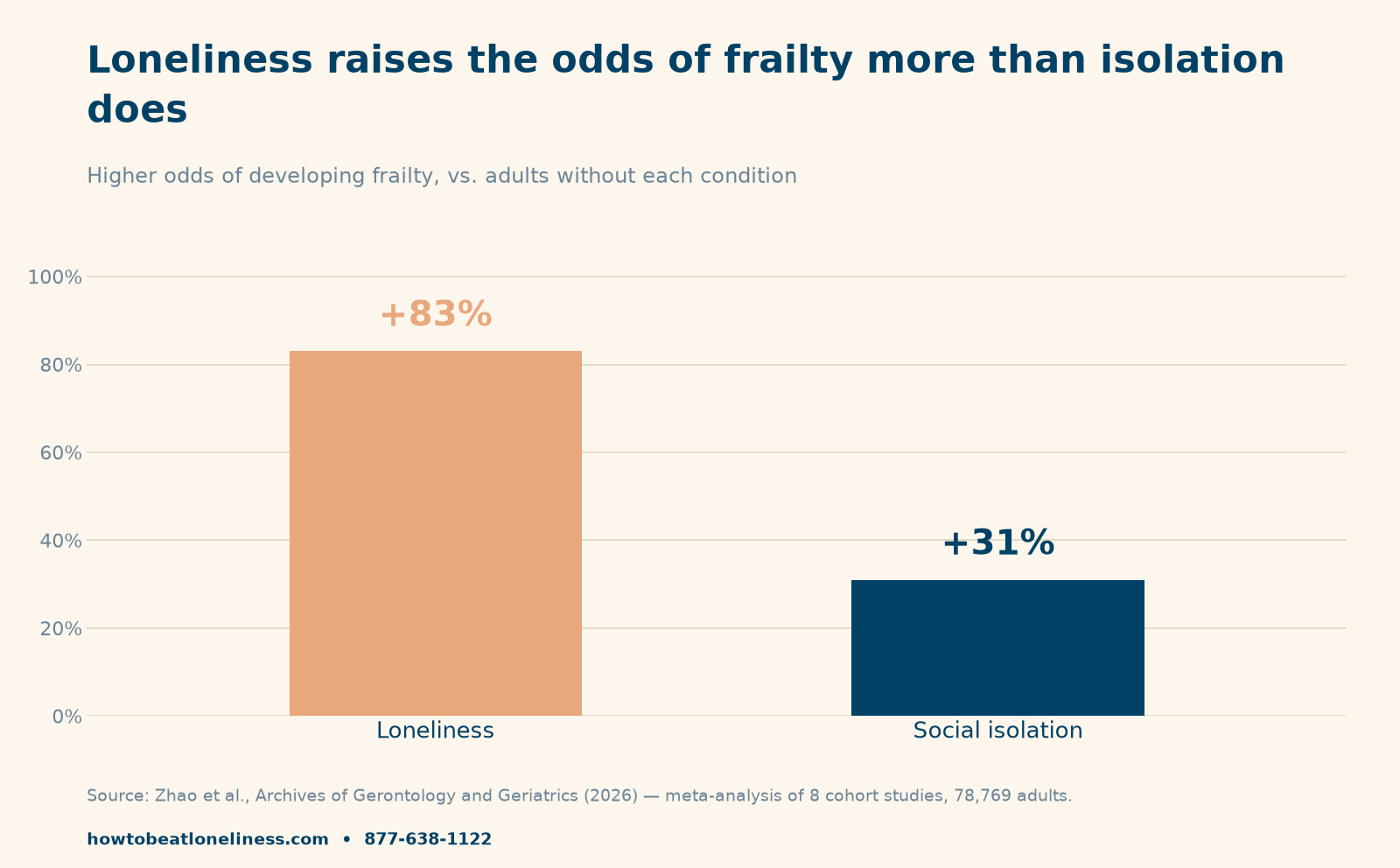
Sit with that comparison for a second. The feeling of being alone predicted frailty more strongly than the measurable fact of having few contacts. The authors’ conclusion is worth quoting in spirit: loneliness is a significant predictor of frailty risk, and catching it early may play a real role in preventing frailty. That’s a medical journal telling doctors to ask their patients about loneliness the way they ask about blood pressure.
What frailty actually means
Frailty isn’t just being old, and it isn’t a normal part of aging. It’s a specific state doctors can measure: strength ebbing, energy draining faster, walking slowing down, weight drifting off without trying, activity shrinking. A frail person has less in reserve — so a small setback, a fall or a flu, hits harder and takes longer to come back from.
That’s why this research matters. Frailty is one of the strongest signals of how the next decade of a person’s life will go. Anything that moves the odds by double digits deserves attention — especially something as unglamorous as being lonely.
Which comes first — the loneliness or the decline?
Honest answer: it runs both ways, and this kind of study can’t fully untangle cause from effect. The National Institute on Aging puts it plainly: poor health makes people more likely to end up isolated, and isolation puts physical and mental health at risk. It’s a loop. Mobility problems shrink your world; a smaller world weakens the body; a weaker body shrinks the world further.
But loops have entry points. You can’t will your knees young again. You can put one more real conversation into a week — and unlike most things in medicine, that lever is free and available today.
This is not a niche finding
The frailty numbers land on top of a pile of evidence that connection is physical health. The U.S. Surgeon General’s 2023 advisory found that lacking social connection can raise the risk of premature death by as much as smoking up to 15 cigarettes a day, and tied disconnection to heart disease, stroke, dementia and depression. NIA adds higher risks of high blood pressure, weakened immune function and hospital readmission to the list.
We wrote about the broader body effects in what loneliness does to your body, and about who’s most exposed in social isolation in older adults. Frailty is the newest entry on a list that was already long.
The half of the loop you can actually reach
If loneliness predicts frailty, then loneliness is not a mood to wait out. It’s a health behavior — like sleep, like walking — and it responds to small, boring, repeated action:
- Put one conversation on the calendar. A standing Tuesday call with a sister, a neighbor, anyone. Rhythm beats intensity.
- Say it to your doctor. This study is exactly why. If researchers want physicians screening for loneliness, you’re allowed to bring it up first — here’s how to talk to your doctor about loneliness.
- Keep the body moving. Walking with someone counts twice — once for the muscles, once for the company.
- Use a free line on the quiet days. Ours is 877-638-1122. A real person answers, there’s no fee and no intake, and wanting to talk is reason enough. For the bigger picture, start with how to beat loneliness.
Frequently asked questions
What is the link between loneliness and frailty?
A 2026 meta-analysis in Archives of Gerontology and Geriatrics pooled 8 cohort studies covering 78,769 adults and found loneliness was associated with about 83 percent higher odds of developing frailty, while social isolation was associated with about 31 percent higher odds.
What are common signs of frailty?
Doctors typically look for a cluster of changes: unintended weight loss, exhaustion, weaker grip strength, slower walking speed, and low physical activity. Having several of these together is what distinguishes frailty from ordinary aging, and it is worth raising with a doctor.
Can loneliness really affect physical health?
Yes. The U.S. Surgeon General’s 2023 advisory found that lacking social connection can raise the risk of premature death by as much as smoking up to 15 cigarettes a day, and the National Institute on Aging links loneliness and isolation to heart disease, depression, cognitive decline and weakened immune function.
Does staying connected prevent frailty?
The new research is observational, so it cannot prove cause and effect on its own. The study authors concluded that early detection of loneliness may play a crucial role in frailty prevention, and staying socially connected is a free, low-risk step that supports both mental and physical health either way.
Important
We are companions, not clinicians. The phone line at How To Beat Loneliness is staffed by real humans who listen — we don’t diagnose, prescribe, or treat. Frailty is a medical condition: if you’ve noticed weight loss, exhaustion or slowing down, please bring it to your doctor. And if you or someone you love is in crisis right now, call or text 988, the U.S. Suicide & Crisis Lifeline, available 24/7.
A note from the founder
Studies like this one put numbers on something our phone agents hear every week: the quiet doesn’t stay in your head. It gets into your knees, your sleep, your appetite. You don’t need to solve all of it today. One conversation is a real, measurable start — and ours are free. The number is 877-638-1122.
— Sergio, How To Beat Loneliness
Sources
- Zhao Y, Deng B, Cheng X, Peng D — Social isolation, loneliness and the risk of frailty status: a meta-analysis of observational studies. Archives of Gerontology and Geriatrics, 2026;146:106219
- National Institute on Aging — Loneliness and Social Isolation: Tips for Staying Connected
- U.S. Surgeon General — Our Epidemic of Loneliness and Isolation (2023 Advisory)