

If you’re in crisis right now — if you’re thinking about hurting yourself — call or text 988 (the US Suicide & Crisis Lifeline), any hour, any day. This page isn’t a substitute for emergency mental-health support. If it isn’t an emergency and you are simply sitting with the thought that my adult children never call me, keep reading — that is exactly what this page is for.
The short version: If you’re thinking my adult children never call me, you’re in very large company — and you don’t have to sit in that quiet alone today. How To Beat Loneliness answers a free phone line at 877-638-1122, a real person picks up, and no crisis is required. Below are seven facts about family silence, all sourced.
I’m Jewel. I answer the free loneliness line at How To Beat Loneliness, and my adult children never call me is one of the sentences I hear most often — usually late, usually said sideways, usually followed by “but they’re busy, it’s fine.” It’s rarely fine. It’s also rarely what the person thinks it is. So here are seven things that are true, with the sources attached, because I think the facts are gentler than the story most people tell themselves at 9pm.
My adult children never call me: 7 honest facts about the silence
1. You are nowhere near the only one — it’s tens of millions
Cornell sociologist Karl Pillemer ran the first large-scale national survey on family estrangement and found that 27% of Americans 18 and older had cut off contact with a family member — at least 67 million people. He called it a problem “hiding in plain sight,” and noted the real number is probably higher, because plenty of people won’t admit it out loud.
Read that again if you’ve been carrying this as a private shame. Sixty-seven million people is not a personal failing. It’s a weather pattern.
2. The parent-and-child rift is the most common kind there is
Of the more than 1,300 people Pillemer surveyed, 10% reported being estranged from a parent or a child — more than the share estranged from a sibling (8%) or from extended family (9%).
The relationship we assume is unbreakable is statistically the one that breaks most.
3. Most silence isn’t a rupture. It’s a fade nobody planned
Pew Research Center found that among U.S. adults with at least one grown child living outside the home, 46% are in contact at least daily and another 39% at least weekly. Which means roughly one in seven parents hears from a grown child less than once a week — and almost none of those are dramatic estrangements. There was no argument. Nobody declared anything.
A fade is harder to name than a fight, and much harder to complain about. That’s exactly why it goes unaddressed for years.
4. If you’re a father, the odds were always tilted against you
In that same Pew data, 52% of American mothers say they’re in touch with a grown child at least once a day, compared with 38% of fathers. A fourteen-point gap.
I mention it because the dads who call me are often certain the silence is a verdict on them specifically. Sometimes it is. Very often it’s a pattern that started long before anyone in the family made a decision about anything.
5. The phone is still the line — and it still opens from your end
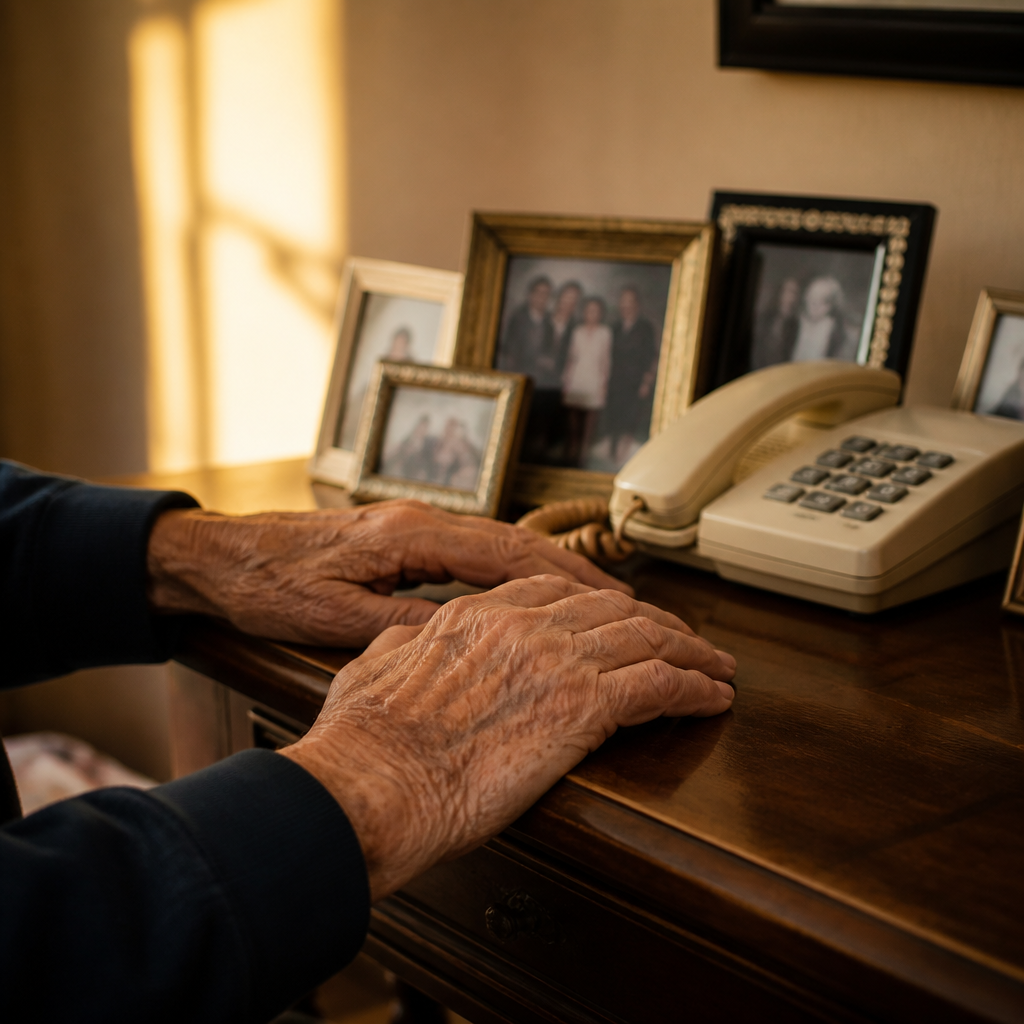
Despite every app invented since, Pew found that 94% of U.S. adults in monthly touch with a living parent say they typically communicate by telephone. Texting is second, at about half.
So the channel isn’t broken and it isn’t obsolete. It’s just that both sides are waiting on the other to use it — each reading the other’s silence as the answer.
6. The quiet isn’t just sad. It has a physical cost
The National Institute on Aging links social isolation and loneliness to higher risk of high blood pressure, heart disease, a weakened immune system, anxiety, depression, cognitive decline and Alzheimer’s disease. UCLA researcher Steve Cole put it bluntly in NIA’s own write-up: “Loneliness acts as a fertilizer for other diseases.”
I’m not saying that to frighten you into dialing anyone. I’m saying it because people apologize to me for minding the silence, as though minding it were self-indulgent. It isn’t. It’s your body keeping accurate score.
7. Most rifts do not stay closed — and reconcilers rarely regret it
This is the fact I’d tattoo on the inside of the phone. Pillemer’s Cornell Family Reconciliation Project interviewed 100 people who had actually repaired a family rift, and found they nearly all did one particular thing: they gave up needing the other person to accept their version of the past, or to apologize for it. They aimed at the present and the future instead, with realistic expectations about who the other person actually is.
Pillemer’s summary: “Most eventually felt much better after the reconciliation, even if it wasn’t perfect.” Not perfect. Better. That’s a much lower bar than the one most people are refusing to jump.
What I’d actually do this week
Three small things, in the order I’d do them.
- Send something that needs no reply. A photo, a line about the weather, a memory with no question mark on the end. Questions feel like invoices. A note that asks for nothing is much easier to answer.
- Drop the ledger, at least on paper. Write down who owes whom what, then put the page in a drawer. You don’t have to forgive anything today. You just don’t have to open the call with the bill.
- Don’t make one relationship carry your whole week. If your children are the only voices you’re waiting on, the wait gets unbearable and every call gets heavier. Our guide on how to beat loneliness walks through the smaller steps, and if you’re on the other side of this — a grown child worried about a parent — read how to help an elderly parent who is lonely.
And if you’d rather talk it through with somebody who isn’t in the family and has no stake in who was right, that’s the whole job of our line. It’s free, it always was, and our founder wrote about why.
Frequently asked questions
Why don’t my adult children call me anymore?
Most often it is drift rather than a decision. Pew Research Center found that about one in seven American parents hears from a grown child less than weekly, and very few of those cases involve any argument at all. Where there is a genuine rift, Cornell research points to long-running causes such as harsh parenting, perceived favouritism, divorce, in-law tension, or disputes over money.
Is it normal to feel this lonely when my adult children never call me?
Yes, and it is not an overreaction. The National Institute on Aging treats loneliness and social isolation as real health risks linked to heart disease, depression and cognitive decline. Minding the silence is your body responding accurately to a genuine loss of connection.
Should I be the one to reach out first?
Usually yes, and it works best when the first contact asks for nothing. Cornell researchers found that people who successfully reconciled gave up needing an apology or agreement about the past, and focused on the present relationship instead. A short note with no question in it is a far easier door to open than a phone call demanding an explanation.
Is there someone free I can talk to about this today?
Yes. How To Beat Loneliness answers a free companion line at 877-638-1122 where a real person picks up and no crisis is required. It is not therapy and it is not a crisis line. It is a conversation with someone who has no stake in who was right.
Important
We are companions, not clinicians. The phone line at How To Beat Loneliness is staffed by real humans who listen — we don’t diagnose, prescribe, or treat. If you’re working through grief, depression, or a mental-health condition, please pair our conversation with a licensed therapist, your doctor, or the resources above.
A note from our call agent
I’ve never once thought a caller was petty for minding this. You raised somebody, and now the house is quiet, and both of those things can be true at the same time without anybody being the villain. If you want to talk it through — or talk about something else entirely, which is honestly most of my week — the line is there and it costs nothing.
— Jewel