

If you’re in crisis right now — call or text 988 (US Suicide & Crisis Lifeline), available 24/7. This article is about finding someone to talk to about grief on an ordinary hard day, and it isn’t a substitute for emergency mental-health support.
The short version: if you want someone to talk to about grief, How To Beat Loneliness runs a free phone line at 877-638-1122. A real person answers. There’s no fee, no intake form, no diagnosis, and no clock running. You can call because it’s Tuesday and the house is too quiet.
Most advice about grief is written for the first two weeks. The casseroles, the cards, the funeral. Almost none of it is written for month seven, when everyone else has gone back to their lives and you’re still standing in the kitchen at 4pm not knowing what to do with yourself.
Here are seven things the research actually says — and where to find a voice when you need one.
Why finding someone to talk to about grief is harder than it should be
Grief has a short social shelf life. People show up fast, and then they stop, mostly because they don’t know what to say and are afraid of saying it wrong. So the person grieving ends up managing everyone else’s discomfort on top of their own loss — and stops bringing it up. That’s how a room full of people who love you turns into a very quiet phone.
1. Loneliness isn’t a side effect of grief. It’s a symptom of it.
This one surprises people. When the American Psychiatric Association wrote the diagnostic criteria for prolonged grief disorder, intense loneliness — feeling alone or detached from others — was put on the list of symptoms, right alongside identity disruption and emotional numbness.
So if you feel lonely in a way that seems out of proportion to how many people are around you, that isn’t you being ungrateful. It’s a documented part of what loss does.
2. There are no stages, and you are not behind
The famous five stages were never meant as a schedule. As Dr. Sarah Stahl of the University of Pittsburgh put it in NIH News in Health: there’s no wrong way to grieve, everyone grieves differently, and there’s no timeline.
Dr. Wendy Lichtenthal adds the part that matters most: one of the things that makes grief harder is believing you’re grieving wrong, or that you should be further along by now.
3. Grief shows up in the body, not just the mood
Headaches. No appetite. Bone-deep fatigue. Dizziness. Sleep that won’t come or won’t stay. NIH lists all of these as ordinary physical symptoms of grieving — which means if you’ve been to the doctor twice this year and nothing turned up, grief may be the answer nobody named.
4. Rebuilding boring routines does more than it sounds like it should
Stahl’s research team ran a program for older grieving adults built around three unglamorous things: sleep, meals, and moving your body. Support came through daily digital check-ins and health coaching — no in-person visits at all. Participants still showed real improvements in depression and anxiety symptoms.
Two things worth taking from that. Small routines are genuinely therapeutic, not just tidy. And contact that isn’t face-to-face still counts. A voice on a phone is not a consolation prize.
5. For most people grief softens — for a minority, it doesn’t
The APA estimates that between 4% and 15% of bereaved adults develop prolonged grief disorder: grief that stays intense, persistent and disabling more than a year after the loss, with at least three symptoms nearly every day for a month.
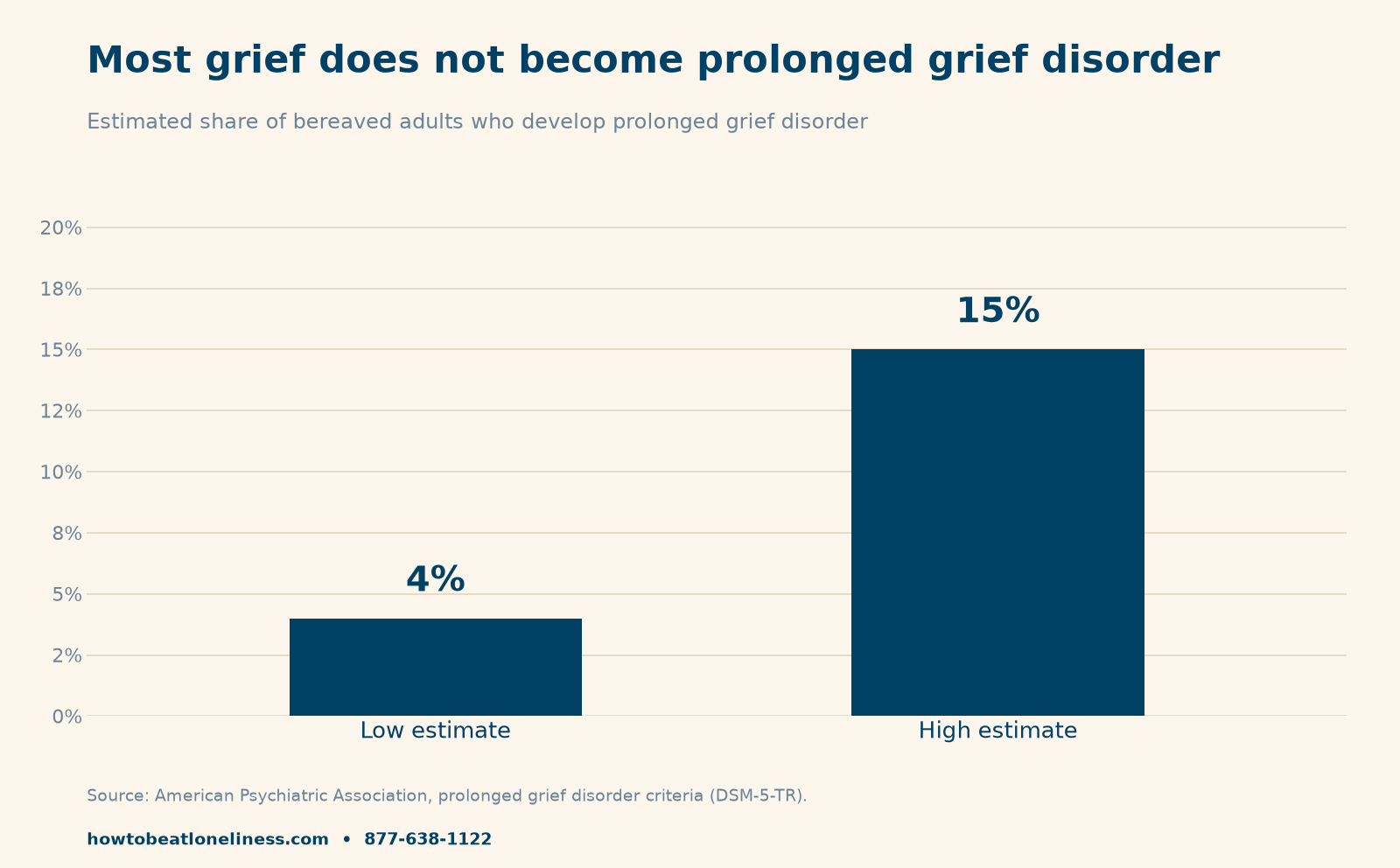
Read that range the kind way. The overwhelming majority of grieving people are not developing a disorder — they’re grieving, which is a normal thing that takes a long and uneven time.
6. Isolation is a risk factor, not just a bad feeling
Both NIH and the APA list lack of social support and social isolation among the risk factors for grief getting stuck. Older adults who lose a spouse are flagged specifically, because they’re often managing their own health changes and a shrinking circle at the same time.
Which is the whole argument for picking up the phone before things get heavy. Reaching out isn’t an admission that you’re failing at grief. It’s the thing the research says protects you.
7. It doesn’t have to be a professional
NIH says it plainly: not everyone needs professional counseling for grief, and many people find their way through with family, friends, faith, or other sources of connection. Dr. Holly Prigerson’s current work is built on exactly that idea — connecting grieving people with others who’ve walked a similar road, because sometimes the most powerful support comes from someone who has been there.
Therapy is a good tool. It is not the only door. And it isn’t available at 11pm on a Sunday.
Where to find someone to talk to about grief tonight
A short, honest list:
- How To Beat Loneliness — 877-638-1122. Free. A real person, no script, no session limit. Call because you want to say their name out loud to someone.
- 988 Suicide & Crisis Lifeline. Free, 24/7, for crisis and for thoughts of harming yourself.
- A local grief support group. The National Institute on Aging suggests checking hospitals, senior centers, funeral homes, religious groups, or your doctor — many are free, and online options exist if leaving the house is too much.
- A grief counselor, if daily life has become hard to get through.
If the loss was your husband or wife, we wrote a longer piece on loneliness after losing a spouse. If you’re further out and the quiet has just become the shape of your days, start with how to beat loneliness. And if you’re wondering who’s on the other end of our line, our founder wrote about why we started a free loneliness phone line.
Frequently asked questions
Who can I talk to about grief for free?
How To Beat Loneliness answers a free line at 877-638-1122 with no fee, no referral and no time limit. Free grief support groups are also commonly run through hospitals, senior centers, funeral homes and religious congregations, and the 988 Suicide & Crisis Lifeline is free 24 hours a day if you are in crisis.
Is it okay to call a loneliness line if I’m grieving?
Yes. You do not need to be in crisis and you do not need a reason beyond wanting to talk. Grief and loneliness overlap so heavily that intense loneliness is listed by the American Psychiatric Association as a symptom of prolonged grief.
How long is grief supposed to last?
There is no set timeline. NIH researchers are explicit that grief does not follow fixed stages and that everyone grieves differently. Intensity usually eases over months and years, with good days and bad days along the way.
When should grief make me see a professional?
Consider talking with your doctor or a grief counselor if more than a year has passed and the grief is still intense enough to disrupt daily life, if you feel stuck or unable to re-engage with the things you care about, or if you are having thoughts of harming yourself. The American Psychiatric Association estimates 4 to 15 percent of bereaved adults develop prolonged grief disorder, which responds well to treatment.
Important
We are companions, not clinicians. The phone line at How To Beat Loneliness is staffed by real humans who listen — we don’t diagnose, prescribe, or treat. If you’re working through grief, depression, or a mental-health condition, please pair our conversation with a licensed therapist, your doctor, or the resources above.
One more thing
You don’t have to have anything prepared. Some of the best calls we take are people who start with I don’t really know why I called. That’s a fine place to start. The number is 877-638-1122, and it’s free.
— Landon, How To Beat Loneliness
Looking for someone to talk to when lonely outside of grief? Our fuller guide to someone to talk to when lonely covers six free options and what each is like.