
The short version: you can talk to your doctor about loneliness — it is a legitimate thing to raise at a checkup, and three plain sentences are enough to start. How To Beat Loneliness answers free at 877-638-1122, where a real person picks up just to talk between appointments — no crisis needed, no cost. If you are thinking about harming yourself, call or text 988 (the U.S. Suicide & Crisis Lifeline) right away — free and answered 24/7.
I am Landon, and I help run How To Beat Loneliness. Here is something I hear constantly: someone sits in an exam room with fifteen minutes on the clock, gets asked about their knee, answers about their knee, and walks out without mentioning the thing that has actually been wearing them down for two years. If you want to talk to your doctor about loneliness and it feels like the wrong thing to bring up, this is for you. It is not the wrong thing. It might be the most useful thing you say all appointment.
Why You Should Talk to Your Doctor About Loneliness
Because it is medical information, not small talk. The National Institute on Aging links loneliness and social isolation in older adults to higher risk of heart disease, depression, and cognitive decline. The U.S. Surgeon General’s 2023 advisory puts numbers on it: poor social connection is associated with a 29% higher risk of heart disease and a 32% higher risk of stroke.
Your doctor is already asking about your sleep, your appetite, your blood pressure, your memory, and your mood. Loneliness pushes on every one of those. Leaving it out is like describing a leak without mentioning the rain.
There is a systems reason too. The National Academies of Sciences, Engineering, and Medicine devoted a whole chapter to the role of the health care system in social isolation, on the grounds that clinicians are often the only professionals a socially isolated older adult sees regularly. If nobody else is in the room, the doctor is the room.

Research from the AARP Public Policy Institute and Stanford University found that roughly 14% of older adults in original Medicare — about 4 million people — have very limited social networks, and that Medicare spends an estimated $1,608 more per year on each of them, around $6.7 billion annually. That is not a scolding. It is evidence that the health system already treats this as its business.
What to Actually Say
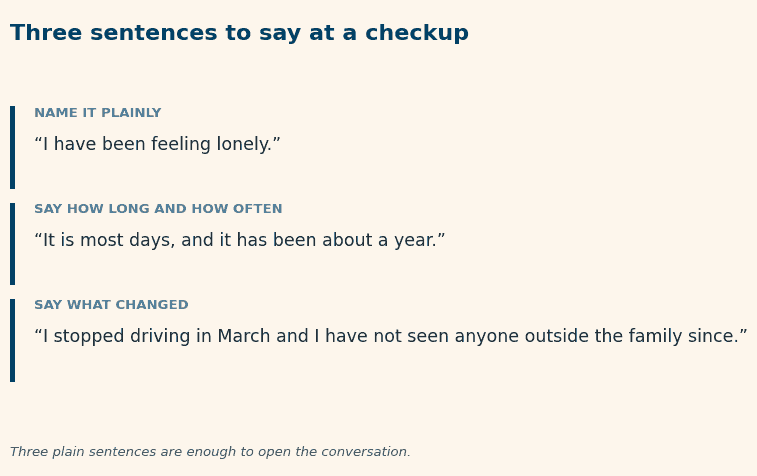
You do not need a speech. You need three sentences, and you should say them early — not with your hand on the door handle.
1. Name it plainly
“I have been feeling lonely.” That is the whole sentence. Not “I have been a bit down I suppose,” which invites a nod and a move along. Doctors are trained to follow the words you give them, so give them the real one.
2. Say how long and how often
“It is most days, and it has been about a year.” Duration and frequency are what turn a feeling into something clinically legible. A rough month is different from eighteen quiet months, and only you can supply that.
3. Say what changed
“I stopped driving in March and I have not seen anyone outside the family since.” Circumstance is the most actionable thing you can hand over, because a lot of it is fixable — transport, hearing, mobility, a medication that flattened you out.
What a Good Doctor Does With It
Knowing what to expect makes the sentence easier to say. Usually one or more of these follows.
- Screen for depression. Loneliness and depression overlap heavily but are not the same thing, and the difference changes the treatment. We wrote about the distinction in loneliness and depression.
- Check the physical gateways. Hearing, vision, mobility, continence, pain. These quietly shut down social life long before anyone calls it loneliness, and several are straightforwardly treatable.
- Review your medications. Sedation, fatigue, and low mood are side effects, and side effects keep people home.
- Refer you outward. Many practices can point you to a social worker, a care navigator, or your Area Agency on Aging, which knows what actually exists in your zip code.
If Raising It Feels Impossible
Two practical workarounds. First, write the three sentences on a card and hand it over — this is not cheating, and nurses and doctors read handed-over cards without blinking. Second, ask for the appointment at the start: “Before we look at the knee, there is one other thing.” Fifteen-minute appointments punish whoever speaks last.
And if the answer you get is a shrug, that is a reason to ask again or ask someone else, not a verdict on you. The CDC treats social isolation as a genuine health risk factor. You are not being dramatic.
In the meantime, the gap between appointments is long and quiet, and that is the part we exist for. If you need someone to talk to when lonely, our free line is answered by a real person at 877-638-1122 — no fee, no referral, no reason required. For the longer road, our guide to how to beat loneliness maps what tends to help.
Important
We are companions, not clinicians. The free line at How To Beat Loneliness is answered by real people who listen — we do not diagnose, prescribe, or treat, and nothing here is medical advice or a substitute for your doctor. Depression is common in later life and very treatable, so if sleep or appetite has gone, if hopelessness is there most days, or if memory changes worry you, please bring it to a professional rather than waiting it out. In a crisis, or if you are thinking about harming yourself, call or text 988 right away. Adults 60 and older can also reach the Institute on Aging Friendship Line at 888-670-1360, free and answered 24/7.
A note from Landon
The thing I would want you to take from this is that nobody in that room is going to be embarrassed except possibly you, and only for about four seconds. I have never once heard from someone who regretted saying it out loud. I have heard from a great many people who spent years not saying it. And on the days between appointments, we are here: 877-638-1122, free, always a real person.
— Landon, How To Beat Loneliness
Frequently asked questions about talking to your doctor about loneliness
Is loneliness something a doctor can actually help with?
Yes, in several concrete ways. A doctor can screen for depression, check the physical causes that shut social life down such as hearing loss or mobility problems, review medications that cause fatigue or low mood, and refer you to a social worker or your Area Agency on Aging.
What exactly should I say to my doctor about feeling lonely?
Three sentences are enough. Name it plainly, say how long and how often it happens, and say what changed in your circumstances. Raise it at the start of the appointment rather than on your way out.
Will my doctor think I am wasting their time?
No. Public health bodies including the CDC and the U.S. Surgeon General treat social isolation and loneliness as real health risk factors linked to heart disease, stroke, depression and cognitive decline. It belongs in a medical appointment.
Who can I talk to between appointments?
How To Beat Loneliness answers free at 877-638-1122 and a real person picks up, with no crisis needed and no cost. Adults 60 and older can also call the Institute on Aging Friendship Line at 888-670-1360, and 988 is there for any day that feels unsafe.
Sources
- National Institute on Aging — Loneliness and Social Isolation: Tips for Staying Connected
- U.S. Surgeon General (2023) — Our Epidemic of Loneliness and Isolation
- National Academies of Sciences, Engineering, and Medicine — Role of the Health Care System
- AARP Public Policy Institute & Stanford University (2017) — Medicare Spends More on Socially Isolated Older Adults
- CDC — Health Effects of Social Isolation and Loneliness