
If you are in crisis right now, call or text 988 (the U.S. Suicide & Crisis Lifeline) — free and answered 24/7. Otherwise, the short version: social isolation in older adults means having few social contacts, and it affects roughly one in four Americans over 65. How To Beat Loneliness answers free at 877-638-1122, where a real person picks up just to talk — no crisis needed, no cost, nothing to sign up for.
I am Sergio, and I started How To Beat Loneliness after noticing how little ordinary company there is on offer between a family visit and an emergency room. Social isolation in older adults is the quiet middle of that gap. It is measurable, it is common, and it is not the same thing as loneliness — which matters more than most people realise. Here are seven facts worth knowing, all of them sourced, and a free number to call at the end: 877-638-1122.
What Social Isolation in Older Adults Actually Means
The two words get used interchangeably, and they should not be. The National Institute on Aging draws the line clearly: social isolation is the lack of social contacts and having few people to interact with regularly. Loneliness is the distressing feeling of being alone or separated.
One is a count. The other is a feeling. They overlap often, but not always, and the difference changes what actually helps.
| Social isolation | Loneliness | |
|---|---|---|
| What it is | Objective — few contacts, little regular interaction | Subjective — the feeling of being disconnected |
| How you would spot it | Count the conversations in a week | Ask how the week felt |
| Can happen without the other? | Yes — a person can be isolated and content | Yes — a person can feel lonely in a full room |
| What tends to help | More regular contact, transport, a standing call | Contact that feels close, not just frequent |
7 Facts About Social Isolation in Older Adults
1. About one in four older Americans is socially isolated
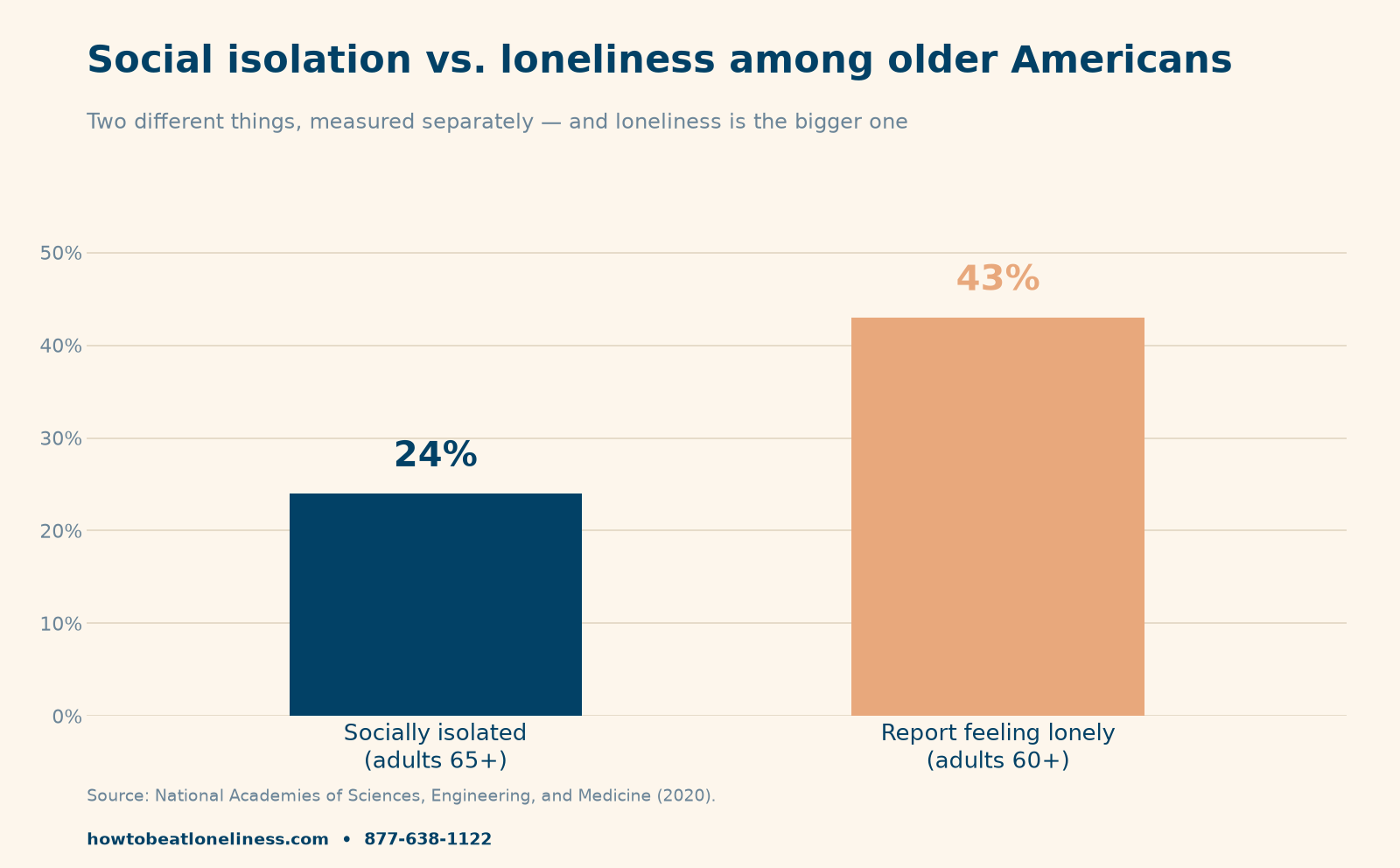
The consensus report from the National Academies of Sciences, Engineering, and Medicine, published via the National Center for Biotechnology Information, puts it at roughly 24% of community-dwelling adults aged 65 and older. That is people living in their own homes, not in care — a quarter of them, structurally short of contact.
2. The feeling is even more widespread than the isolation
The same report finds that 43% of adults over 60 report feeling lonely. Nearly twice the isolation figure. Which tells you something important straight away: most lonely older adults are not sitting in an empty house with nobody’s number. They have contact. It is not landing.
3. You can have one without the other
The CDC is blunt about this: social isolation can pose a health risk even if a person does not feel lonely, and even a person with a lot of friends can feel lonely. That is why asking are you lonely? is a poor screening question on its own. Plenty of people answer no and are still short of the contact their health needs.
4. The health risk is measurable, not metaphorical
This is the part that surprises people. The U.S. Surgeon General’s 2023 advisory reports that poor social relationships are associated with a 29% higher risk of heart disease and a 32% higher risk of stroke, and that among older adults, chronic isolation and loneliness are associated with roughly a 50% higher risk of developing dementia.
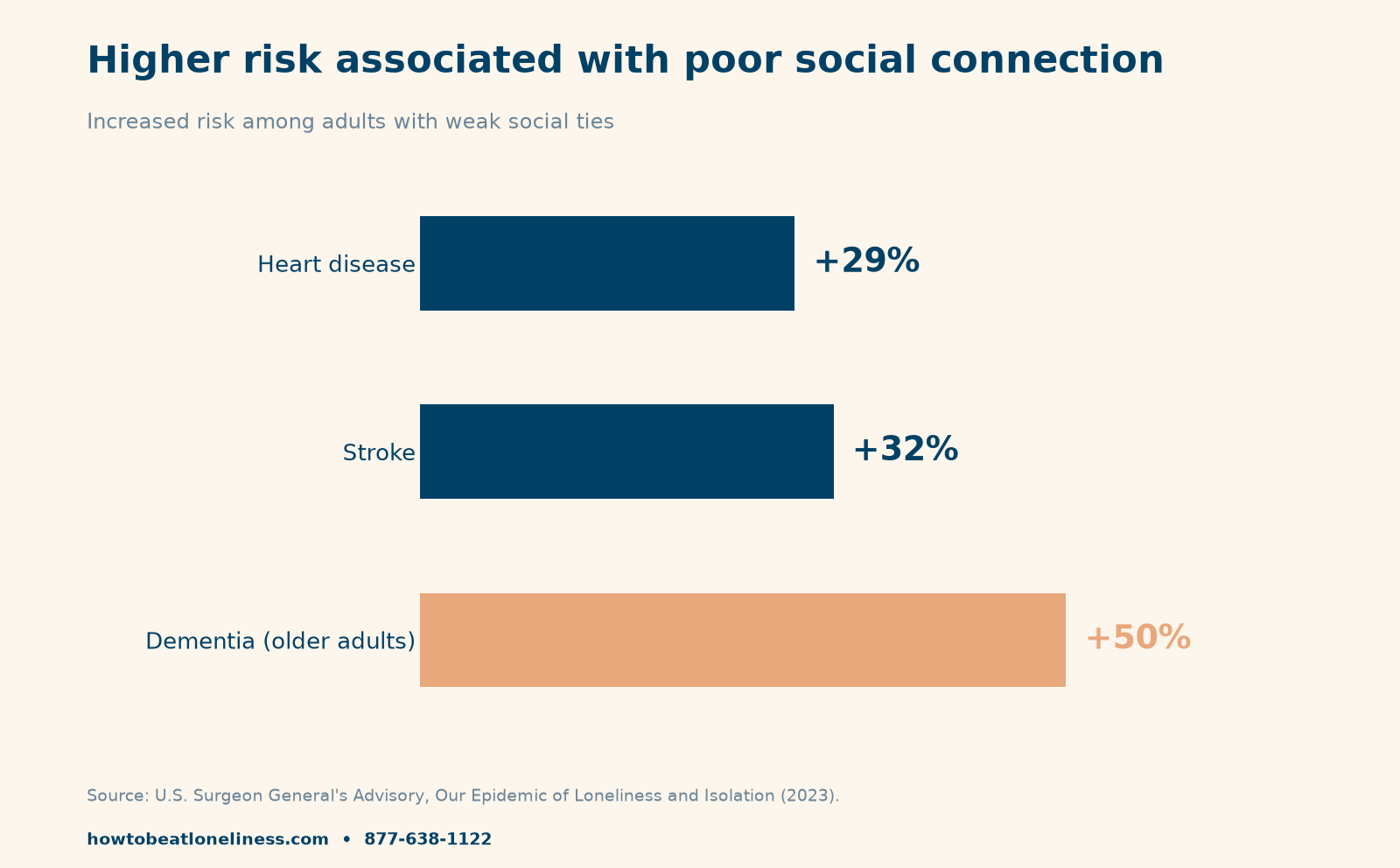
These are associations, not a verdict on any one person. But they are the reason public-health agencies stopped filing this under lifestyle and started filing it under risk.
5. Hearing loss is one of the most underrated causes
The NIA makes a point of this one. People who cannot hear well find conversations exhausting and start withdrawing — not from lack of interest, but from embarrassment and frustration. Worse, they are sometimes read as confused or uncooperative when the truth is simply that they missed the sentence. Untreated hearing problems tend to get worse, and so does the withdrawal.
6. It is usually circumstance, not personality
The NIA’s risk list reads like a list of ordinary later-life events: loss of mobility, vision or hearing problems, living alone, no transport, financial strain, retirement, the death of a spouse, caring for someone who is unwell, living somewhere rural or hard to reach. Nobody chooses their way into that list. It arrives.
7. It is not a fixed condition
This is the fact I would put in bold if I could only keep one. The NIA notes that people who engage in meaningful activities with others feel a sense of purpose and tend to live longer, and that volunteering in particular helps people feel less lonely. The direction of travel is reversible. Not easily, not overnight, but reversible.
What Actually Helps
The interventions that work are unglamorous. Regular contact beats occasional contact. A standing arrangement beats good intentions, because it does not depend on anyone feeling up to it that day.
- Fix the practical barrier first. A hearing test, a ride to the community centre, or a phone with bigger buttons often does more than any amount of encouragement.
- Put it on the calendar. A scheduled call every Tuesday works better than a promise to call more often. We wrote about the options in check-in calls for seniors.
- Give something to do, not just someone to see. Purpose is doing a lot of the work in the research. Volunteering, a class, a shared task.
- Use the free lines that already exist. Ours is one of them. Our free loneliness phone line is answered by a real person at 877-638-1122, and there is no fee, no form, and no reason required.
For the wider picture on where isolation shades into something heavier, see loneliness and depression.
Important
We are companions, not clinicians. The free line at How To Beat Loneliness is answered by real people who listen — we do not diagnose, prescribe, or treat, and we are not a substitute for professional care. If isolation has turned into something heavier — sleep or appetite gone, hopelessness on most days, memory changes that worry you — please pair a conversation with us with your doctor. Depression is common in later life and very treatable. In a crisis, or if you are thinking about harming yourself, call or text 988 (the U.S. Suicide & Crisis Lifeline) right away.
A Note From the Founder
The number I keep coming back to is the gap between 24% and 43% — more people feel it than technically have it. That gap is the whole argument for a line like ours. Contact that counts is not the same as contact that happens. Ours is free, and the number does not change: 877-638-1122.
— Sergio, How To Beat Loneliness
Frequently Asked Questions About Social Isolation in Older Adults
What is social isolation in older adults?
It is the objective lack of social contact — few relationships and little regular interaction with other people. The National Institute on Aging distinguishes it from loneliness, which is the subjective feeling of being alone. A person can be isolated without feeling lonely, and lonely without being isolated.
How common is social isolation among seniors?
Roughly 24% of community-dwelling adults aged 65 and older are socially isolated, according to the National Academies of Sciences, Engineering, and Medicine. The same report found that 43% of adults over 60 report feeling lonely.
Why is social isolation dangerous for older adults?
The U.S. Surgeon General’s 2023 advisory links poor social relationships to a 29% higher risk of heart disease and a 32% higher risk of stroke, and reports that chronic isolation and loneliness among older adults are associated with roughly a 50% higher risk of dementia.
Who can an isolated older adult call just to talk?
How To Beat Loneliness answers free at 877-638-1122, and a real person picks up. No crisis is needed and there is no cost. The Institute on Aging Friendship Line at 888-670-1360 is another free option for adults 60 and older, and 988 is there for any day that feels unsafe.
Sources
- National Academies of Sciences, Engineering, and Medicine — Social Isolation and Loneliness in Older Adults (Summary)
- National Institute on Aging — Loneliness and Social Isolation: Tips for Staying Connected
- CDC — Health Effects of Social Isolation and Loneliness
- U.S. Surgeon General (2023) — Our Epidemic of Loneliness and Isolation