
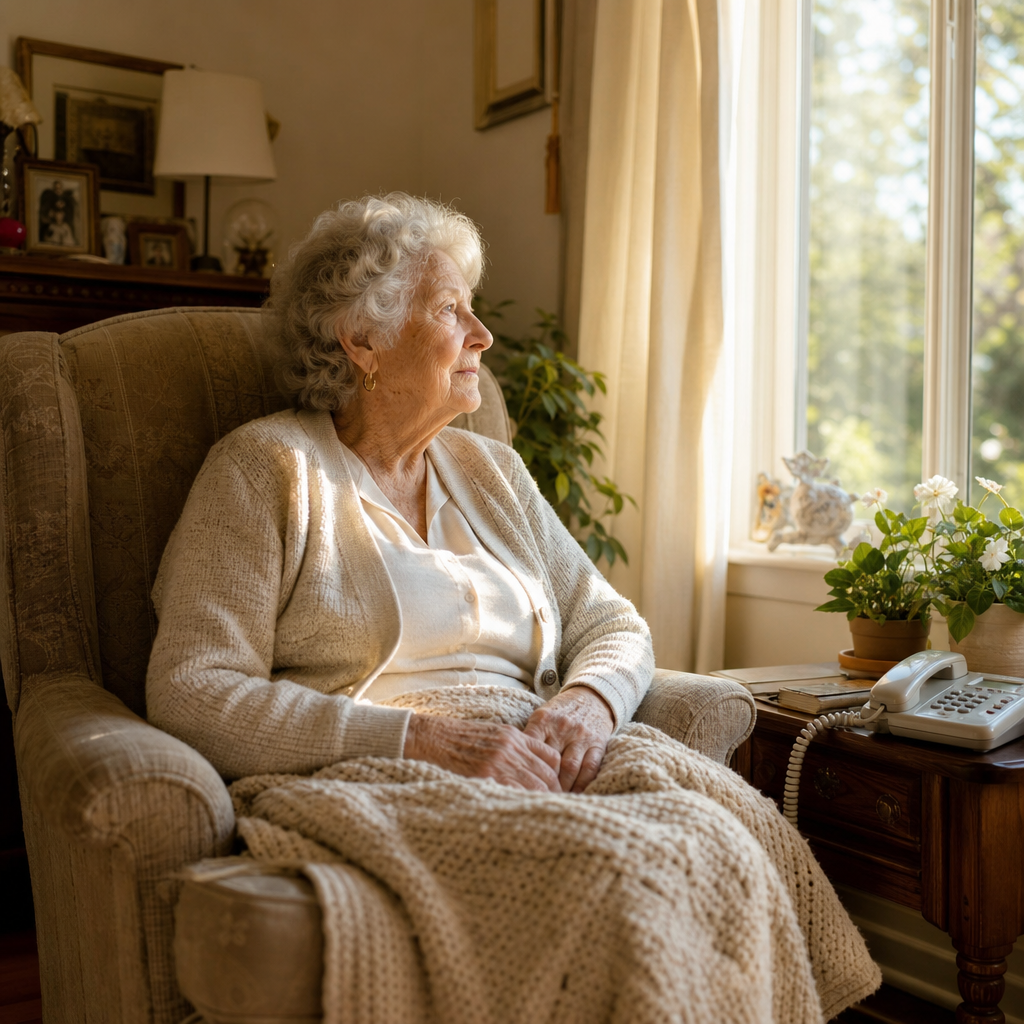
If you’re in crisis right now — if you’re thinking about hurting yourself — call or text 988 (the US Suicide & Crisis Lifeline), any hour, any day. This page isn’t a substitute for emergency mental-health support. If it isn’t an emergency and you are simply homebound and lonely, and the days have gone very quiet, keep reading — that’s exactly what this page is for.
The short version: If you’re homebound and lonely, you can have a real conversation today without leaving your chair. How To Beat Loneliness answers a free phone line at 877-638-1122 — a person picks up, no crisis is required, and there’s nothing to sign up for. Below is what the research actually shows about housebound quiet, plus the options that work from home.
I’m Jewel, and I answer that line. A good share of the people I talk to haven’t been further than the mailbox in weeks — a hip that didn’t heal right, a car that got sold, oxygen tubing that makes the front steps a project. Almost none of them call themselves lonely straight out. They say the house is “quiet.” They say they don’t want to be a bother. So let’s put some plain facts down, because being homebound and lonely is a much bigger and much more ordinary situation than most people sitting in it realize.
Homebound and lonely: why those two words travel together
1. Being homebound stopped being rare
Researchers at Mount Sinai reviewed 10,785 records from the National Health and Aging Trends Study covering 2011 through 2020 and found the share of older adults who were homebound jumped from about 5 percent across the previous decade to 13 percent in 2020. In that research, “homebound” means rarely or never leaving the house — not bedbound, not in a facility. Just home.
The same team made a point that stopped me cold the first time I read it: over that decade, more Americans were homebound than were living in nursing homes. Which means the biggest room full of housebound older people in this country isn’t a building at all. It’s several million living rooms, each one thinking it’s the only one.
2. Isolation and homebound status pull each other along
It’s tempting to assume the order of events is simple: you get sick, you stay home, you get lonely. A peer-reviewed analysis of nine years of that same national survey data found it runs in both directions — socially isolated older adults were more likely to already be homebound, and more likely to become homebound over the years that followed.
That’s a loop, not a straight line. And loops can be interrupted anywhere along the circle, which is genuinely good news. You don’t have to fix your knees to change the amount of conversation in your week.

3. The quiet isn’t only an emotional problem
The National Institute on Aging links social isolation and loneliness to higher risk of high blood pressure, heart disease, a weakened immune system, anxiety, depression, cognitive decline and Alzheimer’s disease. The CDC treats it the same way — as a health risk, not a mood.
I bring that up for one reason only. People apologize to me for minding the silence, as if minding it were vanity. It isn’t. It’s your body keeping accurate score of something real.
What actually helps when you can’t get out
Almost every piece of advice written about loneliness assumes you can drive somewhere. Here’s the shorter list that doesn’t.
| Option | What it is | Cost | How to start |
|---|---|---|---|
| How To Beat Loneliness line | An ordinary conversation with a real person. Not therapy, not a crisis line. | Free | Call 877-638-1122 |
| Eldercare Locator | Federal referral service that connects you to your local Area Agency on Aging — meals, rides, friendly-visitor and telephone-reassurance programs. | Free | Call 1-800-677-1116, Mon–Fri 8am–9pm ET |
| Institute on Aging Friendship Line | A 24-hour warmline built for adults 60+ and adults living with disabilities; they also make ongoing outreach calls. | Free | Current number is listed on the IOA site |
| Home-delivered meals | The food matters, but so does the person at the door — many programs are the only face a client sees that day. | Free or sliding scale | Ask the Eldercare Locator for your county’s program |
| Faith or community check-ins | Many congregations keep a visiting or calling list and will gladly add you. | Free | One phone call to the office |
Eldercare Locator hours and scope per the Administration for Community Living / USAging. Phone numbers verified August 2026.
Five things that work from a chair
- Put one call on the calendar. Not “I should ring my niece sometime” — Tuesday, 10am, written on the paper calendar. A day with a fixed point in it is a different day. Spontaneity is the first thing housebound weeks lose.
- Ask for the standing call, not the favour. People say yes to “could you call me Sunday evenings?” far more often than to “call me more.” One is a slot. The other is a complaint, and nobody knows how to answer a complaint.
- Let the deliveries count as something. The meal driver, the pharmacy runner, the aide. Two extra sentences with each is not the same as a friendship, and it is also not nothing — it’s practice, and practice keeps the muscle from stiffening.
- Fix the room, not just the schedule. Chair near a window with something moving outside it. Phone within arm’s reach of where you actually sit. Hearing checked, because conversation stops being worth the effort when you can only catch half of it — that connection is well documented in our piece on hearing loss and loneliness.
- Say it out loud at your next appointment. Doctors ask about falls and pills and rarely about the quiet, but they can refer you to things you’d never find alone. We wrote a short script for that in how to talk to your doctor about loneliness.
If you want the wider version of all this — the parts that aren’t specific to being housebound — our main guide on how to beat loneliness is the place to start. And if you’d rather just talk to somebody today than read one more list, that’s the entire job of our line. It’s free, it always has been, and our founder wrote about why.
Frequently asked questions
What does homebound actually mean?
In the national aging research, homebound means rarely or never leaving the home — not bedbound, and not living in a care facility. Mount Sinai researchers using ten years of National Health and Aging Trends Study data found this described about 5 percent of older adults across the 2010s and 13 percent in 2020.
Why am I still lonely when people come to the house?
Because task contact and conversation are not the same thing. An aide, a driver and a nurse can pass through your week without anyone once asking what you think about something. That gap is what most homebound callers are describing when they tell me the house feels quiet even on a busy day.
Is there a free number I can call just to talk?
Yes. How To Beat Loneliness answers a free companion line at 877-638-1122 where a real person picks up and no crisis is required. For a 24-hour option built specifically for adults over 60 and adults with disabilities, the Institute on Aging Friendship Line is a long-running warmline, and the Eldercare Locator at 1-800-677-1116 can connect you to telephone-reassurance and friendly-visitor programs in your own county.
Can being homebound and lonely affect my health?
The National Institute on Aging links social isolation and loneliness to higher risk of high blood pressure, heart disease, weakened immunity, anxiety, depression and cognitive decline, and the CDC treats it as a health risk rather than a mood. Research also suggests the relationship runs both ways, with socially isolated older adults more likely to become homebound over time.
Important
We are companions, not clinicians. The phone line at How To Beat Loneliness is staffed by real humans who listen — we don’t diagnose, prescribe, or treat. If you’re working through grief, depression, or a mental-health condition, please pair our conversation with a licensed therapist, your doctor, or the resources above.
A note from our call agent
Nobody has ever wasted my time on this line. Not once. If the biggest thing that happened to you today was the weather turning or a bird on the rail, I’d genuinely like to hear about it — that’s not a consolation prize, that’s the conversation. You don’t need a reason and you don’t need to get up.
— Jewel
For a fuller comparison of free lines and warm places to turn when you’re lonely, our guide to finding someone to talk to when lonely covers six options and what each is like.
Sources
- Mount Sinai — Increase in Homebound Older Adults During the Pandemic (Ankuda et al., JAMA Internal Medicine, 2021)
- Social Isolation, Homebound Status, and Race Among Older Adults — National Health and Aging Trends Study, 2011–2019
- National Institute on Aging — Social isolation, loneliness in older people pose health risks
- Eldercare Locator — Administration for Community Living / USAging
- Institute on Aging — Friendship Line