
If you’re in crisis right now — if you’re thinking about hurting yourself — call or text 988 (the US Suicide & Crisis Lifeline), any hour, any day. This page isn’t a substitute for emergency mental-health support. If it isn’t an emergency and you’re simply eating alone every day and the table has gotten very quiet, keep reading — that’s exactly what this page is for.
The short version: Eating alone every day is linked in the research to more depressive symptoms and thinner, quicker meals — but it is a risk factor, not a verdict, and plenty of people eat alone contentedly. How To Beat Loneliness answers a free phone line at 877-638-1122 if the quiet at your table is the part that’s wearing on you. A real person picks up. No crisis required.
I’m Sergio. I started this line, and I’ve spent two years now listening to how people describe an empty house. Almost nobody opens with the word lonely. What they mention, over and over, is dinner. The cooking-for-one arithmetic. The plate eaten standing at the counter. The six o’clock hour that used to have someone in it. So I went and read what the researchers have actually measured about eating alone every day, because the anecdote deserved better than my opinion.
What the research says about eating alone every day
The best single place to start is a 2021 scoping review in the International Journal of Environmental Research and Public Health, which gathered the studies on older adults eating alone versus eating with company. Three findings from it are worth your time.
1. The depression link keeps showing up
Five separate studies in that review compared older people who ate alone with those who ate alongside someone. All five found higher rates of depressive symptoms among the solo eaters. One of them was longitudinal and followed 37,130 people over time; its authors noted the effect looked amplified for men who lived alone as well as ate alone.
Five studies pointing the same direction is not proof that one causes the other. It is enough to stop treating the empty chair as a triviality.
2. The highest risk isn’t always the person living alone
This is the finding that surprised me. Three of the reviewed studies suggested that the people at particular risk were older adults who ate alone while living with their families — a small group, around five percent of those samples. In the interview research, people in exactly that situation described feeling like a burden.
A full house doesn’t guarantee a full table. If you live with grown children and still eat your supper alone at eight o’clock, the research says you are not imagining the weight of it.
3. Company changes how much you actually eat
In one small experiment inside the review, participants ate the same nutritional supplement twice — once alone, once in a session where they each brought two friends. Eating together produced roughly a 60 percent increase in total energy intake. The sample was tiny, twenty-one people, so hold it loosely. But it matches the larger pattern: solo meals get shorter, simpler and smaller.
A separate study of 2,584 older adults found that women who already had poor nutritional status and ate alone showed greater cognitive decline over the following years than those who ate with others. The authors’ conclusion is the line I keep coming back to: nutrition programs for older people should pay attention to what people eat and to who is there.
What the research does not say
It does not say that eating alone is bad for everyone. One of the qualitative studies in the same review found single-living older people describing meals at home alone as genuinely peaceful — contented, unhurried, with freshness and variety of food mattering more to them than company. That is a real result too, and it belongs here.
So the honest reading is this. Eating alone is a risk factor, not a diagnosis, and risk factors only bite when they stack. The stacking is what to watch for: meals getting shorter. Cooking becoming not worth it. Research on widowers found that once shared meals disappeared, people ate fewer regular meals and spent less time on food altogether — the whole ritual thinning out at once. If that’s the direction your table has been drifting, that’s the part worth interrupting, and there’s more on the wider version of it in our guide to living alone and lonely.
Free ways to put someone back at the table
| Option | What it is | Cost | How to start |
|---|---|---|---|
| Congregate meal site | A group meal at a senior or community center, funded under the Older Americans Act. The meal is the excuse; the table is the point. | Free or by donation | Ask the Eldercare Locator for your county’s site |
| Eldercare Locator | Federal referral line that connects you to your local Area Agency on Aging — meals, rides, friendly-visitor programs. | Free | Call 1-800-677-1116, Mon–Fri 8am–9pm ET |
| Home-delivered meals | For people who can’t get out. The food matters, and so does the person at the door. | Free or sliding scale | Same number as above |
| A standing phone supper | You and one other person eat at the same hour with the phone on the table. It counts. It has for a long time. | Free | Ask one person for one fixed evening |
| How To Beat Loneliness line | An ordinary conversation with a real person. Not therapy, not a crisis line. | Free | Call 877-638-1122 |
Eldercare Locator scope and hours per the Administration for Community Living / USAging. Verified August 2026.
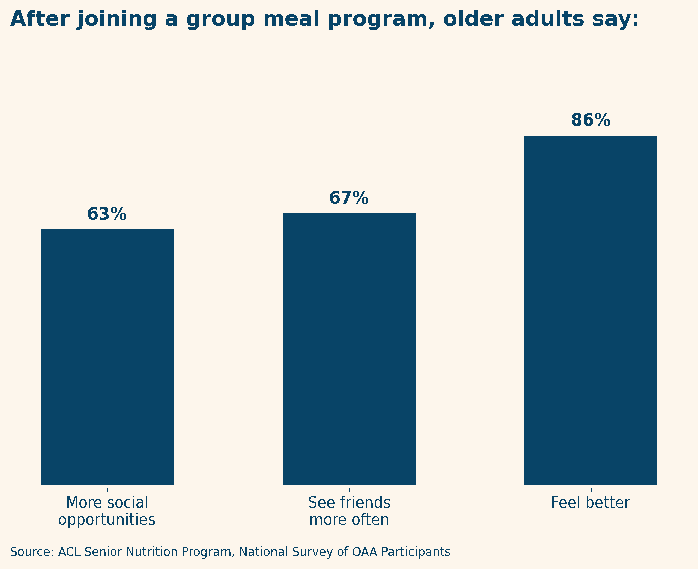
The group-meal option is the one most people skip, and the numbers in the chart above are the argument for it. In the federal survey of participants, 63 percent said their social opportunities had increased, 67 percent said they saw friends more often, and nearly 86 percent said they simply felt better. More than a third said the reason they went in the first place was to see other people, or not to be alone. Nobody there is pretending it’s about the casserole.
Five small things that change a quiet table
- Sit down for one of them. If all three meals happen standing at the counter, pick one and put it on a plate at the table. It sounds like nothing. It’s the difference between refuelling and eating.
- Cook something that takes a while. Not for the food. For the forty minutes that now have a shape to them. Widowers in the research described cooking as the first thing to go, and it takes the rest of the ritual with it.
- Ask for the standing supper, not the visit. “Could you eat with me Thursdays at six?” gets a yes far more often than “come round sometime.” One is a slot on a calendar. The other is a wish.
- Go to the meal site once before you decide. Everyone’s first objection is that it’ll be sad. More than a third of the people already there went for exactly the reason you’re hesitating.
- Say it out loud at your next appointment. Doctors ask about falls and pills and almost never about the table. They can refer you to programs you’d never find alone — there’s a short script in our piece on how to talk to your doctor about loneliness.
And if what you want tonight isn’t a program or a plan but a conversation, that’s the whole job of our line. It’s free, it always has been, and if you’d like the wider version of everything above, our main guide on how to beat loneliness is the place to go next. If you’d just like someone to talk to when lonely, that page has the shortest path to a voice.
Frequently asked questions
Is eating alone every day bad for you?
It is a risk factor rather than a verdict. A 2021 scoping review found that across five studies, older adults who ate alone reported higher rates of depressive symptoms than those who ate with company, and solo meals tended to be shorter and simpler. But the same review also found older people who described eating alone at home as peaceful and contented. What matters is the direction of travel — meals thinning out, cooking stopping, appetite fading.
Why does eating alone feel worse than being alone the rest of the day?
Because a meal is one of the few daily events that was designed for more than one person. Most hours of a day are neutral about company. Six o’clock is not. That is also why the hour arrives on schedule, every single day, which is what makes it wearing.
Where can I find a free group meal for seniors near me?
Call the Eldercare Locator at 1-800-677-1116, Monday to Friday, 8am to 9pm Eastern. It is the federal referral service run through the Administration for Community Living, and it will connect you to the Area Agency on Aging for your county, which handles congregate meal sites and home-delivered meals.
Can I talk to someone if I just don’t want to eat dinner alone tonight?
Yes. How To Beat Loneliness answers a free line at 877-638-1122 where a real person picks up and no crisis is required. People call while the kettle is on. That is a completely ordinary reason to call.
Important
We are companions, not clinicians. The phone line at How To Beat Loneliness is staffed by real humans who listen — we don’t diagnose, prescribe, or treat. If you’re working through grief, depression, or an eating problem, please pair our conversation with a licensed therapist, your doctor, or the 988 Lifeline in a crisis.
One more thing
The thing I’ve learned from two years of this is that people wait for a reason big enough to justify picking up the phone, and dinner never feels big enough. It is. If the quietest hour of your day happens to be the one with a plate in it, that’s a good enough reason and always was. 877-638-1122, free, a person on the other end. You can even call while you eat.
— Sergio, How To Beat Loneliness
Sources
- Bjørnwall et al. — Eating Alone or Together among Community-Living Older People: A Scoping Review (Int. J. Environ. Res. Public Health, 2021)
- Administration for Community Living — Meaningful Connection and Better Health through Congregate Meals
- ACL — Senior Nutrition Program (Older Americans Act nutrition services)
- National Institute on Aging — Social isolation, loneliness in older people pose health risks
- Eldercare Locator — Administration for Community Living / USAging