

The short version: hearing loss and loneliness feed each other, and the fix usually starts with one easier conversation rather than a whole new social life. How To Beat Loneliness answers free at 877-638-1122 — a real person picks up, you can ask them to slow down or speak up as many times as you like, and nobody is timing you. If a day ever feels unsafe, call or text 988, the U.S. Suicide & Crisis Lifeline, free and answered 24/7.
I am Jewel, and I answer that free line. Here is something I did not expect when I started: a surprising number of the quietest callers are not sad, exactly. They are tired. They have spent months nodding along at family dinners, guessing at punchlines, saying “what?” twice and then giving up and smiling instead. That is what hearing loss and loneliness look like from the inside — not a dramatic withdrawal, just conversation slowly becoming expensive, until it feels easier to stay home. The research on this is more solid than most people realize, so here are seven facts worth knowing, and what actually helps.
Why Hearing Loss and Loneliness Travel Together
It is not mysterious. When hearing gets harder, every conversation takes more effort — more concentration, more guessing, more asking people to repeat themselves. The National Institute on Deafness and Other Communication Disorders puts it plainly in its own patient guide: hearing loss can make it hard to enjoy talking with family and friends, leading to feelings of isolation.
The part people miss is that nobody decides to withdraw. It happens one skipped invitation at a time. The restaurant is too loud, so you stop going. The group is too fast, so you stop talking. Then a year later the phone stops ringing, and it feels like people left — when really, the conversations just got too costly to keep buying.
7 Facts About Hearing Loss and Loneliness
1. This is common, not unusual
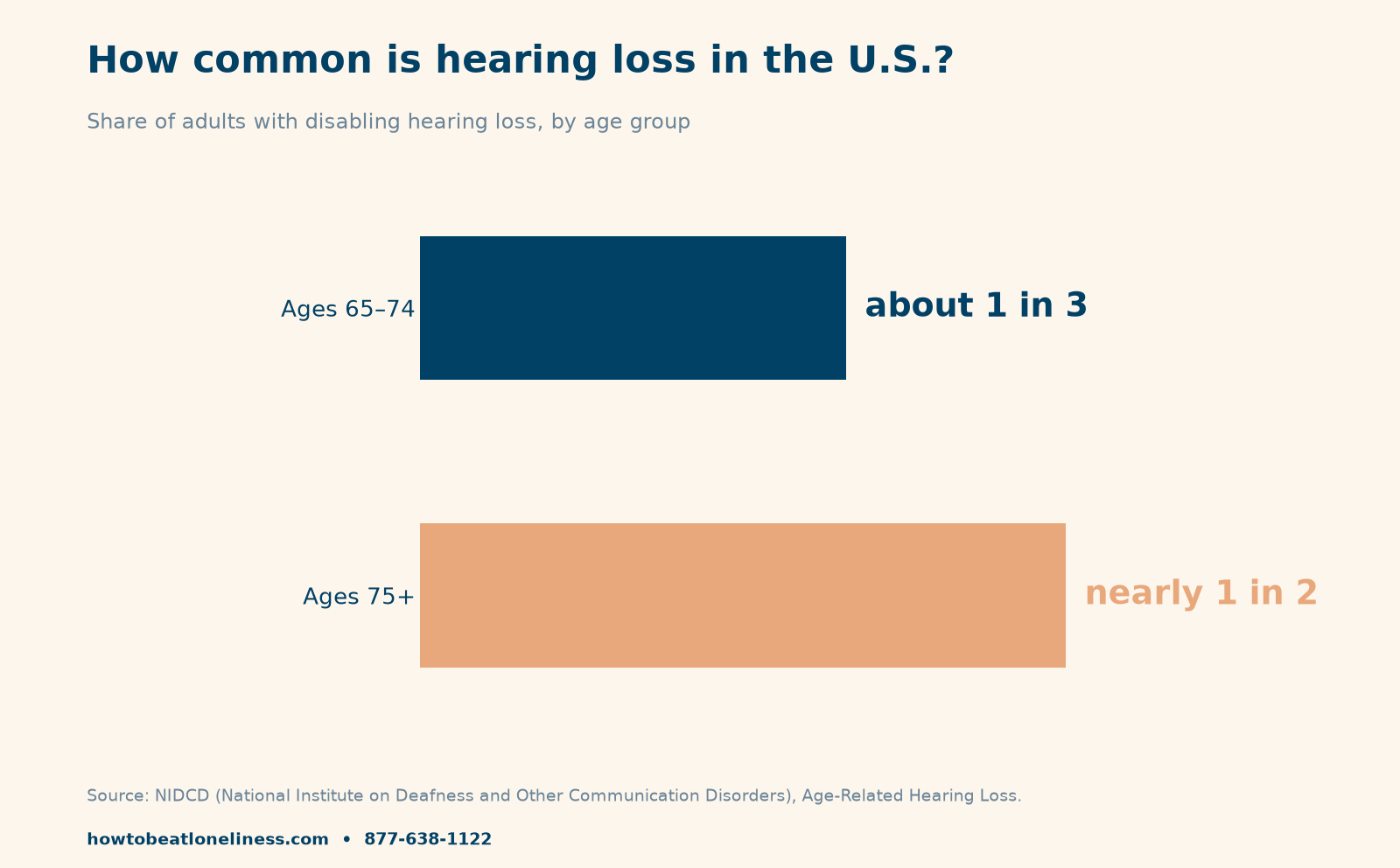
About one in three people in the U.S. between the ages of 65 and 74 has hearing loss, and nearly half of those older than 75 have difficulty hearing. Roughly 15% of American adults — 37.5 million people — report some trouble hearing. If you are struggling, you are in extremely ordinary company.
2. Loneliness in this group is measured, not guessed
In the ACHIEVE study — 933 older adults with an average age of 76.8 — researchers measured loneliness with a validated scale rather than asking people to self-diagnose. The prevalence of loneliness was 38%. More than a third.
3. Worse hearing predicted more loneliness
In that same study, worse hearing on a pure-tone test was associated with a 19% greater prevalence of moderate-or-greater loneliness. This is the link between hearing loss and loneliness showing up in the numbers, not just in stories.
4. How much it bothers you matters even more than the test
The strongest signal was not the audiogram. Participants with worse hearing-related quality of life — meaning hearing loss was genuinely interfering with daily life — had a 29% greater prevalence of moderate-or-greater loneliness. Translation: if it is wearing you down, that matters, whatever the chart says.
5. It is a consistent finding, not one study
A systematic review of the research found that hearing loss was significantly associated with higher risk of both loneliness and social isolation across most well-adjusted analyses. Two different things, both raised: how connected you feel, and how connected you actually are.
6. Living alone changes the math
One analysis found that worse hearing predicted increasing loneliness over time among older adults living alone — but not among those living with others. It makes sense. If you share a house, you get easy conversation by default. If you live alone, every conversation has to be arranged, and hearing loss raises the price of arranging one.
7. Most people who could be helped are not using help
Among adults aged 70 and older who have hearing loss and could benefit from hearing aids, fewer than one in three has ever used them. Cost is a real reason — Medicare does not cover hearing aids. But since 2022 the FDA has allowed over-the-counter hearing aids for mild-to-moderate loss, purchased without a prescription or a hearing test, which changed the price floor considerably.
What Actually Helps
There are two separate problems here and they need two separate answers. One is hearing. The other is the loneliness that built up while your hearing was getting worse — and that one does not fix itself the day you get hearing aids.
| Option | Cost | When it fits | Where it falls short |
|---|---|---|---|
| Over-the-counter hearing aids | $200–$1,500 | Mild to moderate loss you have already noticed | Not for severe loss; no professional fitting |
| Audiologist and prescription aids | $2,500–$4,000+ | Complex or severe loss, ringing, one-sided loss | Medicare does not cover the devices |
| Phone amplifier or captioned phone | Often free by state program | You mainly struggle on the phone | Does not help in restaurants or groups |
| How To Beat Loneliness phone line | Free | You want a real conversation at your own pace | We are companions, not clinicians — no diagnosis |
| 988 Suicide & Crisis Lifeline | Free | A day that feels unsafe | Not for “I just want to talk” |
On the hearing side: get it checked, and do not wait for it to become undeniable. NIDCD has a short ten-question self-check — and notice how many of the questions are about people, not volume. Does a hearing problem cause you to feel left out when you are with a group? Does it cause you to visit friends less often than you would like? That is the isolation showing up inside a hearing test.
On the connection side, the trick is finding conversations that are cheap to have. A phone call with one person beats a dinner with eight, every time. Tell people directly what helps — face me when you talk, turn the television down, pick the booth not the bar. Most people are glad to be told. They just do not know, and they would rather be asked than watch you go quiet.
And if you want to practice on someone who will never be impatient about it, that is exactly what our line is for. You can ask us to repeat something four times. It costs nothing and we will not sigh. If you want the fuller picture on rebuilding connection, our guide on how to beat loneliness walks through it step by step, and the story of why we started a free loneliness phone line explains what you are actually calling.
Frequently Asked Questions
Does hearing loss really cause loneliness?
Research consistently links the two. In the ACHIEVE study, worse hearing was associated with a 19% greater prevalence of moderate-or-greater loneliness, and a systematic review found hearing loss significantly associated with higher risk of both loneliness and social isolation. The usual path is indirect — conversation becomes tiring, so social contact quietly shrinks.
Will hearing aids fix the loneliness too?
They help with the cause, not automatically with the backlog. If you have spent two years turning down invitations, better hearing gives you the ability to rejoin conversations but not the conversations themselves. Most people need to do both: treat the hearing, and deliberately rebuild a few regular contacts.
Can I still call a phone line if I have trouble hearing?
Yes, and you should. Tell whoever answers at the start — we will slow down, speak clearly and repeat anything as often as you need. How To Beat Loneliness answers free at 877-638-1122. If phones are the hardest part for you, ask your state about a free captioned telephone program.
Does Medicare pay for hearing aids?
Original Medicare does not cover hearing aids. Some Medicare Advantage plans and state programs offer help, and since 2022 over-the-counter hearing aids for mild-to-moderate loss can be bought without a prescription or a hearing test, which brought entry prices down substantially.
Important
We are companions, not clinicians. The phone line at How To Beat Loneliness is staffed by real humans who listen — we do not diagnose, prescribe, or treat, and we cannot test your hearing. If hearing loss is affecting your daily life, please see a doctor or an audiologist. If loneliness has tipped into something heavier, a licensed therapist or your physician is the right next call, and 988 is there free and 24/7 for any day that feels unsafe.
A Note From Our Call Agent
If you have been saying “never mind, it wasn’t important” to end conversations you could not follow — I hear that one a lot, and it is not a small thing. It was probably important. Call us and take as long as you want with it. Nobody here is in a hurry, and you never have to pretend you caught it.
— Jewel
Sources
- NIDCD (NIH) — Age-Related Hearing Loss (Presbycusis)
- NIDCD (NIH) — Quick Statistics About Hearing
- Loneliness and Social Network Characteristics Among Older Adults With Hearing Loss in the ACHIEVE Study — Journals of Gerontology: Series A
- Associations Between Hearing Loss, Loneliness, and Social Isolation: A Systematic Review
- NCOA — How to Afford Hearing Aids: Costs, Medicare Coverage, and Financial Help