
The short version. We run a free loneliness phone line at 877-638-1122. A real human picks up. No AI, no scripts, no upsell, no sign-up. If you just want to talk to somebody for a few minutes, that’s what it’s for.
I’m Landon Myers, and I started How To Beat Loneliness because the thing I keep hearing from people — at the gym, at church, from my own family — is some version of the same sentence. “I just don’t have anyone to talk to.” Not in a crisis way. Not in a therapy way. Just… nobody picks up. So we built a free loneliness phone line where somebody does. The number is 877-638-1122, it’s toll-free in the US, and it costs you nothing.
What the line actually is
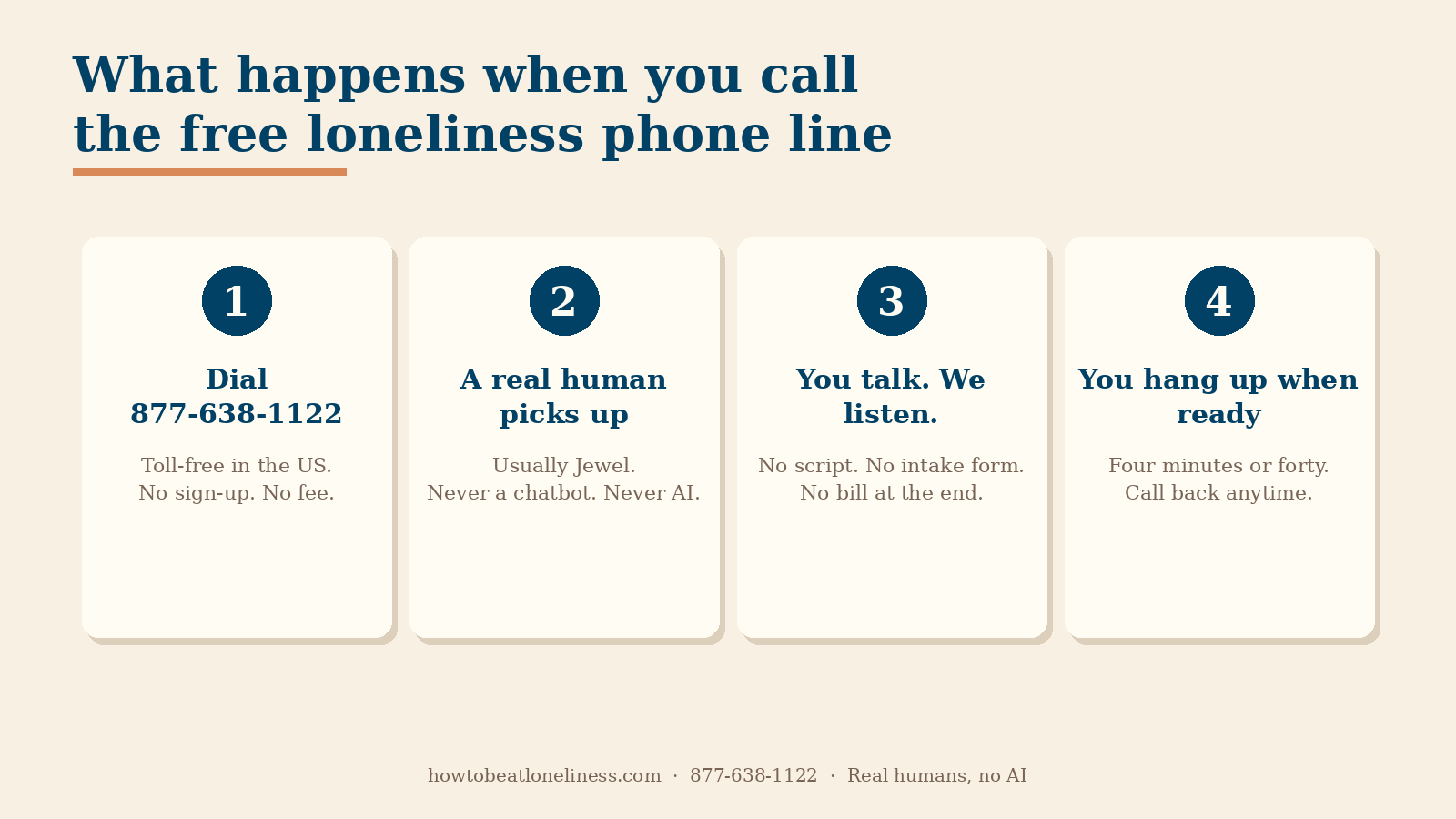
You call. A real person on our team — usually Jewel, who runs the line day to day — picks up the phone. You talk. She listens. That’s the whole product.
There is no intake form. No “press 1 for English.” No questionnaire about your symptoms. No upsell at the end of the call to a paid service. If the call lasts four minutes because that’s all you needed today, that’s a good call. If it lasts forty because you’ve been holding it in for a week, that’s a good call too. You don’t have to give your real name either, if you’d rather not — there are several ways to talk to someone anonymously, and this line is one of them.
We are companions, not clinicians. We don’t diagnose anybody. We don’t prescribe anything. We’re not a therapist and we’re not a crisis hotline. We’re the friend on the other end of the line on a Tuesday afternoon when the house is too quiet — a number you can call just to talk, nothing more complicated than that.
Why I built this instead of something else
My background is in sales, training, and team leadership. I’ve spent years building teams and coaching people on how to actually communicate — not corporate-speak communicate, but the kind where you slow down and listen to what the other person is really saying. That’s the skill that turns a stranger into someone who feels less alone, and it’s a skill almost nobody is paid to use anymore.
When the US Surgeon General called loneliness an epidemic in 2023, the advisory put numbers on something we all already felt — about half of US adults reporting meaningful loneliness, with health consequences on par with smoking. The policy response since has mostly been more apps, more chatbots, more text-based “wellness check-ins.” A lot of well-meaning technology pointed at a problem that is, at its core, the absence of a human voice.
So I went the other direction. A phone number. Humans. Free.
Who calls us
It’s not who I expected. When we started, I thought the line would mostly be for older folks — widows, retired people, anyone whose social world has gotten quiet. Those calls do come in. But so do calls from a 34-year-old who works from home and hasn’t had a real conversation in six days. From a caregiver who is surrounded by people all day and somehow more isolated than anyone. From a dad whose kids just left for college.
What I’ve learned in a short time running this is that loneliness doesn’t sort itself by age or life stage. It shows up in a retired businessman whose identity walked out the door with the corner office. It shows up in a widow who used to set two plates and now sets one. It shows up in an adult who has friends on paper and nobody to actually call.
One thing I’ve noticed across every call: the hardest part is the first thirty seconds. The reaching out. The dialing. After that, people talk. They almost always talk.
What you can expect when you call
1. A real human answers
Right now that’s almost always Jewel. Sometimes it’s me. As we grow, it’ll be more trained listeners on the team — every one of them a real, paid human being. We made a hard rule on day one: no AI on the call, ever. The whole point breaks if the voice on the other end isn’t a person.
2. You don’t have to explain why you called
You can if you want. You don’t have to. A lot of callers open with “I don’t really know why I’m calling.” That’s a perfect way to start. We take it from there.
3. We don’t keep a file on you
We log that you called, so if you call back the person picking up has the courtesy of remembering your name. We don’t write down what you said. There’s no therapist’s notebook on this end.
4. There’s no bill at the end
The line is free. We do offer longer scheduled sessions for people who want them — those are paid, and they fund the free line. But nobody on a call to the free line is ever pitched a paid session mid-conversation. That’s a rule we wrote down in our team’s handbook on day one and we are serious about it.
How a free phone line stays free
Three ways. First, the longer paid sessions I mentioned — for people who want a full hour with the same listener every week, that’s a paid option. Second, partnerships with churches, retirement communities, and local nonprofits who refer their members to us. Third, donations from people who use the line and want to keep it open for the next caller.
None of those funding sources change what happens on the free loneliness phone line itself. If you call 877-638-1122, you get a person, you get time, you get listened to, and you owe nobody anything.
What we are not
This is the part I want to be honest about, because the wrong expectation helps nobody.
We are not a crisis line. If you are in immediate danger to yourself or somebody else, please call or text 988 in the US — the Suicide & Crisis Lifeline, free, 24/7, trained professionals. Outside the US, please use your local equivalent.
We are not therapy. Therapy is a serious, licensed practice that does things we can’t do. If you’re working through grief, depression, trauma, or any diagnosed condition, please pair us with a real therapist. Many of our callers do both — they talk to a therapist weekly and they call us when the week feels long.
We are not a friendship app, a dating service, or a chatbot pretending to care. We’re a phone. With a person. Picking up.
If you’ve read this far
The number is 877-638-1122. It’s free. A real person — probably Jewel — will pick up. You don’t need a reason. You don’t need to know what to say. The first thirty seconds are the hard part. After that, we just talk.
Important
We are companions, not clinicians. The phone line at How To Beat Loneliness is staffed by real humans who listen — we don’t diagnose, prescribe, or treat. If you’re in crisis, call or text 988 (US Suicide & Crisis Lifeline), available 24/7. If you’re working through grief, depression, or a mental-health condition, please pair our conversation with a licensed therapist or your doctor.
A note from our call agent
Landon’s right that the first thirty seconds are the hardest. Here’s a small thing that helps: don’t try to plan what you’ll say. Just dial. I’ll do the rest of the work.
— Jewel
Frequently asked questions about the free loneliness phone line
Is there a free phone line for loneliness?
Yes — How To Beat Loneliness is a free line where a real, trained human answers when you are lonely: 877-638-1122. No fee, no sign-up, no AI.
Who answers the free loneliness phone line?
A real person, not a bot — someone trained to listen, not to diagnose or sell you anything.
Is the loneliness line a crisis hotline?
No. It is a warmline for ordinary lonely moments. For emergencies or thoughts of self-harm, call or text 988 right away.
How much does it cost to call?
Nothing. The line is free; paid companion sessions exist only to help fund it, and callers are never upsold.
More ways to reach out
If any of these sound like your week, each one links to more help — and the same free number to call, 877-638-1122:
- Someone to talk to when lonely
- A free number to call when lonely
- A number to call just to talk
- Is there a hotline for loneliness?
- I have no one to talk to — what helps right now
- Feeling lonely at night
- How to help an elderly parent who is lonely