
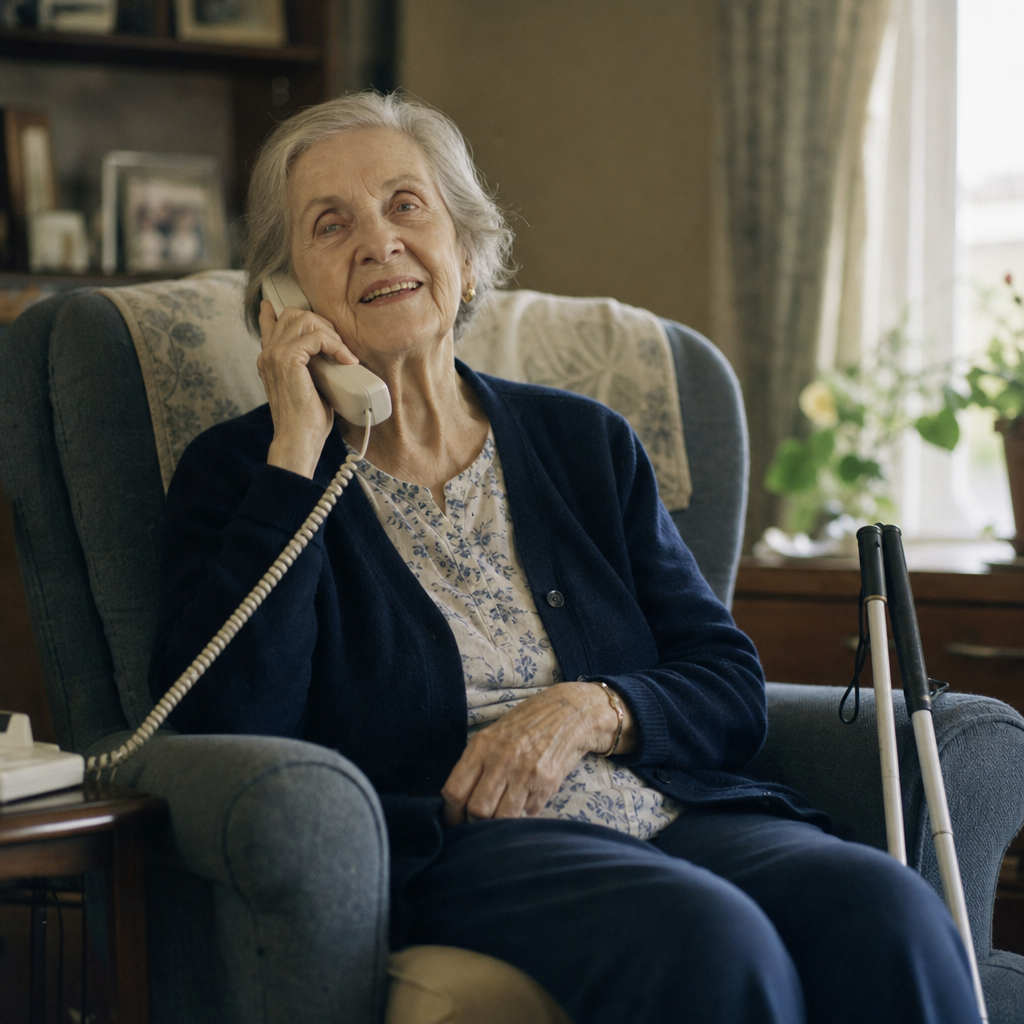
Short answer: If vision loss and loneliness have arrived together in your life, How To Beat Loneliness runs a free phone line you can call right now at 877-638-1122 — no screen, no app, no forms to read, just a real person on the other end of an ordinary telephone. Research on older adults with vision loss found that how satisfied people were with their social life predicted loneliness far better than how much sight they had lost.
Nobody warns you about the part that has nothing to do with your eyes. The doctor explains the macular degeneration, or the glaucoma, or the diabetic retinopathy. There is a pamphlet with print too small to read. What nobody writes down is that within a year you will have stopped driving to the coffee group, stopped reading the church bulletin, stopped recognizing your neighbor across the street — and that the quiet that follows is its own separate condition.
I have heard it on our line more than once, usually phrased as an apology. I’m sorry, I know this isn’t what you’re for. I just haven’t talked to anybody since Tuesday. It is exactly what we are for.
Why vision loss and loneliness show up together
Vision loss and loneliness are linked because losing sight quietly removes the small, unplanned contact that most of a social life is actually made of. The National Institute on Aging lists vision loss, alongside hearing and memory loss, among the changes that put older adults at higher risk of social isolation and loneliness. It is not one dramatic loss. It is fifty small ones.
- The car goes first. For most people, giving up driving is the single biggest cut to their week — the errands, the visits, the reason to leave at all.
- Faces stop arriving. With central vision gone, you may not see a smile across a room, or catch that someone is waiting for you to answer. Conversation gets tiring in a way that is hard to explain to anyone.
- Reading was company. The newspaper, the crossword, the letters, the church newsletter. Losing print is losing a companion, and most people never name it out loud.
- You get careful. Unfamiliar rooms, curbs, strange bathrooms. Declining the invitation starts to feel more sensible than accepting it, and then the invitations stop coming.

How common this is, and what travels with it
A CDC study found that 13.6% of Americans aged 65 or older reported vision impairment. That is roughly one in seven people in the coffee group, the pew, the waiting room. You are not an unusual case.
The same CDC analysis looked at what else those adults were living with. After adjusting for age, sex, race, education, weight, smoking and activity, older adults with vision impairment were substantially more likely to report several other conditions — including the two that matter most for loneliness:
The two peach bars are the ones that concern us here. Hearing impairment at nearly twice the odds means a great many people are losing both senses at once — and a national cohort study found that dual sensory impairment predicts loneliness and social isolation more strongly than either loss alone. If you have ever felt like you are working twice as hard as everyone else just to follow a conversation, that is why. We wrote about the hearing half of this separately in hearing loss and loneliness.
The finding that changes how to think about this
Here is the part worth holding onto. Researchers studying pathways to loneliness among older adults with vision loss used machine learning to find out what actually predicted who ended up lonely. The strongest predictors were not how much sight a person had left. They were satisfaction with social life, optimism, anxiety and depression.
The clearest result in that study: people who were legally blind but satisfied with their social life fell into the low loneliness group. People with more remaining vision but low social satisfaction fell into the high one.
Read that twice, because it cuts against how everyone talks about this. The eye disease is not what is making you lonely. The shrinking of contact around the eye disease is. That distinction matters enormously, because your retina is largely out of your hands and your contact is not.
What actually helps, starting this week
Most advice for people losing their sight is about tasks — labeling the stove, lighting the stairs. Useful, and not the problem here. This list is about the other thing.
- Lean on the telephone on purpose. Almost every modern way of staying in touch assumes a screen you can see. The plain telephone does not. It is the one channel low vision barely touches, and most people underuse it out of habit rather than preference.
- Get the free talking books. The Library of Congress runs the National Library Service for the Blind and Print Disabled — audio books and magazines, mailed to your door or downloaded, free, along with the player. Call 888-657-7323. Getting reading back does more for morale than people expect.
- Fix the ride problem before the friendship problem. The federal Eldercare Locator at 800-677-1116 connects you to your county’s Area Agency on Aging for transportation, meals and in-home help. Isolation that starts as a logistics problem should be solved as one.
- Tell people what you need, plainly. Say your name when you come in. Tell me who else is here. Don’t move my chair. People are not avoiding you out of coldness; they are avoiding you because they are afraid of doing it wrong. Instructions relieve them.
- Say something out loud every day. After a run of silent days, speech gets stiff and the next call feels harder than the last. Read aloud, talk to the dog, or call our line. It keeps the machinery working.
- Bring it up at the eye appointment. Say that you have been alone and it has been hard. It is relevant, and low-vision rehabilitation services exist that most patients are never told about. Our guide on how to talk to your doctor about loneliness has the words for it.
If getting out of the house at all has become the obstacle, we covered that in homebound and lonely. For the wider picture over months rather than days, start with our main guide on how to beat loneliness.
Who to call for what
| What you need | Where to call | Cost |
|---|---|---|
| Just someone to talk to, today | How To Beat Loneliness — 877-638-1122 | Free |
| Audio books and magazines by mail | National Library Service — 888-657-7323 | Free |
| Rides, meals, in-home help | Eldercare Locator — 800-677-1116 | Free referral |
| You are in crisis or thinking of harming yourself | 988 Suicide & Crisis Lifeline — call or text 988 | Free, 24/7 |
What happens if you call our line
Nothing complicated, and nothing you have to see to do. You dial 877-638-1122. A person picks up. There is no menu to read, no form to fill in, no website to navigate first. You do not have to explain your diagnosis or prove you are lonely enough to deserve the call.
It is free, it does not bill your insurance, and nothing goes in your medical record. If you would rather know exactly how a call goes before you dial, we wrote it out on our free loneliness phone line page.
One note on safety: losing your sight is a real grief, and depression is genuinely more common alongside vision impairment. If the loneliness has turned into hopelessness, or you are having thoughts of hurting yourself, please call or text 988 — the Suicide & Crisis Lifeline, free and staffed around the clock. That is not an overreaction. We are companions, not clinicians, and 988 is the right door for that.
Frequently asked questions
Does losing your vision really make you lonelier?
Yes, but indirectly. The National Institute on Aging lists vision loss among the changes that raise the risk of social isolation in older adults. What drives it is the loss of driving, reading and easy face-to-face contact rather than the eye condition itself.
How many older adults have vision loss?
A CDC study found that 13.6% of Americans aged 65 or older reported vision impairment — about one in seven. It is one of the most common health changes of later life, and one of the least discussed socially.
Does it get lonelier the worse your eyesight gets?
Not necessarily, and this is the encouraging part. In a study of pathways to loneliness among older adults with vision loss, people who were legally blind but satisfied with their social life scored in the low-loneliness group. Social contact predicted loneliness better than remaining sight did.
What free help exists if I cannot read anymore?
The Library of Congress National Library Service for the Blind and Print Disabled mails free audio books, magazines and a player to your door. Call 888-657-7323. For rides, meals and in-home support, the Eldercare Locator at 800-677-1116 connects you to services in your own county.
Who can I call if I just want to talk to somebody?
How To Beat Loneliness answers at 877-638-1122. It is free, there is no appointment, nothing to read or type, and you do not need a crisis or a diagnosis to call. Many people tell us they simply wanted to hear a voice, which is reason enough.
— Sergio, How To Beat Loneliness. If reading has gotten hard and the days have gotten quiet, call us at 877-638-1122. It is free, and someone will pick up.