
If you are in crisis right now, call or text 988 (the U.S. Suicide & Crisis Lifeline) — free and answered 24/7. Otherwise, here is the short version: you can talk to someone anonymously on every free line in this guide, because not one of them asks for your name — and How To Beat Loneliness answers free at 877-638-1122, where a real person picks up just to talk. No crisis needed, no cost, nothing to sign up for.
I am Jewel, and I am one of the people who answers that free line. The question I wish more people would ask out loud is the one they usually type into Google instead at eleven at night: can I talk to someone anonymously, without my name ending up somewhere, without anyone I know finding out? It is a fair question, and it deserves a straight answer rather than a reassuring one. So below are six free places to turn, what each one genuinely knows about you, and the one honest catch nobody puts on their homepage. If you would rather see every option laid out first, start with our guide to somewhere to turn when you need someone to talk to.
Can You Really Talk to Someone Anonymously?
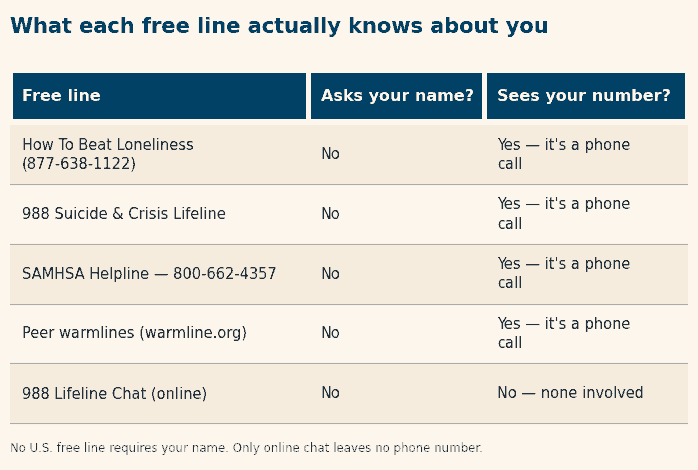
Mostly, yes — with one honest caveat. No major U.S. helpline requires your name. The 988 Lifeline says so in plain language in its own confidentiality statement: you do not have to share any personal information about who you are or where you are in order to receive support. The same is true of peer warmlines, of the federal SAMHSA helpline, and of our line.
The caveat is the part worth knowing before you dial. That same 988 statement is unusually candid about it: confidential and anonymous are not the same thing. A phone call carries a phone number. Lines typically receive the number you called from, whether or not anyone ever looks at it or uses it. Confidential means what you say is protected and not handed around. Anonymous would mean nobody could identify you at all — and on a normal phone call, that is a slightly bigger promise than a phone network can keep.
None of that is a reason not to call. It is a reason to pick the door that fits what you actually want.
6 Free Ways to Talk to Someone Anonymously
1. A free companion line — 877-638-1122
This is ours, so treat it as the biased entry — but the terms are simple. You call 877-638-1122, a real human picks up, and we talk for as long as you want. There is no fee, no account, no form, and no reason required. You can give a first name, a different name, or no name at all. We are companions, not clinicians: nobody is assessing you, and nobody reports the call back to your family. Four minutes or forty are both good calls.
2. A peer warmline
A warmline is a free, confidential line you call when you are not in crisis but do need someone to talk to. The American Psychiatric Association describes them as filling exactly the gap between coping alone and needing an emergency room. They are usually staffed by trained peers who have lived through something similar. You can find one in your state through the national warmline directory. If you want the fuller picture first, we wrote a guide on what a warmline is and who answers.
3. The 988 Suicide & Crisis Lifeline
If the day has tipped from lonely into unsafe, this is the number: call or text 988, free, 24 hours a day. You do not need to identify yourself. Counselors are trained for exactly this conversation, and reaching for it is a smart, brave thing rather than an overreaction.
4. 988 Lifeline Chat — the closest thing to true anonymity
If privacy is the thing standing between you and reaching out, this is the practical answer. The 988 Lifeline also runs a chat service, available 24/7, and a chat involves no phone number at all. For anyone whose real worry is a number appearing on a shared phone bill, typing rather than talking removes that worry entirely.
5. The SAMHSA National Helpline — 800-662-4357
Run by the federal government, SAMHSA’s National Helpline is free, confidential, and open 24 hours a day, 365 days a year, in English and Spanish. It is a referral and information service rather than a listening line — it points you toward local treatment and support — and you do not need a diagnosis, insurance, or a referral to call it.
6. The Institute on Aging Friendship Line — 888-670-1360
For adults 60 and older, the Institute on Aging Friendship Line is free and answered around the clock. It is both a warmline and a crisis line, and it will also make scheduled check-in calls if you want a voice on a regular basis rather than only on the hard evenings.

You Are Not the Only One Dialling
People often want to stay anonymous because they assume they are the odd one out. They are not. In the American Psychiatric Association’s Healthy Minds Monthly Poll in early 2024, 30% of U.S. adults said they had felt lonely at least once a week over the past year, and 10% said they felt lonely every single day. That is roughly one in three people, and one in ten carrying it daily.
The U.S. Surgeon General’s 2023 advisory made the same case at national scale, treating social connection as a genuine public-health priority rather than a private failing. Whatever you are about to say on the phone, somebody said something close to it an hour ago.
Confidential vs. Anonymous: A Quick Comparison
| Free option | Cost | Hours | Best when you want… |
|---|---|---|---|
| How To Beat Loneliness — 877-638-1122 | Free | Daily | Ordinary company and a real conversation |
| Peer warmline (warmline.org) | Free | Varies by state | Someone with lived experience, before a crisis |
| 988 Lifeline — call or text | Free | 24/7 | A day that has turned unsafe |
| 988 Lifeline Chat | Free | 24/7 | Maximum privacy — no phone number involved |
| SAMHSA Helpline — 800-662-4357 | Free | 24/7, 365 | Referrals to local treatment and support |
| IOA Friendship Line — 888-670-1360 | Free | 24/7 | Adults 60+, including scheduled check-ins |
How to Keep a Call as Private as You Want It
A few small things genuinely help, and none of them require you to explain yourself.
- Use whatever name you like. First name, middle name, or none. Nobody on a free line will press you for it, and nobody will think it is strange.
- If a shared phone bill is the real worry, use chat. An online chat leaves no call record on a household plan. This is the single most effective privacy step available.
- You control how much you say. You can talk for twenty minutes without naming your town, your job, or anyone in your family, and the conversation still works.
- You can hang up. There is no obligation and no follow-up. Knowing the exit is there makes the first call much easier to make.
And if you are still weighing it up, the wider guide on how to beat loneliness covers what comes after the first conversation, while our list of free lines you can call for loneliness lays out more numbers side by side.
Important
We are companions, not clinicians. The free line at How To Beat Loneliness is answered by real people who listen — we do not diagnose, prescribe, or treat, and we are not a substitute for professional care. If loneliness has turned into something heavier — you have stopped sleeping or eating well, or you feel hopeless more days than not — please pair a conversation with us with your doctor or a licensed therapist. Depression is common and very treatable. In a crisis, or if you are thinking about harming yourself, call or text 988 (the U.S. Suicide & Crisis Lifeline) right away.
A note from our call agent
In my experience the people most worried about staying anonymous are rarely hiding anything — they are just embarrassed, and embarrassment is a heavy thing to carry alone at nine in the evening. So here is my honest take: no one who answers a free line is keeping score, and no one is surprised by you. If it helps to give me a made-up name, give me a made-up name. I would still rather hear from you than not. 877-638-1122.
— Jewel, How To Beat Loneliness
Frequently asked questions about talking to someone anonymously
Can I talk to someone anonymously for free?
Yes. No major U.S. helpline requires your name. How To Beat Loneliness answers free at 877-638-1122 with no name, no signup and no crisis required, and peer warmlines, the 988 Lifeline and the SAMHSA National Helpline are all free and confidential too.
Is a helpline call really confidential?
Yes, but confidential and anonymous are not the same thing. The 988 Lifeline states plainly that you do not have to share any personal information to get support, while also noting that it typically receives the phone number you call from. What you say is protected; the call itself still travels over a phone network.
What is the most private way to talk to someone?
Online chat. The 988 Lifeline runs a free 24/7 chat service, and because a chat involves no phone number, nothing appears on a shared phone bill. If privacy is the reason you have not reached out yet, chat is the practical answer.
Do I have to be in crisis to call a free line?
No. Companion lines and warmlines exist for ordinary loneliness, not emergencies. How To Beat Loneliness answers at 877-638-1122 for people who simply want a real conversation. Crisis lines such as 988 are there for the days that feel unsafe.
Anonymity matters to a lot of callers. If you want every option side by side, read someone to talk to when lonely.
Sources
- 988 Suicide & Crisis Lifeline — Confidentiality Statement
- SAMHSA — National Helpline (1-800-662-HELP)
- American Psychiatric Association — Warm Lines: Providing Help Before a Crisis Develops
- American Psychiatric Association — Healthy Minds Monthly Poll, January 2024
- U.S. Surgeon General (2023) — Our Epidemic of Loneliness and Isolation
- Institute on Aging — Friendship Line (888-670-1360)