

Short version: Feeling lonely at work is more common than it looks — Gallup found 1 in 5 U.S. employees feel lonely “a lot” on a given day, and remote workers feel it worst. If you want a real human conversation about it today, call 877-638-1122 — free, no script, no upsell.
I’m Landon. I’m part of the team at How To Beat Loneliness, and one thing I hear from callers that surprises people is this: a lot of them have a full calendar of meetings and still feel completely alone. Being busy and being connected turned out to be two different things.
Feeling lonely at work isn’t about how many people are on your screen or in your row of desks. It’s about whether anyone there actually knows what’s going on with you. You can grind through eight meetings in a day and never once say something true to another person — and that adds up over a year in a way that’s easy to miss until you stop and notice it.
What feeling lonely at work actually looks like, by the numbers
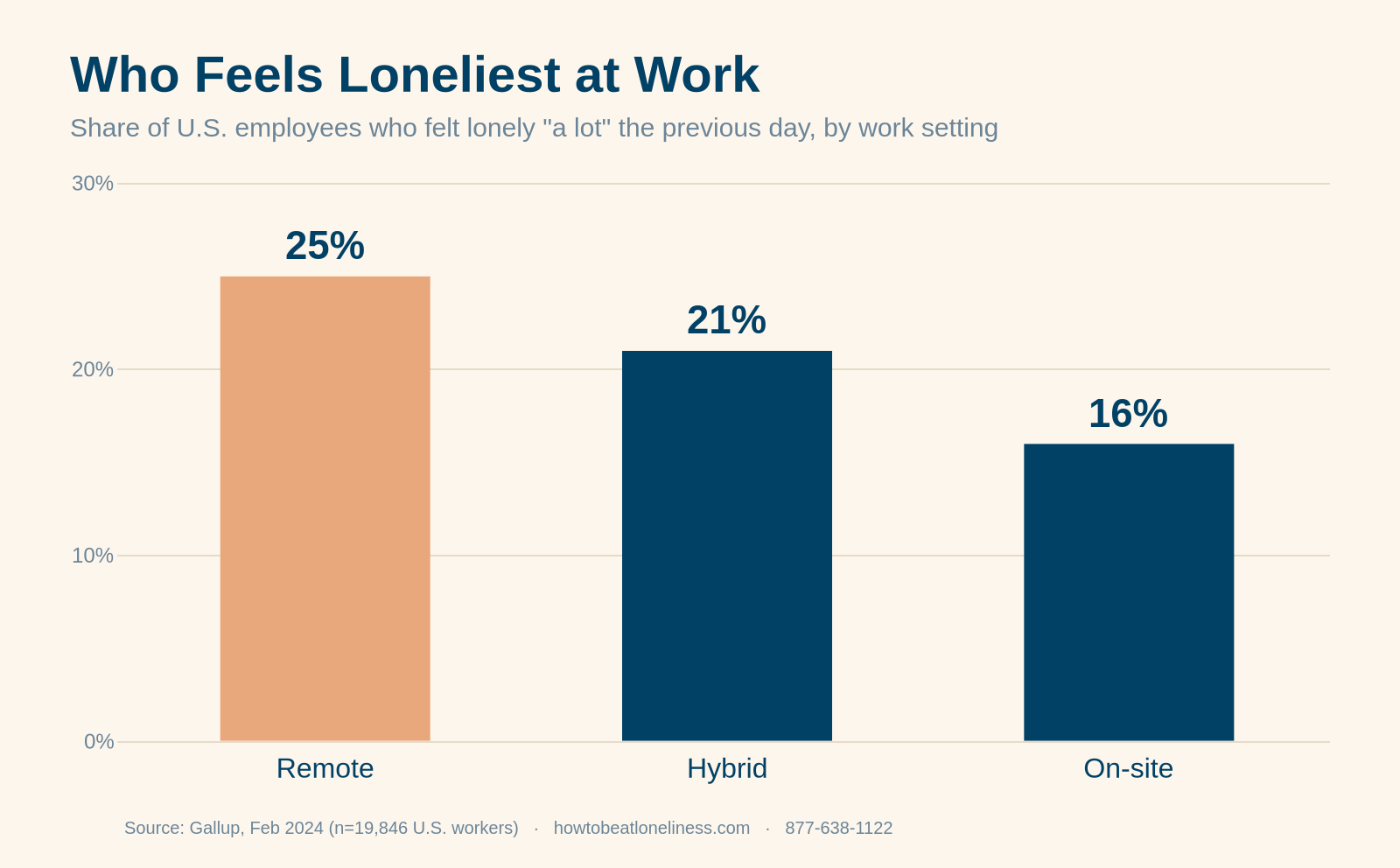
Gallup surveyed nearly 20,000 U.S. workers in early 2024 and found that 1 in 5 employees (20%) felt lonely “a lot” the previous day — and it wasn’t spread evenly. Work setting made the biggest difference of anything Gallup measured: 25% of fully remote employees reported that kind of loneliness, versus 21% of hybrid workers and 16% of people working entirely on-site. Age mattered too — workers under 35 reported loneliness at 22%, against 19% for those 35 and older. Interestingly, management level barely moved the number at all; a manager is about as likely to feel lonely at work as the people they manage.
Why it hits younger workers and remote workers hardest
A 2025 survey of roughly 2,000 employed U.S. adults found that 77% of Gen Z employees said they’d felt lonely at work at some point, compared with a 64% national average — and 14% said they felt it often (18% among Gen Z men specifically). What’s interesting is the paradox underneath that number: Gen Z workers were actually slightly less likely to report having zero work friends than older workers (21% versus 26%) — they’re not isolated in the “nobody talks to me” sense. They’re isolated in a quieter way: busy, surrounded by people, and still not known by anyone there.
If you work from home, the Gallup numbers above say the quiet part out loud: the commute, the hallway small talk, the lunch table you didn’t choose but ended up at anyway — those were doing more work than anyone gave them credit for. Losing them without replacing them is where a lot of remote loneliness comes from — we go deeper on that exact problem in work-from-home loneliness: 6 things that actually help.
7 things that actually help
- Say it out loud to one person. Not a big announcement — just “work’s felt a little isolating lately” to a coworker or your manager. Most people assume everyone else has it figured out, which is exactly why nobody says anything first.
- Protect one small-talk moment a day, on purpose. The two minutes by the coffee machine or the first few minutes of a video call before the “real” meeting starts aren’t wasted time — treat them like a scheduled task instead of something to skip.
- If you’re remote, book one no-agenda call a week. Fifteen minutes with a colleague, nothing to present, nothing to decide. It sounds artificial until you do it a few times.
- Join something that already exists instead of waiting to be asked. A lunch group, an employee resource group, a Slack channel for a hobby — showing up once is usually enough to stop being a stranger.
- Ask a specific question, not a vague one. “Want to grab coffee Thursday at 2?” gets a yes far more often than “we should catch up sometime,” which quietly means never.
- Use your EAP or employee resource group before you’re in crisis, not just after. Most people only think of those programs as a last resort — they’re built for the ordinary, lower-grade stuff too.
- When work friendships can’t fill the gap, talk to someone outside of work about it. A free call just to say the week out loud — 877-638-1122 — counts as doing something about it, even on days a coworker isn’t the right person to say it to.
A short checklist for this week
- Name the feeling to one real person — coworker, manager, or friend.
- Pick one recurring small-talk moment and actually show up for it.
- If remote: get one no-agenda call on the calendar.
- Join one group you’ve been meaning to join.
- Send one specific invitation this week, not a vague “let’s catch up.”
- If it’s heavier than “a little lonely,” call 877-638-1122 — free, any time.
Questions people ask us about this
Is it normal to feel lonely at work even when I’m around people all day?
Yes — loneliness tracks connection, not headcount. Gallup’s own data shows management level barely matters to the loneliness number, which tells you it’s not about how many people are nearby.
Does working from home really make it worse?
For a lot of people, yes. Gallup found fully remote employees report that kind of daily loneliness at 25%, compared with 16% for on-site workers — the biggest gap of anything they measured. It’s not a reason to go back to an office you don’t want to be in; it just means the small, in-person moments you lost need a deliberate replacement.
What if my workplace just doesn’t have much of a social culture?
You don’t need the whole office to change — one specific, recurring connection with one or two people does more than waiting for a culture shift. Start smaller than feels necessary.
Office friendships aren’t the only kind worth having, either — if you’re watching a friend go through this, our guide on how to help a lonely friend has specific things to say and do. And if “lonely at work” is really part of a bigger pattern of not having people to turn to, our guide to finding someone to talk to when you’re lonely walks through every free option. Men in particular are losing close friendships at a striking rate — we broke down the numbers in men have no close friends, and work is often where those friendships used to happen. If you’ve lost a job entirely rather than just feeling distant at one, the loneliness that follows runs deeper than this list covers — see job loss and loneliness, by the numbers.
— Landon, How To Beat Loneliness