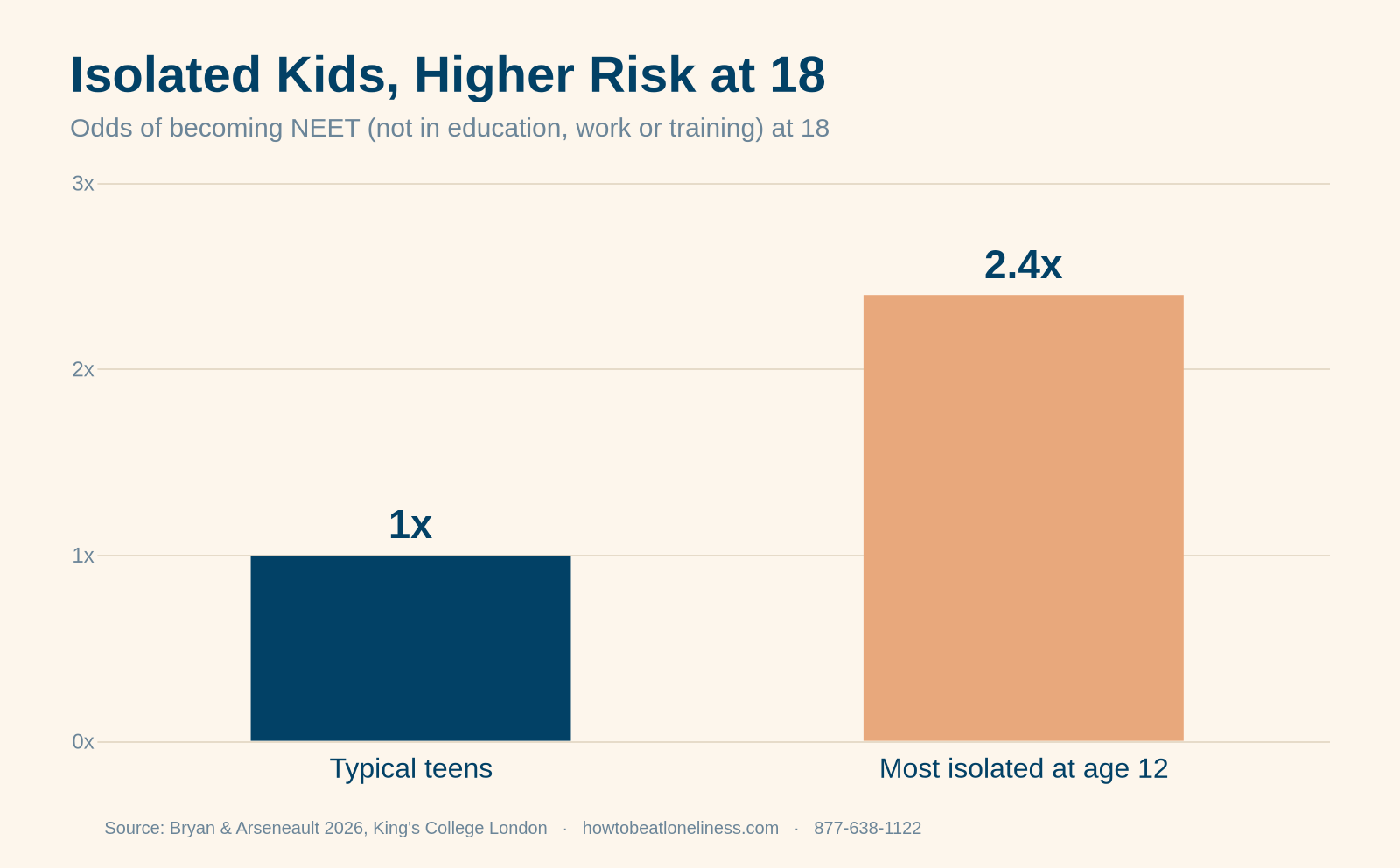
Short version: Social isolation in childhood raises a 12-year-old’s odds of being NEET (not in education, work, or training) at 18 by roughly 2.4 times, a new King’s College London study finds. If you want a real human conversation about it today, call 877-638-1122 — free, no script, no upsell.
I’m Jewel. I’m one of the people who picks up the phone when you call the free loneliness line at How To Beat Loneliness. Most of our callers are adults — but every so often, someone tells me, almost as an aside, that they’ve felt alone since they were a kid. A new study says that’s not a coincidence.
Researchers at King’s College London just tracked more than 2,200 twins from birth into young adulthood, and what they found is worth taking seriously: social isolation in childhood doesn’t just hurt in the moment. It tends to follow kids out the other side.
What the new study on social isolation in childhood found
Published in September 2026 in the journal Development and Psychopathology, the study followed children in Britain’s long-running E-Risk twin cohort and measured how isolated they actually were at age 12 — not how lonely they felt, but how few real social connections they had.
The most isolated 12-year-olds had about 2.4 times higher odds of becoming NEET — not in education, employment, or training — by age 18, compared with their peers. The researchers said the link between early isolation and later struggles with school and work was two to three times stronger than other well-known risk factors, including childhood mental health difficulties.
Feeling lonely about it didn’t fix it on its own
Here’s the part that stopped me: kids who were isolated and felt lonely about it at 12 were just as likely to still be isolated at 18 as kids who were isolated and didn’t seem to mind. Noticing you’re alone doesn’t automatically lead anywhere better — not without someone stepping in from the outside.
The researchers put it plainly: schools and youth services are often well placed to notice when a child is withdrawn or excluded from their peers. The same is true for parents, grandparents, coaches, and neighbors — the people who see a kid often enough to notice a pattern, not just a bad week.
If this sounds like someone you know — or like you
If you’re a parent or grandparent and a kid in your life has quietly pulled away from friends, this is worth paying attention to — not panicking over, just paying attention to. A low-key invitation back in, offered more than once, matters more than it might seem. Our guide on how to help a lonely friend has specific phrases that work on kids too, not just adults.
And if you recognize this pattern in yourself — if you’ve felt apart from people since you were young and it never quite lifted — you’re not broken, and you’re not the only one. That’s exactly the kind of call we get. You don’t need a reason to call, and you don’t need to have it figured out first. If you want a fuller list of free, human places to turn, our guide to someone to talk to when lonely covers six real options.
Sources
— Jewel, How To Beat Loneliness