
If you’re in crisis right now — call or text 988 (US Suicide & Crisis Lifeline), available 24/7. This article isn’t a substitute for emergency mental-health support. Short version: real survey data shows job loss and loneliness travel together — unemployed adults report feeling lonely roughly three times as often as employed ones. If you want to talk to a real person about it today, call 877-638-1122 — free, no script, no upsell.
I’m Sergio. I run How To Beat Loneliness — a free phone line for people who just need to talk. A few weeks ago Jewel mentioned how often “I just lost my job” comes up on calls, not as the whole story but as the opening line — and it made me go look for the research on job loss and loneliness. It turns out there’s more of it than I expected, and the numbers are bigger than I expected too.
If you’d rather skip the article and just talk to someone: 877-638-1122. Free, every day, no voicemail maze.
Job Loss and Loneliness, by the Numbers: 40% vs. 14%
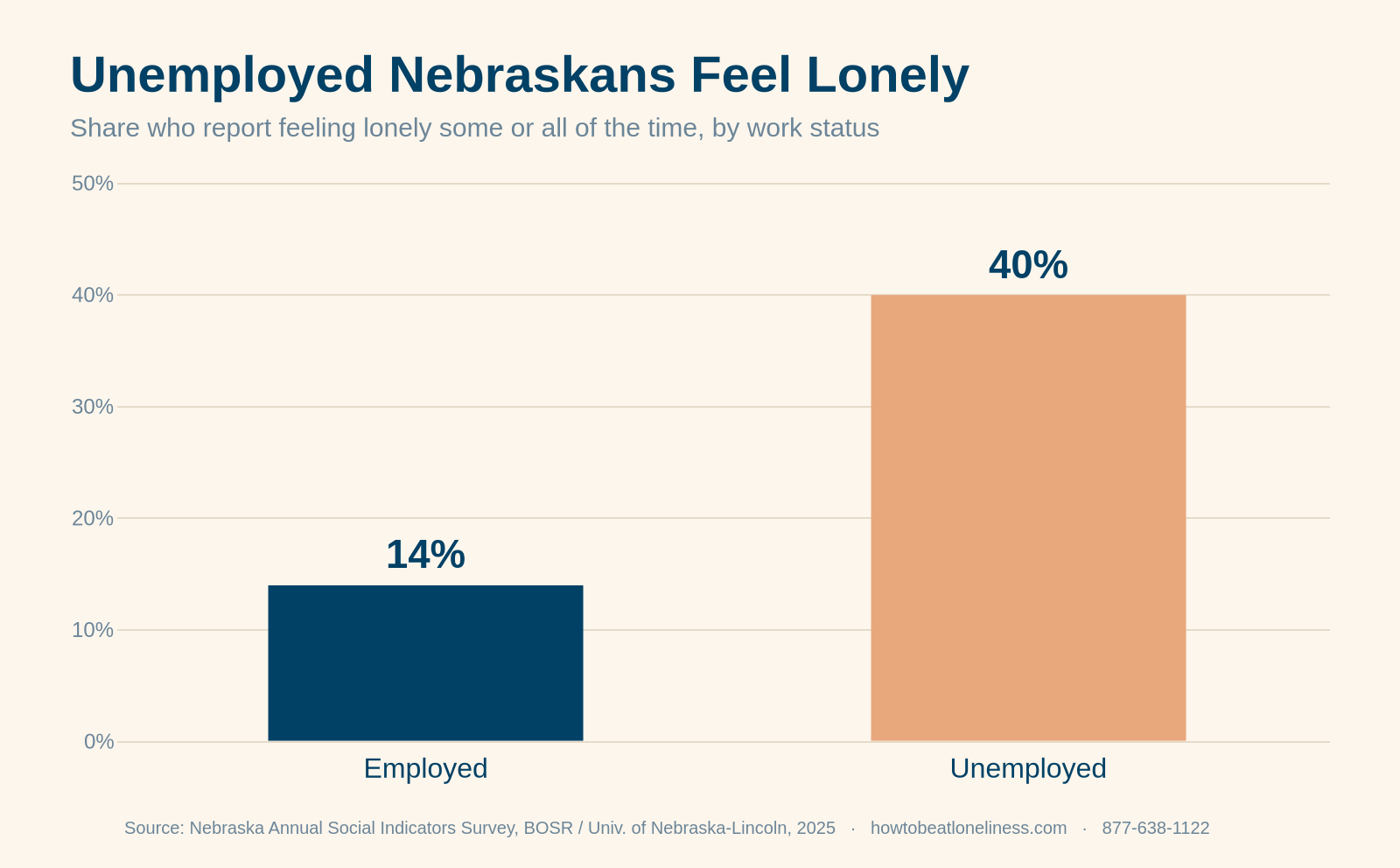
The clearest number comes from the 2025 Nebraska Annual Social Indicators Survey, run by the Bureau of Sociological Research at the University of Nebraska–Lincoln. Among unemployed respondents, 40% said they feel lonely some or all of the time. Among employed respondents, that number was 14% — almost three times lower. It’s one survey, in one state, but it’s a real, dated measurement, not a guess — and it lines up with what shows up on our own phone line.
Losing a job raises your risk of loneliness by almost 19%
A 2025 study in Social Science & Medicine, using nearly two decades of data from Australia’s HILDA survey, found that unemployment increases the risk of loneliness by almost 19% — and that the effect doesn’t fade once the next paycheck arrives. Researchers found elevated loneliness could persist for several years after an unemployment spell ends, long after the job search itself is over.

Why a job’s loneliness math is bigger than it looks
A job isn’t just income. It’s a built-in, no-effort reason to see the same twenty or two hundred people most days of the week — the coworker who always refills the coffee pot, the one who waves from the next cubicle, the small talk in the elevator. None of that shows up on a resume, but all of it disappears the same week the job does. In the same Nebraska survey, being unmarried roughly quadrupled the odds of frequent loneliness too (30% vs. 8% for married residents) — which tells you something useful: job loss and loneliness are linked at a scale comparable to losing a life partner’s daily company, not a minor inconvenience to shrug off.
About 1 in 6 people feel this way even with a job
For context: across the same Nebraska survey, roughly 1 in 6 adults (about 17%) said they feel lonely some or all of the time, regardless of work status. So loneliness isn’t only a job-loss problem — but losing a job more than doubles the baseline rate, on top of whatever else is already going on in someone’s life.
What actually helps while you’re between jobs
- Keep one standing plan with another person — a walk, a coffee, a call — that doesn’t depend on whether the job search went well that day.
- Say the real sentence out loud to someone: “I’m lonelier than I expected since I lost my job.” Naming it to another person is often the first thing that actually loosens it.
- Look for structure that isn’t a job yet — a volunteer shift, a class, a recurring group — anything that puts you around the same faces more than once.
- If you just want to talk it through with a real person today, that’s exactly what our free phone line is for — no pitch, no “have you tried networking.”
If this sounds close to what’s happening at work right now rather than after it, our piece on feeling lonely at work covers that side of it. And if what you’re really after is just a free, no-pressure conversation, here’s who to call and what to expect.
Important
We are companions, not clinicians. The phone line at How To Beat Loneliness is staffed by real humans who listen — we don’t diagnose, prescribe, or treat. If job loss has brought on something heavier than loneliness — ongoing low mood, hopelessness, or thoughts of harming yourself — please pair our conversation with a licensed professional, your doctor, or the resource below.
If you’re in immediate danger or thinking about hurting yourself, call or text 988 (US Suicide & Crisis Lifeline).
— Sergio, How To Beat Loneliness