

Short version: Work from home loneliness is a real, measured thing — not just a feeling. Remote workers spend roughly an extra hour alone every workday compared to people who go into an office. If you’d rather skip the article and just talk to a real person today, call 877-638-1122 — free, no script, no upsell.
I’m Landon. I’m one of the people who answers the free line at How To Beat Loneliness, and over the past year I’ve noticed a pattern: some of the loneliest callers I talk to have a job, a paycheck, and nothing anyone would call “wrong” with their life. They just work from home, and somewhere along the way the days got quiet.
Turns out that’s not just a feeling — it’s measured. Work from home loneliness showed up clearly in a study out of MIT’s Blueprint Labs, published in the journal Science in 2026. If you’d rather skip the research and just talk to someone: 877-638-1122.
What the work from home loneliness research actually found
Economists Natalia Emanuel, Emma Harrington, and Amanda Pallais tracked U.S. workers across five nationally representative surveys from 2011 to 2024, deliberately setting aside the peak pandemic years so the pandemic itself wouldn’t skew the numbers. What they found: people in remote-friendly jobs spend about 1.1 more waking hours alone on a typical workday than people in jobs that stayed in-person. For people who already live alone, the odds of going an entire day with zero human contact rose by 7 percentage points — an 83% jump over pre-pandemic levels. Mental distress ticked up too, and prescriptions for anxiety and depression medication among remote workers rose roughly 50% relative to before the pandemic.
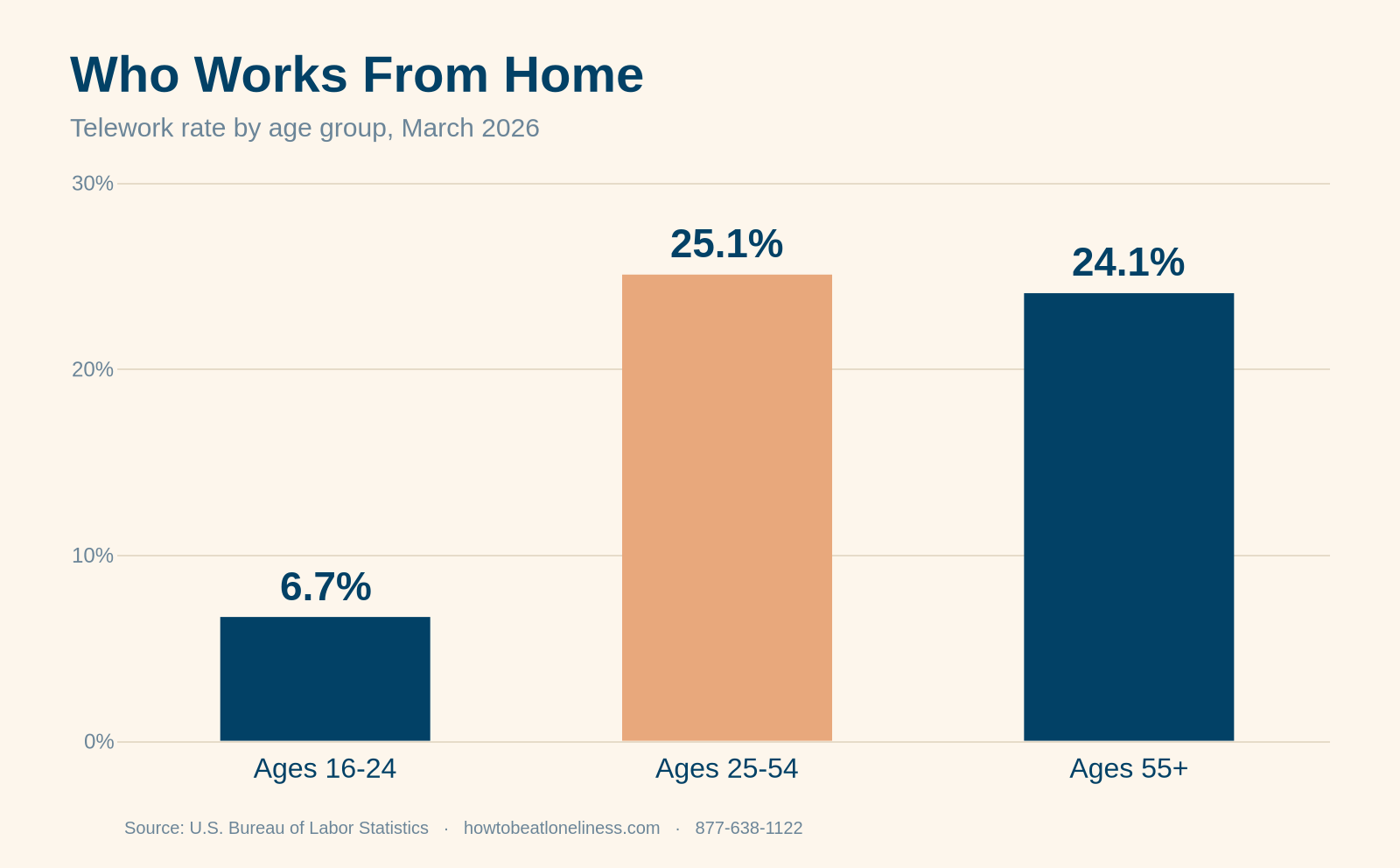
None of that means working from home is bad for everyone, and the researchers are careful to say so. It means flexibility has a real trade-off: fewer built-in chances to be around other people. As of March 2026, the U.S. Bureau of Labor Statistics put the telework rate at 22.6% of all workers — so this isn’t a small or fringe group. It’s thousands of people reading this right now, at a desk, in a quiet house.
Why remote work turns into “alone,” one day at a time
It’s rarely one big thing. An office gives you small, automatic social contact you never had to plan for — a hallway hello, a coffee-run invite, someone noticing you look tired. Work from home strips all of that out by default. Nobody schedules a replacement for it, so most people just… don’t get one. The work still gets done. The quiet just gets bigger.
6 things that actually help
1. Put one fixed “human moment” on your calendar — every single day
Not a work meeting. A call to a friend, a family member, or our free line at 877-638-1122. The research above points at the mechanism directly: it’s the missing hour of human contact that does the damage, so the fix is putting a specific hour back, on purpose, not waiting for it to happen on its own.
2. Work from somewhere else, at least part of the week
A library, a coffee shop, a co-working space — anywhere with other humans nearby, even strangers. You don’t have to talk to anyone. Just being around people, in person, measurably changes a day.
3. Join one recurring thing that has nothing to do with work
A class, a running group, a choir, a weekly game night. It needs to repeat on a schedule, because a one-time thing doesn’t build the habit of seeing the same faces. If you’re a man and in-person groups feel awkward to walk into cold, we put together a short list of free clubs worth trying — Men’s Sheds, league bowling, and a few others that are easier to show up to than people expect. Everyone else can start with our roundup of hobbies that actually got people talking to other people.
4. Give the workday an actual ending
Close the laptop. Put it somewhere you can’t see it. Then do something physical and small — a walk, a stretch, feeding the dog — before you do anything else. Without an office to walk out of, you need a ritual that tells your brain the day is over, or it never really is.
5. Turn your camera on for at least one call a day
Voice-only and chat-only meetings are efficient, but they’re also where “alone” quietly wins. Seeing an actual face, even on a screen, for even five minutes, is a different kind of contact than reading a message. Take the camera-on option when it’s offered.
6. If you can’t remember your last real conversation, don’t wait it out
Not a work Slack message. A real back-and-forth with someone who knows you. If it’s been more than a few days, that’s the signal to do something about it today — not “eventually.” Our guide to finding someone to talk to covers free options beyond our own line, or you can just call us: 877-638-1122.
A quick checklist to actually use
- One human moment on the calendar, every day — not “whenever it happens”
- At least one day a week worked from somewhere with other people around
- One recurring, repeating activity that has nothing to do with work
- A real end-of-workday ritual — laptop closed, something physical, every time
- Camera on for at least one call a day
- A real conversation within the last few days — if not, that’s today’s move
Common questions about work from home loneliness
Is loneliness from remote work actually different from loneliness in general?
The feeling is the same, but the cause is specific and fixable: it’s missing, structural, daily contact that an office used to provide automatically. That’s good news — it means the fix is also structural, not something you have to “feel your way out of.”
What if I like working from home and don’t want to go back to an office?
You don’t have to choose between the two. Nothing above requires giving up remote work — it’s about rebuilding the small, repeated contact an office happened to supply for free, on your own terms and your own schedule.
I live alone and work from home. Am I at higher risk?
The research says yes, somewhat — people who already live alone saw the biggest jump in going a full day with no human contact at all. That makes the daily “human moment” habit (tip #1) especially worth building if this is you.
What do I do if none of this is enough tonight?
Call 877-638-1122. It’s free, it’s a real person, and you don’t need a reason beyond “I just want to talk to someone.”
If working from home has tipped into something heavier than ordinary loneliness — ongoing anxiety or depression that doesn’t lift — that’s worth real support beyond this article, and a free, confidential conversation is available 24/7 at 988.
— Landon, How To Beat Loneliness
Sources
- MIT Blueprint Labs — “Home Alone: Remote Work, Isolation, and Mental Health” (Emanuel, Harrington & Pallais, Science, 2026)
- Pulse 2.0 — “Remote Work Linked To Higher Isolation And Mental Health Challenges, Science Study Finds” (2026)
- U.S. Bureau of Labor Statistics — “22.6 percent of workers teleworked in March 2026”