
If you’re in crisis right now — if you’re thinking about hurting yourself — call or text 988 (the US Suicide & Crisis Lifeline), any hour, any day. This page isn’t a substitute for emergency mental-health support. If it isn’t an emergency and you’re simply lonely after giving up driving, and the week has gone strangely still, keep reading — that’s exactly what this page is for.
The short version: If you’re lonely after giving up driving, you can have a real conversation today without going anywhere. How To Beat Loneliness answers a free phone line at 877-638-1122 — a person picks up, no crisis required, nothing to sign up for. Below is what researchers actually measured about life after the keys, and what has been shown to help.
I’m Jewel, and I answer that line. People almost never call me and say “I stopped driving and now I’m lonely.” They call and say the days got long. They mention, halfway through, that the car went to a grandson in March. Then they change the subject, because handing over a set of keys sounds like a small thing to be sad about. It isn’t small, and the research is unusually clear about that. Here’s what happens to people who are lonely after giving up driving, and what actually moves the needle.
Why people get lonely after giving up driving
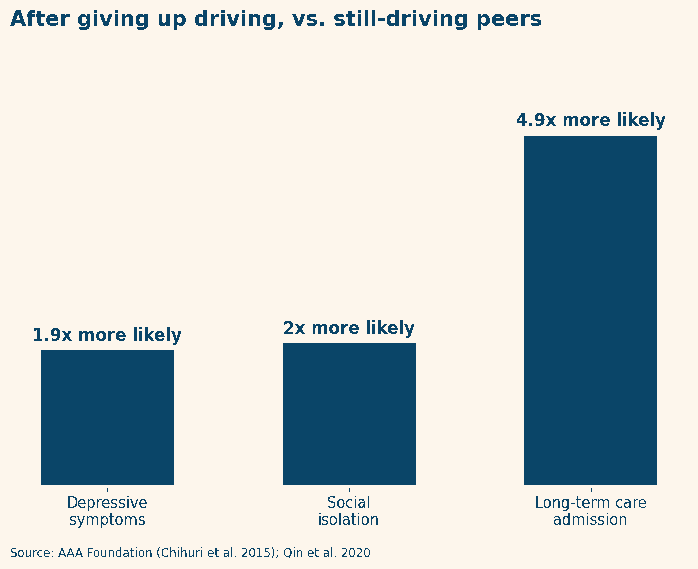
Giving up driving removes the errands, and the errands were carrying most of the conversation. In a systematic review of 16 studies of drivers aged 55 and older, funded by the AAA Foundation for Traffic Safety, researchers found that stopping driving almost doubled the risk of increased depressive symptoms (odds ratio 1.91). Former drivers also showed “markedly low participation in outside activities” compared with people the same age who still drove.
The part that surprises people is that the losses are not mostly about the destination. A trip to the pharmacy was four short exchanges — the neighbor on the step, the woman at the counter, someone in the parking lot. Nobody counts those as company. Then they stop, all at once, and the week is suddenly very quiet.
The number I think about most: friendships shrink by half
One study inside that AAA review followed people for 13 years and found that driving cessation was associated with a 51 percent reduction in the size of a person’s social network of friends and relatives. Half the people in your life, over a decade, quietly gone.
Nobody meant for that to happen. Friendships between older adults are held together by the person who can still drive to the other one, and when that stops, the visits don’t get canceled — they just stop being scheduled. This is also why so many people tell me they feel like they did something wrong. They didn’t. They lost the transport, and the transport was the friendship’s delivery system.
Isolation roughly doubles, and it hits some people harder
A 2020 analysis of the National Health and Aging Trends Study found that older adults who had stopped driving in the past year had roughly twice the odds of falling into a higher social isolation category. The odds were higher still for people aged 85 and over, for men compared with women, and for people living alone.
That last group is worth naming plainly. If you live alone and you stop driving, your household conversation and your outside conversation end in the same month. There is no remaining channel. That is not a character flaw and it is not rare — it’s arithmetic.
The same AAA review found former drivers were nearly five times as likely as current drivers to be admitted to long-term care. Researchers are careful to say the causation runs in both directions — declining health causes people to stop driving, too. But their conclusion was direct: programs that protect mobility and social function after driving stops are the thing that’s missing.
What actually helps after the keys go
Most advice here is about rides. Rides matter, but rides alone don’t fix it — you can get to the appointment and still not talk to anybody. Do both.
- Call the Eldercare Locator first. One free federal number — 1-800-677-1116, Monday to Friday, 8am to 9pm ET — connects you to your local Area Agency on Aging, which is where the senior transport, volunteer-driver and friendly-visitor programs actually live. Most people have never heard of it and it’s the single highest-value call on this page.
- Replace the errand, not just the ride. If the grocery run was your Thursday, put something in the Thursday slot that has people in it — a library hour, a coffee at the senior center, a standing phone call. An empty slot is what does the damage.
- Ask for the standing call, not the favor. People say yes to “could you ring me Sunday evenings?” far more readily than to “call me more.” One is a slot in a calendar. The other sounds like a complaint, and nobody knows how to answer a complaint.
- Be the host now. You’ve probably spent forty years driving to other people. The friend who still drives will usually come to you if invited to something specific — a Tuesday coffee, not “sometime.”
- Say it at your next appointment. Doctors ask about falls and pills and almost never about the quiet, but they can refer you to things you would never find on your own. There’s a short script for this in our piece on how to talk to your doctor about loneliness.
If leaving the house isn’t realistic at all right now, the options that work from a chair are collected in our guide for people who are homebound and lonely. For the wider picture, our main guide on how to beat loneliness is the place to start — and if what you actually want is someone to talk to when lonely, that’s the entire job of our line. It’s free, it always has been.
Frequently asked questions
Is it normal to feel lonely after giving up driving?
Yes, and it is well documented. A systematic review of 16 studies of adults aged 55 and older, published by the AAA Foundation for Traffic Safety, found that driving cessation almost doubled the risk of increased depressive symptoms and was linked to markedly lower participation in outside activities. One study in that review measured a 51 percent drop in the size of a person’s friend and family network over 13 years.
How long does the adjustment take?
The research follows people over years rather than weeks, and the social losses in those studies accumulate gradually rather than arriving all at once. That’s the useful part: the decline is slow, which means it can be interrupted at any point by adding contact back in deliberately. It rarely repairs itself on its own, because the errands that used to generate contact are gone for good.
Where do I find rides for seniors near me?
Call the Eldercare Locator at 1-800-677-1116, Monday to Friday, 8am to 9pm Eastern. It is a free public service of the US Administration for Community Living, and it routes you to your own county’s Area Agency on Aging, which keeps the local lists for senior transport, volunteer drivers, home-delivered meals and telephone-reassurance programs.
Is there a free number I can call just to talk?
Yes. How To Beat Loneliness answers a free companion line at 877-638-1122, where a real person picks up and no crisis is required. It is a conversation, not therapy and not a crisis service. If you would rather have an ongoing arrangement, ask the Eldercare Locator about telephone-reassurance programs, which schedule regular check-in calls in your own area.
Important
We are companions, not clinicians. The phone line at How To Beat Loneliness is staffed by real humans who listen — we don’t diagnose, prescribe, or treat. The depression findings on this page describe population-level risk, not a diagnosis of anyone. If you’re struggling with your mood after a big change like this, please pair our conversation with your doctor or a licensed therapist.
A note from our call agent
A man told me once that the worst morning was not the day he stopped driving. It was the first Saturday afterward, when he stood in the kitchen at nine o’clock and realized he had nowhere he was expected. That’s the thing I’d want you to know: what you’re missing isn’t the car. It’s being expected somewhere.
So let today be a day you’re expected. The line is free, it’s open, and you don’t need a reason.
— Jewel
Sources
- AAA Foundation for Traffic Safety — Driving Cessation and Health Outcomes in Older Adults (Chihuri, Mielenz, DiMaggio, Betz & Jones)
- Chihuri et al. — Driving Cessation and Health Outcomes in Older Adults, Journal of the American Geriatrics Society (2016)
- Qin, Xiang & Taylor — Driving Cessation and Social Isolation in Older Adults, Journal of Aging and Health (2020)
- National Institute on Aging — Social isolation, loneliness in older people pose health risks
- Eldercare Locator — Administration for Community Living / USAging