
If you are in crisis right now — call or text 988 (the US Suicide & Crisis Lifeline), free and available 24 hours a day. This article about chronic illness and loneliness is not a substitute for emergency mental-health care.
The short version: being sick for a long time makes people lonely, and being lonely tends to make people sicker. It runs both directions. If you want to talk to a human about it today, How To Beat Loneliness runs a free phone line at 877-638-1122. No diagnosis, no intake form, no fee — a real person picks up and listens.
I am Sergio. I founded How To Beat Loneliness, and one thing I did not expect when we started the phone line is how many of the calls would begin with a diagnosis. Not a crisis — a diagnosis. Diabetes. COPD. Long-haul fatigue. A back that stopped cooperating in 2019. People call to talk about being lonely, and somewhere in the first five minutes an illness shows up, because chronic illness and loneliness almost always arrive as a pair.
Nobody warns you about that part. The doctor explains the condition. The pharmacist explains the pills. Nobody sits you down and says: this is also going to cost you your Thursday nights, and most of your friends will not know what to say.
Why Chronic Illness and Loneliness Feed Each Other
The National Institute on Aging puts it about as plainly as a federal agency can: if you are in poor health, you are more likely to become socially isolated or lonely — and if you are socially isolated or lonely, that puts your physical and mental health at risk. It is a loop, not a line.
The CDC lists a chronic disease or condition outright as an individual risk factor for social isolation and loneliness, right alongside long-term disability and living without transportation. This is not a soft observation about mood. It is a documented risk factor in the same category as not being able to leave your house.
The mechanics are dull and obvious once you say them out loud. Illness eats time — appointments, recovery days, the two hours after a treatment when you are useless. Illness eats money, and money is what most socializing quietly runs on. Illness eats stamina, so the invitation you would have said yes to in 2015 now costs more than you have. And illness makes other people awkward. They do not stop caring. They stop knowing what to open with, so they open with nothing.
What the Research Actually Shows
A few numbers worth carrying around, all from sources that publish their methods.
- About 1 in 3 US adults report feeling lonely, and about 1 in 4 report not having the social and emotional support they need, according to CDC surveillance data from 2022. That is the baseline before illness enters the picture.
- Roughly 34.5% of older adults living with chronic disease experience social isolation — measurably higher than the general older-adult rate, which sits closer to a quarter.
- A systematic review of loneliness and common chronic physical conditions found loneliness to be a prevalent stressor among adults with heart disease, high blood pressure, stroke, and lung disease — not a fringe complaint in a handful of cases.
- Adults who are lonely or socially isolated tend to have longer hospital stays, more readmissions, and earlier death than adults with steady social connection, per the NIA.
The risk figures that get quoted most often come from the National Academies of Sciences, Engineering, and Medicine, and they are the reason public-health agencies stopped treating this as a lifestyle issue.
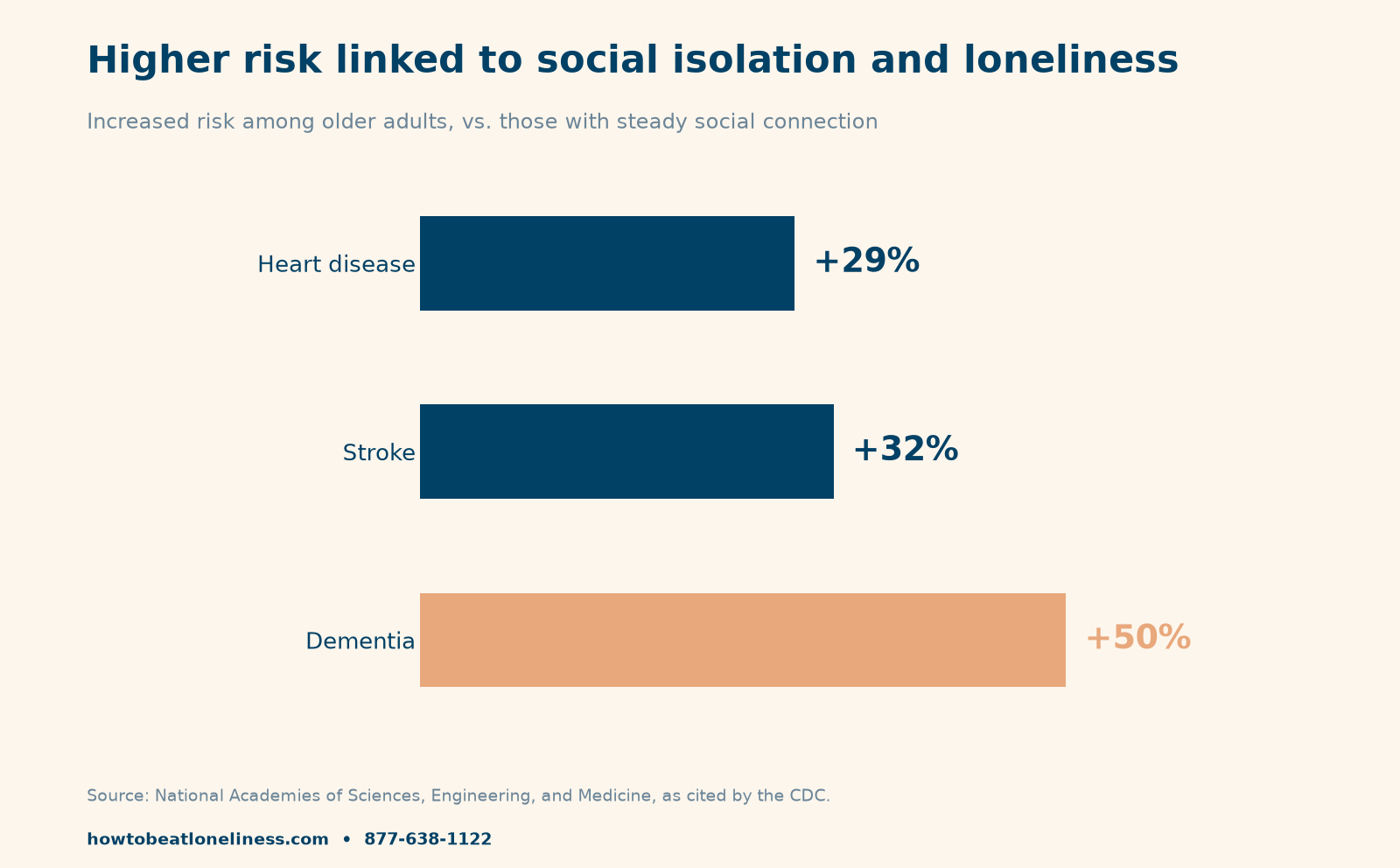
Read that chart carefully, because it is easy to misread. It does not say loneliness gives you dementia. It says isolation and the conditions on that list keep close company, and the arrow points both ways. We wrote about the same two-way pattern in loneliness and frailty, where an analysis of nearly 79,000 adults found the same shape.
The Parts Nobody Warns You About
Callers describe the same handful of things often enough that I have stopped thinking of them as individual stories.
1. The casserole window closes
People show up for an acute event. A surgery, a diagnosis, a hospital stay. Meals arrive, cards arrive, the phone rings. Then about six weeks pass and everyone reasonably assumes the emergency is over. Chronic means it is not over. It means the support curve ended and the illness did not.
2. You start editing yourself
After the fourth or fifth time you answer how are you honestly and watch someone’s face do the thing, you stop. You say fine. Then you are lonely in a room full of people who think you are fine, which is a specific and unpleasant kind of alone.
3. Burden math
Almost everyone doing this runs a private ledger of how much they are allowed to need. I already asked my daughter for a ride Tuesday, so I cannot call her tonight just because I am low. The ledger is not real, but it governs behavior anyway, and it is the single most common reason people tell us they had not called anyone in weeks.
4. The world shrinks by accident
No one decides to withdraw. You skip one thing because you feel rough. Then the group makes plans without checking, because last time you said no. Then you are not on the list. Nobody was unkind. The list just re-formed around your absence.
What Actually Helps
None of this is a cure for the underlying condition. It is about keeping the second problem from compounding the first.
Say the quiet part to your doctor. Loneliness belongs at a checkup. The NIA explicitly encourages telling a clinician if you feel isolated a lot of the time, because it changes what they understand about your symptoms and what they can refer you to. If that conversation feels strange to open, we wrote a script for it: how to talk to your doctor about loneliness.
Lower the bar on what counts as contact. When energy is the scarce resource, a forty-minute lunch is a bad unit. A seven-minute phone call is a good one. Regular and small beats rare and large, every time.
Give people a specific job. Most friends go quiet because they are afraid of being useless or intrusive, not because they stopped caring. Would you call me Sunday around four is easy to say yes to. Let me know if you need anything never gets used by anyone.
Use a line where the ledger does not apply. This is the whole reason ours exists. You cannot use up your turn with us. There is no favor being spent, no worry about being too much on a bad week. That is also true of the Eldercare Locator at 800-677-1116 for local services, and of peer warmlines in many states.
Find people with the same condition. Illness-specific groups skip the explaining. You do not have to describe what a flare is. If you want the broader picture of what works and why, start with our guide on how to beat loneliness.
Frequently Asked Questions
Is it normal to feel lonely when you have a chronic illness?
Yes, and it is common enough to be measured. Around 34.5% of older adults living with chronic disease experience social isolation, and the CDC lists chronic conditions as a recognized risk factor for loneliness. Feeling this way is not a character flaw or a sign you are handling the illness badly.
Why do friends stop calling when someone is sick for a long time?
Usually because they do not know what to say and are afraid of intruding, not because they stopped caring. Support tends to cluster around an acute event and then fade, while a chronic condition continues. Naming a specific, small request often restarts contact faster than waiting to be asked.
Can loneliness make a chronic condition worse?
The relationship runs both ways. The NIA reports that adults who are lonely or socially isolated tend to have longer hospital stays, more readmissions, and higher risks of heart disease, depression and cognitive decline. Loneliness is not the cause of the underlying illness, but it is treated by public-health agencies as a genuine health risk on its own.
Who can I talk to if I do not want to burden my family?
A free phone line exists for exactly that reason. How To Beat Loneliness answers at 877-638-1122 and there is no favor being spent and no limit on how often you call. Peer warmlines and the Eldercare Locator at 800-677-1116 are other options that carry no social cost.
Is there a free number to call just to talk about being sick?
Yes. Our line at 877-638-1122 is free and you do not need to be in crisis to use it. If you are in crisis, call or text 988 instead, which is staffed for exactly that and is also free and available 24 hours a day.
Important
We are companions, not clinicians. The phone line at How To Beat Loneliness is staffed by real humans who listen — we do not diagnose, prescribe, or treat, and nothing here is medical advice about your condition. If you are managing a chronic illness alongside depression, grief, or anxiety, please pair a conversation with us with your doctor or a licensed therapist. If you are in crisis, call or text 988.
A Note From Our Call Agent
If you have been carrying a condition for years and you have quietly decided that you are already asking too much of everyone around you — that is the ledger talking, and it is wrong. You do not have to be having a bad day to call us. You do not have to explain your diagnosis or be interesting about it. Seven minutes on the phone with someone who is not keeping score is a real thing, and it is free. The number is 877-638-1122.
— Sergio, How To Beat Loneliness
Sources
- CDC — Health Effects of Social Isolation and Loneliness (risk factors, including chronic disease)
- National Institute on Aging — Loneliness and Social Isolation: Tips for Staying Connected
- Petitte T, et al. — A Systematic Review of Loneliness and Common Chronic Physical Conditions in Adults. The Open Psychology Journal, 2015
- Experiences of Social Isolation in Older Adults with Chronic Diseases: A Qualitative Study Based on Patients’ Perspectives, 2025
- Eldercare Locator — local support services for older adults, 800-677-1116