

The short version: companionship services for seniors come in three shapes — paid in-home companions (about $34 an hour), free volunteer visitors through government and community programs, and free phone lines. How To Beat Loneliness is the third kind. It costs nothing, there is no application, and a real person answers at 877-638-1122.
I get a version of this question every week, usually from an adult daughter three states away: Mom is alone most of the day. What do I actually buy? The honest answer is that companionship services for seniors is a category, not a product — and the price range inside it runs from roughly $35 an hour down to zero. Most families only ever hear about the expensive end. This is the map of the whole thing, including the free parts, and a free number you can call today: 877-638-1122.
What companionship services for seniors actually means
Companion care is non-medical. Nobody is changing a dressing or managing insulin. The job is presence and the small logistics that come with it: conversation, a card game, a ride to the pharmacy, a walk around the block, someone noticing that the mail piled up.
That distinction matters more than it sounds, because it decides who pays. Medical care has an insurance pathway. Company does not. And the need is not niche — the CDC reports that about 1 in 3 U.S. adults feel lonely and about 1 in 4 say they lack social and emotional support, with older adults at higher risk. Isolation is linked to heart disease, stroke, depression, dementia and earlier death.
What the paid version costs in 2026
Here is the number families flinch at. In the Genworth and CareScout Cost of Care Survey, the national median for homemaker services — the category most companion care is billed under — is $33.99 an hour, and a home health aide is $35.02. Agencies commonly set a four-hour visit minimum, so a modest three-visits-a-week arrangement lands somewhere north of $1,600 a month.
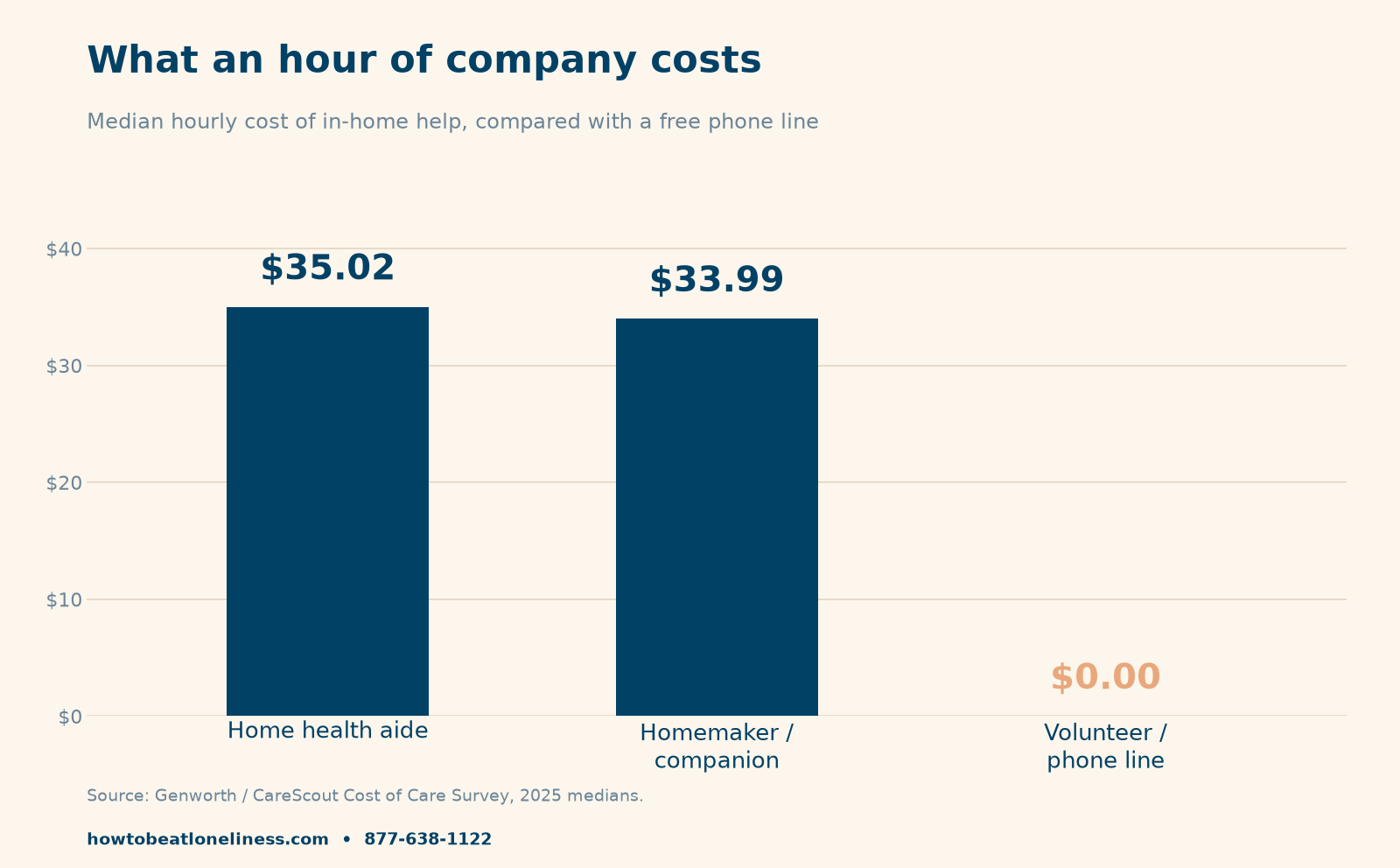
Paid companions are worth it for some households — especially when there are errands, transportation and light housekeeping bundled in, or when a family caregiver is running on fumes and needs guaranteed hours off. But if what your parent is missing is conversation, you are paying an hourly rate for something several programs give away.
The free options most families never hear about
1. The AmeriCorps Seniors Senior Companion Program
A federal program that matches trained volunteers aged 55 and over with other older adults who need company and light assistance — visits, phone reassurance, medication reminders, help getting to appointments, and respite for family caregivers. It is free to the person receiving the visits. Availability is local and waitlists happen, so ask early.
2. Your Area Agency on Aging
There are more than 600 Area Agencies on Aging in the United States, plus over 270 Title VI Native American aging programs. Many run friendly-visitor or telephone-reassurance programs nobody advertises. The Eldercare Locator connects you to yours — 800-677-1116, weekdays.
3. Faith and community volunteer visitors
Congregations, senior centers, libraries and hospice volunteer corps often maintain visitor rosters. This is the least formal option and the most variable, but it is also the one most likely to produce an actual friendship rather than a scheduled appointment.
4. Free phone lines
The lowest-friction option there is. No intake form, no scheduling, no stranger in the house. You dial, and someone talks with you. That is what we do — and if you want to know exactly what happens when you call one, we wrote up the difference between a warmline and a crisis line. Some services also do scheduled check-in calls for seniors if a regular rhythm helps more than an open door.
Side by side
| Option | Cost | When it fits | Where it falls short |
|---|---|---|---|
| Paid in-home companion | ~$34/hour, often 4-hour minimum | Errands, rides, housekeeping, guaranteed caregiver respite | Expensive; scheduled, not spontaneous |
| AmeriCorps Senior Companion | Free | Regular in-person visits and light help | Local availability; possible waitlist |
| Area Agency on Aging visitor programs | Free | Friendly visits, telephone reassurance | Varies enormously by county |
| How To Beat Loneliness phone line | Free | Wanting to talk, today, without arranging anything | Not in person; no errands or transport |
| 988 Suicide & Crisis Lifeline | Free | Active crisis | Not built for I just want to talk |
Does Medicare pay for any of this?
Original Medicare covers medically necessary services, and companionship is not one of them — so the answer there is no. Some Medicare Advantage plans do offer limited non-medical in-home support as a supplemental benefit, and NCOA notes these benefits change every plan year and are usually tied to specific chronic-condition or income criteria. Worth a phone call to the plan. Not worth planning around.
How to choose without overthinking it
Ask one question first: is the problem the hours, or the quiet?
- If it’s the hours — appointments missed, groceries not happening, a spouse-caregiver who hasn’t left the house in a month — pay for the companion. That is what the money buys.
- If it’s the quiet — the afternoons, the long stretch after the news ends — start with the free channels. Call the Eldercare Locator for a local visitor program, and use a phone line in the meantime, because the waitlist is real and the loneliness is now.
- If you’re not sure, do both cheaply for a month and watch what actually gets used. Families are usually wrong about which one their parent will take to.
One more thing worth saying plainly: nobody has to qualify for a conversation. If you have been putting this off because it felt like it needed a plan, it doesn’t. More on the wider picture in our guide to how to beat loneliness, and the reason we built a free line at all is written up here.
Frequently asked questions
What are companionship services for seniors?
Non-medical support focused on presence and conversation — visits, phone calls, games, walks, rides, light errands. No clinical care is involved.
How much do companionship services for seniors cost?
Paid in-home companion care runs around $34 an hour at the national median, with many agencies requiring a four-hour minimum visit. Volunteer programs and phone lines are free.
Are there free companionship services for seniors?
Yes. The AmeriCorps Seniors Senior Companion Program, friendly-visitor and telephone-reassurance programs run through Area Agencies on Aging, community and faith volunteer rosters, and free phone lines including ours at 877-638-1122.
Does Medicare cover companion care?
Original Medicare does not, because companion care is not medically necessary. Some Medicare Advantage plans offer limited in-home support as a supplemental benefit, but eligibility rules vary by plan and change each year.
Is a phone line as good as an in-person visit?
It is different, not lesser. A visit helps with the physical world. A call helps with the quiet, costs nothing, needs no scheduling, and is available on the days a visit is not.
Important
We are companions, not clinicians. The phone line at How To Beat Loneliness is staffed by real humans who listen — we don’t diagnose, prescribe, or treat. If depression, grief or a mental-health condition is part of the picture, pair the conversation with a doctor or licensed therapist. And if you or someone you love is in crisis right now, call or text 988, the U.S. Suicide & Crisis Lifeline, available 24/7.
A note from the founder
I built this line because the cheapest thing on that chart is also the thing people are most embarrassed to ask for. There is no minimum, no assessment, no four-hour block. If the house is too quiet this afternoon, the number is 877-638-1122, and someone will pick up.
— Sergio, How To Beat Loneliness