
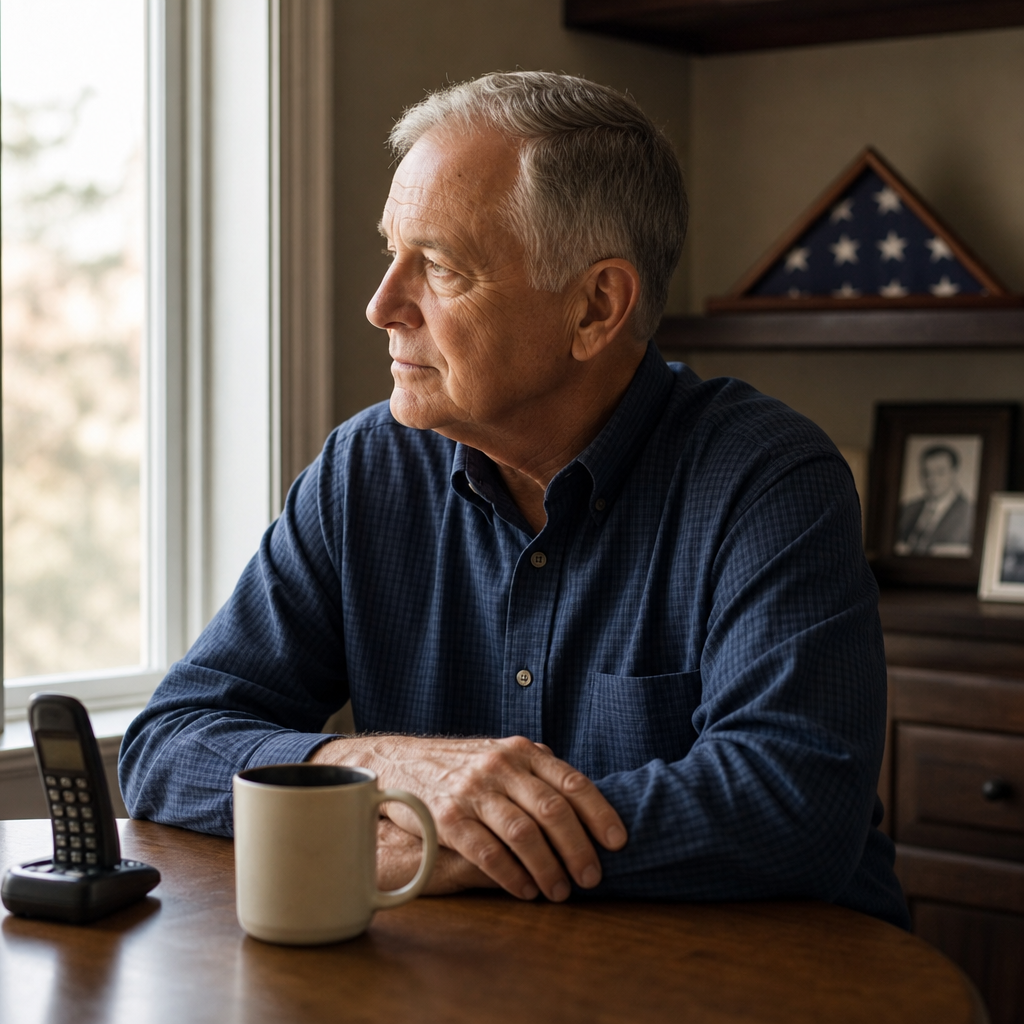
If you are a Veteran in crisis right now, dial 988 then Press 1 to reach the Veterans Crisis Line — free, confidential, answered 24/7, and you do not need to be enrolled in VA care. Otherwise, the short version: veteran loneliness is far more common than most families realize, and it is a health issue rather than a personal failing. We keep a page of what we offer for veterans specifically. How To Beat Loneliness answers free at 877-638-1122, where a real person picks up just to talk on an ordinary day — no crisis needed, no cost, nothing to sign up for.
I am Landon, and I help run How To Beat Loneliness. Veteran loneliness comes up on our line more often than almost anything else, and it rarely arrives with that name attached. It arrives as the house is quiet since my wife passed, or I have not had a real conversation since I retired, or nobody here knows what I did for twenty-two years. Below are seven facts worth knowing, every one of them sourced, and a short list of places to turn.
Veteran Loneliness by the Numbers
The most careful look at this comes from the National Health and Resilience in Veterans Study, a nationally representative survey of 4,069 U.S. veterans with an average age of 62, run from November 2019 through March 2020 and published in The American Journal of Geriatric Psychiatry.
1. More than half of older veterans feel lonely
In that study, 56.9% of veterans said they feel lonely at least some of the time — 37.2% sometimes and 19.7% often. The researchers called it a behavioral epidemic, which is unusually blunt language for a journal.
If you have been assuming you are the odd one out on your street, the arithmetic says otherwise.
2. It is tied to suicide risk, not just low mood
The same survey found that veterans who reported feeling lonely often had a twelve-fold greater likelihood of suicidal ideation compared with those who hardly ever felt lonely. For those who felt lonely sometimes, the likelihood was roughly three-fold.
That is why this is not a soft subject. It is also why the VA itself publishes loneliness and social isolation as suicide risk factors in its clinical guidance.
3. For many, it does not pass on its own
A three-year longitudinal study of U.S. military veterans tracked loneliness over time rather than at a single moment. Nearly 40% followed trajectories marked by moderate to high loneliness, and both of those groups drifted upward across the three years.
Waiting it out is a reasonable instinct. The data suggests it is not usually a winning strategy.
4. The body keeps score
The U.S. Surgeon General’s 2023 advisory reports that poor social connection is associated with a 29% higher risk of heart disease and a 32% higher risk of stroke, with a mortality impact comparable to smoking up to fifteen cigarettes a day.
We went through the rest of that research in what loneliness does to your body. The short version is that this shows up in bloodwork, not just in mood.
5. Loneliness and depression are related but separate
Veterans are often screened for depression and PTSD, and rightly so. But loneliness is a distinct condition with its own course, and someone can screen clean for depression while still going a fortnight without a real conversation. Knowing which one you are dealing with changes what helps, and we pulled the differences apart in loneliness and depression.
6. Leaving the service removes the scaffolding, not the need
This one is not a statistic, it is what we hear. Military life supplies company by default — a unit, a schedule, people who understand the shorthand. Civilian life supplies none of that automatically, and the gap can open years later rather than immediately: after a spouse dies, after a move to be near the grandchildren, after the last of the old crew stops answering. The need for company did not change. The structure that used to meet it did.
7. Help does not require enrollment or a crisis
The Veterans Crisis Line can be reached by dialling 988 then pressing 1, by text at 838255, or by online chat — and it is available whether or not you are enrolled in VA benefits or health care. Responders are trained in crisis intervention and in military culture, which spares you the explaining.
And for the far more common situation — a quiet Tuesday, no emergency, nobody to ring — that is what our line is for.
Where to Turn
Different lines are built for different days. Here is what each one is actually for.
| Where | Number | Best for | Cost |
|---|---|---|---|
| Veterans Crisis Line | Dial 988, then Press 1 (or text 838255) | Any hour a day feels unsafe; responders know military culture | Free, no enrollment needed |
| How To Beat Loneliness | 877-638-1122 | An ordinary quiet day when you just want to talk to somebody | Free |
| VA mental health care | Through your local VA | Ongoing treatment for depression, PTSD, or substance use | Varies by eligibility |
| Institute on Aging Friendship Line | 888-670-1360 | Adults 60 and older wanting a warm, regular check-in | Free |
If none of that feels like a fit yet, start smaller. We also keep a page for veterans and their families with the plain version of what we do and who answers. Our guide to how to beat loneliness covers the first moves that tend to work when reaching out feels like too much, and our free loneliness phone line founder’s note explains exactly what happens when you call us.
Important
We are companions, not clinicians. The free line at How To Beat Loneliness is answered by real people who listen — we do not diagnose, prescribe, or treat, and nothing here is medical advice or a substitute for professional care. If sleep or appetite has gone, if hopelessness sits there most days, or if you are leaning on alcohol to get through the evening, please bring it to a doctor or to VA mental health services rather than waiting it out. If you are a Veteran in crisis or thinking about harming yourself, dial 988 then Press 1 for the Veterans Crisis Line, or text 838255 — free, confidential, and answered 24/7.
A note from Landon
The number that stays with me is the twelve-fold one. Not because it is frightening, though it is, but because of what sits underneath it: a lot of men and women who were trained never to be the one who needs something, now sitting in quiet houses deciding they are not entitled to pick up a phone. You are. There is no threshold to clear and no story you have to be ready to tell. 877-638-1122, free, and a real person answers.
— Landon, How To Beat Loneliness
Frequently asked questions about veteran loneliness
How common is loneliness among veterans?
More common than most people expect. In a nationally representative survey of 4,069 U.S. veterans with an average age of 62, 56.9% said they felt lonely at least some of the time — 37.2% sometimes and 19.7% often.
Why do veterans feel lonely after leaving the service?
Military life supplies company by default through a unit, a shared schedule, and people who understand the shorthand. Civilian life supplies none of that automatically, and the gap often opens years later after a loss, a move, or retirement rather than right away.
Is there a number a veteran can call just to talk?
Yes. How To Beat Loneliness answers free at 877-638-1122 and a real person picks up, with no crisis needed and no cost. Adults 60 and older can also call the Institute on Aging Friendship Line at 888-670-1360.
What is the Veterans Crisis Line number?
Dial 988 and then press 1, or send a text to 838255. It is free, confidential, answered 24 hours a day, and available whether or not you are enrolled in VA benefits or health care.
Sources
- Straus et al. (2021) — Behavioral Epidemic of Loneliness in Older U.S. Military Veterans, The American Journal of Geriatric Psychiatry
- Loneliness Trajectories in U.S. Military Veterans: A 3-Year Longitudinal Study of Risk and Protective Factors
- U.S. Department of Veterans Affairs — Loneliness and Social Isolation: Risk Factors for Suicide
- U.S. Surgeon General (2023) — Our Epidemic of Loneliness and Isolation
- Veterans Crisis Line — Dial 988 then Press 1