
If you’re in crisis right now — call or text 988 (US Suicide & Crisis Lifeline), available 24/7. This article isn’t a substitute for emergency mental-health support. What follows are seven researched facts about loneliness after losing a spouse — because sometimes understanding what’s happening to you is the first piece of relief.
I’m Sergio. I started How To Beat Loneliness, and the calls that stay with me longest are the ones that begin with “my husband died in March” or “it’s been two years since I lost her.” Loneliness after losing a spouse is its own kind of loneliness — heavier, stranger, harder to explain to people who haven’t been there. I’m not going to explain your grief to you. I’m going to share seven facts from the research, because nearly every widowed caller tells us the same thing: “I thought it was just me.” It isn’t. If you would rather start by reading about finding someone to talk to about grief, start there, and we offer ongoing grief companion support if you want the same person each week. If the calendar is what’s weighing on you, we also wrote about being lonely during the holidays after a loss. And there’s a real human on the other end of 877-638-1122, free, whenever you want to say any of this out loud.
What the research says about loneliness after losing a spouse
1. For most widowed people, loneliness is the hardest part — harder than anything else
Not the paperwork, not the finances, not even the grief itself. In a study of recently bereaved older adults, nearly 70% of older widows and widowers named loneliness as the single most difficult thing to cope with day to day. If the loneliness feels bigger than everything else on your plate, that’s not weakness — that’s how loneliness after losing a spouse usually works.
2. Being surrounded by people doesn’t fix it — and research knows why
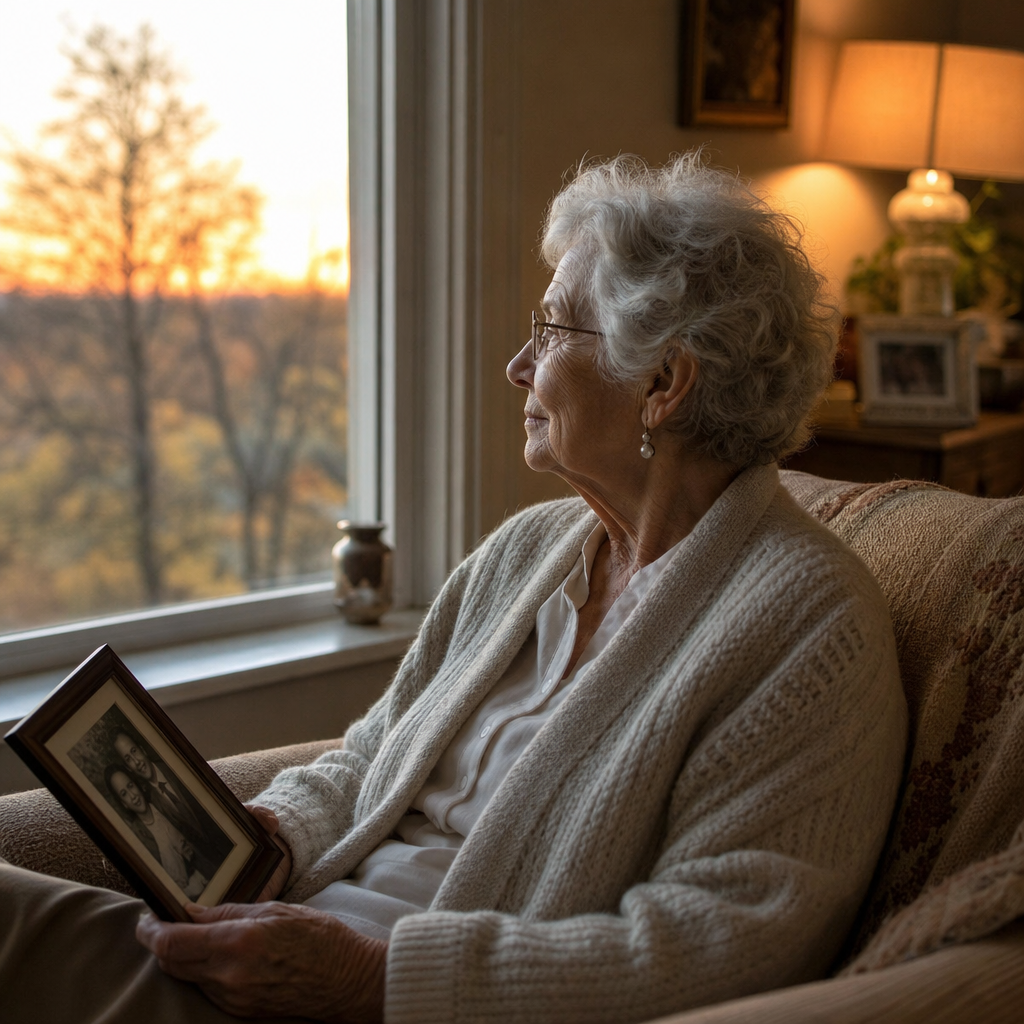
The same research draws a line between being alone and feeling lonely. Many widowed people have children calling, neighbors dropping off food, a full church pew — and still feel achingly alone. That’s because a spouse occupied a specific role no crowd can fill: the person who was simply there, at breakfast and at 10 p.m. The loneliness is for that one chair, not for company in general. It’s the same reason a move into a care community doesn’t automatically lift it — loneliness in assisted living is common precisely because being around people isn’t the same as being known by one. Knowing this helps families too — it explains why “but you have so many people who love you” lands so flat. If someone you love is the one grieving, here’s what to say to a lonely friend.
3. The “widowhood effect” is real — the first three months are the most fragile
Losing a spouse affects the body, not just the heart. Researchers at Harvard found that surviving spouses had a 66% higher risk of dying in the first three months after the loss. Doctors call it the widowhood effect. It’s one more reason the early months aren’t the time to “tough it out” alone — eating, sleeping, and talking to someone regularly are genuinely protective.
4. The risk fades with time — your body and mind do adapt
Here’s the gentler half of that finding. A meta-analysis of widowhood and mortality found the excess risk is highest early and then declines steadily over the years that follow. Grief researchers see the same pattern with loneliness after losing a spouse: it typically peaks right after the loss, and then follows different paths for different people — for many it slowly eases. The first year is not a preview of the rest of your life.
5. You are in enormous company — most new widows and widowers are over 65
According to the U.S. Census Bureau, about 70% of people widowed in any given year are 65 or older — and among Americans 75 and up who ever married, 58% of women and 28% of men have lost a spouse. Widowhood can feel like exile from normal life. The numbers say the opposite: it’s one of the most shared experiences of later life, which is exactly why support for it exists everywhere from grief groups to free phone lines.
6. The loneliness lives in the routines — so new routines genuinely help
Researchers who interviewed widows about daily life found the loneliness concentrated in the broken rituals — coffee made for two, the side of the bed, the 6 p.m. sound of a key in the door. The same research found that deliberately building new routines is one of the main ways widowed people cope. Not big reinventions — small, repeatable anchors: a standing walk, breakfast at the same café, a scheduled call. Evenings tend to be the hardest, and nighttime loneliness has its own playbook.
7. Connection isn’t a luxury — it’s protective, and it can be rebuilt
Studies that followed widowed older adults over time found that social support — from children, friends, anyone steady — measurably protects against the worst loneliness trajectories. And the U.S. Surgeon General’s advisory puts the stakes plainly: lacking social connection carries a health risk comparable to smoking up to 15 cigarettes a day. Reaching out isn’t being a burden. It’s medicine — the kind you’re allowed to ask for.
What to do with all this
You can’t shortcut grief, and we’d never tell you to. But the research on loneliness after losing a spouse points to a short, doable list: treat the early months gently, expect the loneliness to live in the routines, build one or two new anchors, and let people in — even one person, even by phone. Loss has many doors; loneliness after divorce walks a similar road, and the same small steps help.
And if today the house is too quiet and you just want to hear a voice — that’s reason enough. Call us. A real person answers, there’s nothing to sign up for, and it costs nothing.
Important
We are companions, not clinicians. The phone line at How To Beat Loneliness is staffed by real humans who listen — we don’t diagnose, prescribe, or treat. Loneliness after losing a spouse can shade into depression, and that deserves real care: if you’re sinking rather than just sad, please pair our conversation with a licensed therapist or your doctor, and remember 988 is there any hour for the dark moments.
A note from the founder
If you’ve read this far, odds are you’re carrying this loss yourself, or watching someone you love carry it. Either way — you don’t have to narrate it perfectly or be “doing well” to call us. Some of the best calls we get are mostly silence and a cup of coffee. The line is free, and the person who answers is real. — Sergio
Frequently asked questions about loneliness after losing a spouse
Why is loneliness after losing a spouse so intense?
You lose not just a person but your daily companion, your shared routines, and the one who held your history. Around 70% of widowed older adults call loneliness the hardest part of losing a spouse.
How long does loneliness last after losing a spouse?
There is no set timeline. The sharpest stretch is often the first months — the period researchers call the widowhood effect — and it tends to ease unevenly after that. Grieving at your own pace is normal.
What helps with loneliness after losing a spouse?
Gentle routines, letting people in rather than waving them off, bereavement groups, and talking about your spouse instead of around them all help. You do not have to be strong alone.
Is there someone I can talk to after losing my spouse?
Yes — How To Beat Loneliness is a free line answered by a real person who will simply listen, for as long as you need: 877-638-1122.
Sources
- Feeling Lonely Versus Being Alone: Loneliness and Social Support Among Recently Bereaved Persons (PMC)
- Harvard T.H. Chan School of Public Health — “Widowhood effect” greatest in first three months
- Widowhood and Mortality: A Meta-Analysis and Meta-Regression (PMC)
- Development of Loneliness and Social Isolation After Spousal Loss: A Systematic Review of Longitudinal Studies on Widowhood (PMC)
- U.S. Census Bureau — Marriage, Divorce, Widowhood Remain Prevalent Among Older Populations
- Establishing routines to cope with the loneliness associated with widowhood: a narrative analysis (PubMed)
- Understanding Loneliness Patterns Among Widowed Older Adults Over Time and the Protective Effect of Social Support (PMC)
- U.S. Surgeon General — Our Epidemic of Loneliness and Isolation (2023 Advisory)