
The short version: loneliness in assisted living is far more common than families expect, because being surrounded by people is not the same as having company. How To Beat Loneliness answers free at 877-638-1122, where a real person picks up just to talk — no crisis needed, no cost, and residents can dial it themselves. If you or someone you love is thinking about self-harm, call or text 988 (the U.S. Suicide & Crisis Lifeline) right away — it is free and answered 24/7.
I am Landon, and I help run How To Beat Loneliness. One of the most confusing calls we get comes from adult children who did everything right. They found a good facility, the staff are kind, there is bingo on Tuesday and a garden and a hairdresser down the hall — and their mother is still lonely. If that is you, you have not failed, and neither has she. Loneliness in assisted living is its own particular problem, and it has less to do with the number of people in the building than with what kind of contact those people offer.
Why Loneliness in Assisted Living Happens
Moving in solves an impressive list of problems. Meals appear. Someone is there if you fall. Laundry gets done, the lawn is not your job any more, and there is a ride to the doctor on Thursday. Those are real and they matter.
But almost none of them are the thing loneliness is actually about. Loneliness is not a shortage of humans in the vicinity; it is a shortage of people who know you. A resident can be greeted by name fourteen times a day by staff who genuinely like her and still go a month without a single conversation about her late husband, her career, or the town she grew up in. Proximity is not the same as connection, and a full dining room can be one of the loneliest places there is.
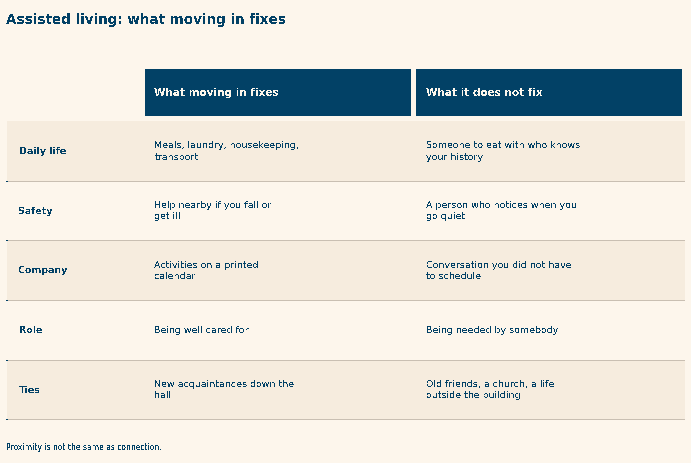
| What moving in fixes | What it does not fix | |
|---|---|---|
| Daily life | Meals, laundry, housekeeping, transport | Someone to eat with who knows your history |
| Safety | Help nearby if you fall or get ill | A person who notices when you go quiet |
| Company | Activities on a printed calendar | Conversation you did not have to schedule |
| Role | Being well cared for | Being needed by somebody |
| Ties | New acquaintances down the hall | Old friends, a church, a life outside the building |
The Losses That Arrive With the Move
A move into assisted living rarely happens on a good day. It usually follows a fall, a diagnosis, or the death of a spouse, and it arrives bundled with several losses at once: the house, the neighborhood, the car, and often the last shreds of a daily routine that belonged to that person alone.
The car is the one families underestimate. When driving stops, so does the ability to visit a friend without asking permission, arranging a ride, or fitting into somebody else’s schedule. Every remaining relationship suddenly depends on other people making the effort. For a proud, independent person, that is a hard thing to accept, and many quietly stop asking rather than feel like a burden. A call that simply arrives on a schedule sidesteps that problem entirely, which is why so many families look into regular check-in calls for seniors once a parent has moved in.
Why This Is Worth Taking Seriously
Loneliness is not only an unhappy mood; it is a health issue. The National Institute on Aging links social isolation and loneliness in older adults to higher risk of heart disease, depression, and cognitive decline. The U.S. Surgeon General’s 2023 advisory on our epidemic of loneliness and isolation makes the same case at national scale, treating social connection as a genuine public-health priority rather than a nicety.
Researchers have also looked specifically at senior housing, and the findings are humbling: studies of residents in senior housing and assisted living communities have repeatedly found high levels of loneliness despite constant proximity to other people, with results varying considerably from one community to another. In other words, the building is not the variable that decides it. What happens inside it is. If you want to read the primary work, the review Social Networks in Retirement and Assisted Living Communities is a good starting point.
What Actually Helps
Ask about their life, not their day
How was lunch gets a one-word answer. Tell me about your first job does not. Residents are asked about their immediate comfort constantly and about their actual life almost never, and the difference between those two questions is the difference between being managed and being known.
Come at the same time each week
A short visit they can count on beats a long one they cannot predict. Anticipation is half the value — a Tuesday visit gives them Sunday, Monday, and Tuesday morning to look forward to. Unscheduled generosity gives them nothing to hold.
Protect one tie to the outside world
A former neighbor, a church, an old colleague, a hobby group — something that belongs to them rather than to the facility. When every relationship a person has is inside one building and dependent on staff rosters, their world has quietly become very small.
Give them something to give
People feel connected when they are needed, not only when they are cared for. Ask for advice you will actually take. Let them help with a decision, mind a plant, write a letter, teach a grandchild something. Being permanently on the receiving end of care is corrosive in a way that families rarely notice.
Leave a number they can dial alone
This is the one we exist for. Independence matters enormously to people who have lost a lot of it, and a phone number they can use without asking anybody’s permission restores a small piece of it. Write 877-638-1122 on a card by the phone. A real person answers, it is free, there is no crisis required, and nobody will report the call back to the family or the facility.
If you are supporting a parent through this, our guide on how to help an elderly parent who is lonely pairs closely with this one, and our full guide to how to beat loneliness maps the longer road back to connection.
Important
We are companions, not clinicians. The free line at How To Beat Loneliness is answered by real people who listen — we do not diagnose, prescribe, or treat, and we are not a substitute for the care team at a facility. Loneliness and depression overlap heavily in older adults, and depression is very treatable: if a resident has stopped eating, stopped sleeping, withdrawn from everything, or seems hopeless more days than not, raise it with their doctor and the facility rather than waiting it out. In a crisis, or if they are thinking about harming themselves, call or text 988 (the U.S. Suicide & Crisis Lifeline) right away. Adults 60 and older can also reach the Institute on Aging Friendship Line at 888-670-1360 for free 24/7 conversation and scheduled check-in calls.
A note from Landon
If you moved a parent into a good place and they are still lonely, the guilt that comes with that is heavy and, I think, misplaced. You solved the problems that could be solved by a building. The one that is left is the one only people solve, and it does not need a big gesture — it needs someone asking better questions, on a schedule she can count on. And when you cannot be there, we are glad to be one of the voices in her week: 877-638-1122, free, always a real person.
— Landon, How To Beat Loneliness
Frequently asked questions about loneliness in assisted living
Why is my parent lonely in assisted living when there are so many people around?
Because proximity is not the same as connection. Loneliness is about being known, not about how many people are nearby. A resident can be greeted by name all day by kind staff and still have nobody to talk to about her history, her marriage, or her work.
Is loneliness in assisted living common?
Yes. Studies of senior housing and assisted living residents have repeatedly found high levels of loneliness despite constant proximity to others, and levels vary a lot between communities. It is one of the most common and least discussed parts of moving into care.
How can I help a lonely parent in assisted living?
Visit at the same time each week so they have something to anticipate, ask about their life rather than their day, protect one tie to the world outside the building, give them a way to be useful, and leave a phone number they can dial on their own.
Is there a free number a resident can call just to talk?
Yes. How To Beat Loneliness answers free at 877-638-1122, where a real person picks up just to talk with no crisis needed. Adults 60 and older can also call the Institute on Aging Friendship Line at 888-670-1360, free and answered 24/7.
Sources
- National Institute on Aging — Loneliness and Social Isolation: Tips for Staying Connected
- U.S. Surgeon General (2023) — Our Epidemic of Loneliness and Isolation
- Social Networks in Retirement and Assisted Living Communities: A Literature Review (PubMed)
- Institute on Aging — Friendship Line (888-670-1360)