
If you’re in crisis right now — call or text 988 (US Suicide & Crisis Lifeline), available 24/7. This article isn’t a substitute for emergency mental-health support. If you’d just like to talk to a real person about loneliness, our free phone line is open: 877-638-1122.
I’m Jewel. I’m one of the people who picks up the phone when you call the free loneliness line at How To Beat Loneliness. A good number of our calls are about single parent loneliness — getting kids fed, to school, to bed, with no second adult in the house to hand any of it to.
Single parent loneliness is its own particular kind of alone: surrounded by a child all day, and still the only adult in the room when the lights go out. It shows up in the car after drop-off, in the quiet after bedtime, in not having anyone to call when the kid has a fever at 2 a.m. If that’s where you are tonight, you can skip the rest of this and just talk: 877-638-1122. If you want the honest version of what helps, keep reading.
Why Single Parent Loneliness Feels Different
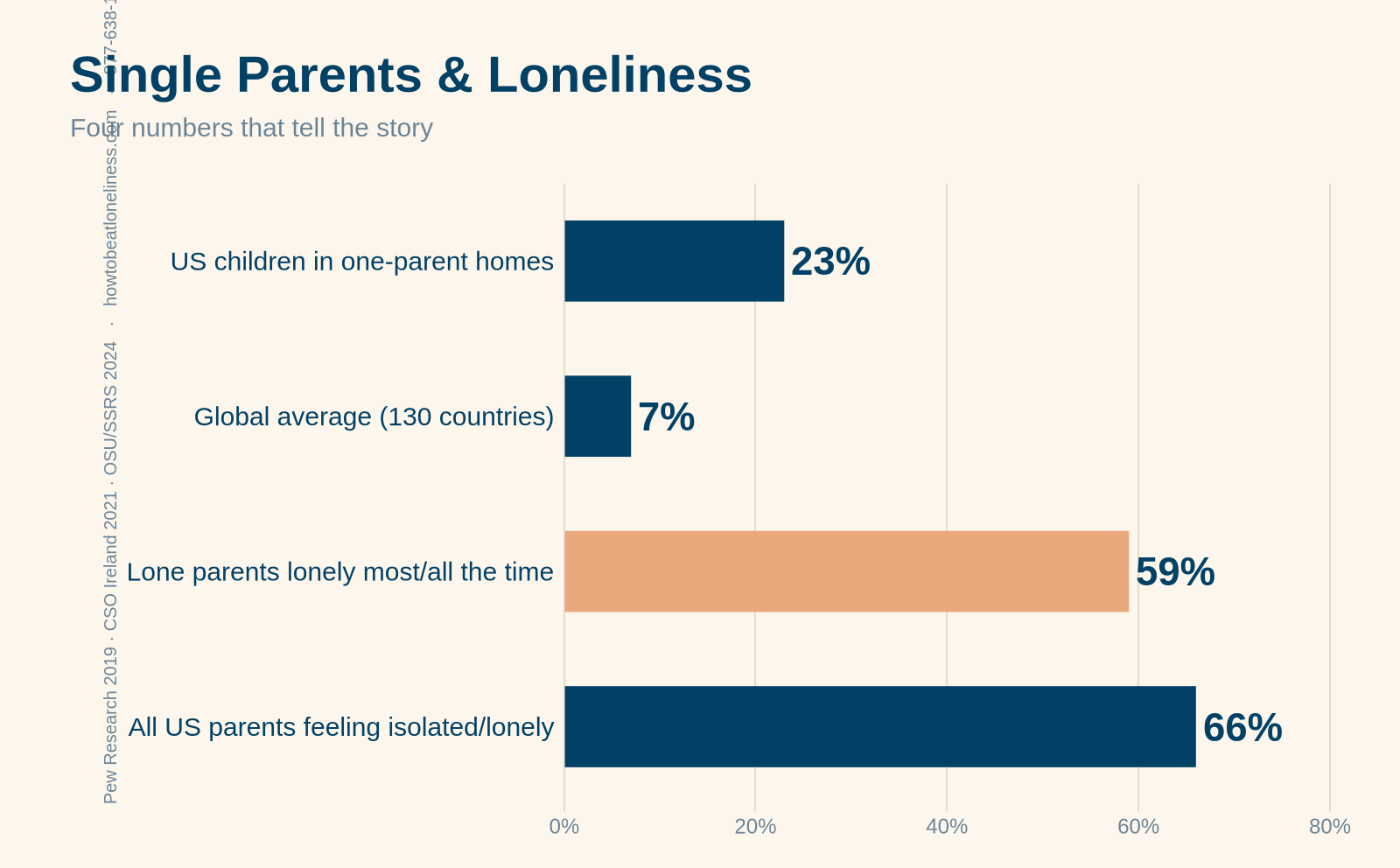
The United States has the world’s highest share of kids growing up with just one parent in the house — 23% of American children under 18, compared with a 7% global average across 130 countries Pew Research studied. That’s not a fringe situation. It’s thirty-plus million households where one adult is doing the work two were built to share.
And the loneliness that comes with it is measurable, not just a feeling. A 2021 Irish government survey (the CSO’s “Life at Home” study) found 59% of lone parents said they felt lonely all or most of the time — roughly three times the rate reported by parents with a partner in the house. Separately, a 2024 US survey of parents generally found 66% feel isolated or lonely at least sometimes, and 38% say they have no one supporting them in the job at all. Single parents are carrying the heaviest end of that.
7 Things That Actually Help
None of these require a second parent to show up. They’re things one tired adult can actually do.
1. Name it as loneliness, not failure
The tiredness of solo parenting and the loneliness of solo parenting are two different problems. Tiredness gets better with sleep. Loneliness needs contact with another adult who isn’t depending on you for anything. Treating the second one as a real, separate need — instead of a character flaw — is what makes it possible to act on.
2. Build one standing adult contact into the week
Not “someday coffee” — an actual recurring slot: a Sunday call with a sibling, a Tuesday drop-off chat with another parent at pickup, a free weekly call to a line like ours. A loneliness researcher’s rule of thumb holds here: a small amount of contact on a fixed schedule beats a big plan that keeps slipping.
3. Trade childcare, don’t just ask for it
“Can you take mine for two hours Saturday, I’ll take yours Sunday” lands differently than asking a favor — it’s a trade, which is easier to say yes to and easier to ask for again. One other single parent you trade with regularly does more for loneliness than five parents you only wave to.
4. Use the in-between minutes on purpose
The carpool line, the laundromat, the waiting room — they’re already in your day. A short, genuine exchange with another adult in those minutes counts as real connection; it doesn’t have to wait for a free evening that may not come this month.
5. Let one person know the real load
Most people around a single parent see the surface — “doing great, so capable” — and never hear what the 9 p.m.-to-sunrise stretch actually feels like. Telling one person the real version, not the highlight-reel version, is what turns an acquaintance into someone who’ll actually show up.
6. Find the people already built for this
Single-parent meetup groups, co-op childcare swaps, and parenting-focused community groups exist precisely because this situation is common, not rare. The same is true for caregivers juggling it all alone — you’re not the only household missing a second adult.
7. Call someone who isn’t also tired
Everyone else in a single parent’s circle is usually stretched thin too. A free line staffed by someone whose whole job that hour is to listen — not to also need something from you — is a different kind of rest. That’s what our phone line is for, any evening, no appointment: 877-638-1122.
A Short Checklist to Keep
- Call it loneliness, not just tiredness, so you act on the right problem.
- Put one adult contact on a repeating schedule this week.
- Offer a childcare trade instead of asking a favor.
- Use the carpool line or pickup minutes for a real exchange.
- Tell one person the honest version of your week.
- Look for a single-parent or co-op group near you.
- Keep 877-638-1122 saved for the nights nothing else is open.
Important
We are companions, not clinicians. The phone line at How To Beat Loneliness is staffed by real humans who listen — we don’t diagnose, prescribe, or treat. If you’re working through grief, depression, or a mental-health condition on top of solo parenting, please pair our conversation with a licensed therapist, your doctor, or one of the resources above.
If you’re in immediate danger or thinking about hurting yourself, call or text 988 (US Suicide & Crisis Lifeline).
Questions We Hear
Is single parent loneliness actually common, or does it just feel that way?
It’s common and measured, not just a feeling: a 2021 Irish government survey found 59% of lone parents reported feeling lonely all or most of the time, roughly three times the rate among parented households with two adults. You’re describing something real, not overreacting.
Does it get better once the kids are older?
Some of the physical exhaustion eases, but the adult-contact gap often doesn’t close on its own — it closes when a single parent builds a standing connection into the week on purpose, which works at any age of kid.
What’s the fastest thing I can do about it tonight?
Pick one person — a sibling, a fellow parent, a free line like ours — and make contact tonight instead of planning to “reach out soon.” Call 877-638-1122 if there’s no one else; it’s free, no script, no upsell.
Is relying on a phone line instead of “real” friends a bad sign?
No. For a lot of single parents it’s the first real adult conversation of a long week, and it’s often what makes room to build the in-person connections later. We’re companions for the moment you’re in, not a replacement for the friendships you’re building.
If today’s the first time you’ve put a name to this — you’re not the only parent googling it this week, and if the loneliness started with a split rather than always solo parenting, this is worth a read too. And if you’d rather just hear a real voice than read another paragraph, here’s how the free line works.
— Jewel, How To Beat Loneliness