
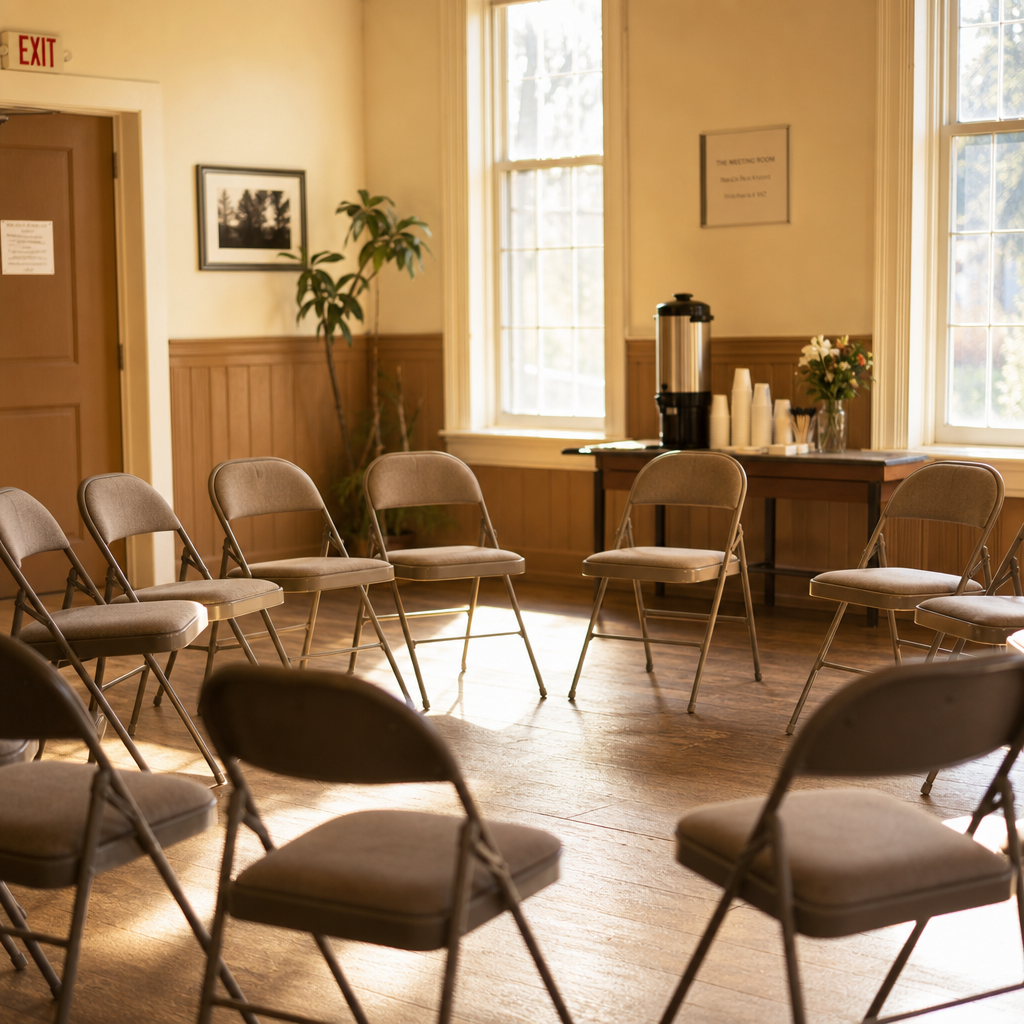
The short version: loneliness support groups are regular gatherings — in person or online — where people who feel isolated meet to talk and be heard. They’re not therapy, most are free or low-cost, and they genuinely help. Below are six real places to find one. And if today feels heavy, you can call or text 988 (the U.S. Suicide & Crisis Lifeline) any time, or reach a real human on our free line: 877-638-1122.
I’m Landon. I help run How To Beat Loneliness, and before this I spent years training and managing teams — work that comes down to one thing: getting people in a room and helping them actually talk to each other. That’s most of what a good support group is. If you’ve been searching for loneliness support groups, you’ve already done the hardest part, which is deciding you don’t want to do this alone anymore. Let me show you where to look — and what to expect when you get there. The free number stays here the whole time: 877-638-1122.
What loneliness support groups actually are
A loneliness support group is a small, regular gathering of people who all know what isolation feels like — and who show up to listen to each other. Some meet in a community-center room with coffee and folding chairs. Some meet on a video call. Some are built around a shared situation: widowhood, caregiving, a recent move, a health diagnosis, or years in uniform — veterans’ groups are often the easiest room to walk into, and we’ve written about why loneliness hits so many veterans once the service ends. What they have in common is the thing that makes them work — nobody in the room needs you to explain why you came.
It’s worth being clear about what these groups are not. They’re not therapy, and the people running them usually aren’t clinicians. That isn’t a weakness — it’s the point. You’re not a patient there. You’re a person with something to say, sitting with other people who want to hear it.
And they work. A meta-analysis of randomized controlled trials found that social-support programs measurably lowered loneliness among older adults, with the strongest results from shorter, focused programs of a few months. The U.S. Surgeon General’s 2023 advisory reached the same conclusion from the other direction: rebuilding connection is one of the most powerful things we can do for our health — loneliness carries risks the advisory compared to smoking 15 cigarettes a day, including a 29% higher risk of heart disease and 32% higher risk of stroke.
Where to find loneliness support groups: 6 real places
Here’s the part people get stuck on. “Support group” sounds like one specific thing, but loneliness support groups live in a lot of different places — and one of them is almost certainly near you, or one tap away.
1. Senior centers and community centers
Most towns have a senior center or community center, and many run a regular coffee hour, lunch club, or “friendly visitor” program built specifically around connection. They’re usually free, they’re local, and the staff have heard “I don’t really know anyone here” a hundred times — they know exactly what to do with it. The National Council on Aging points to senior-center programming as one of the most reliable ways older adults rebuild a social circle.
2. Faith communities
Churches, synagogues, mosques, and temples very often run small groups, grief ministries, and visiting programs — and you don’t have to be a regular to use them. Even if you haven’t been through the doors in years, most will welcome you back with no quiz at the entrance. If faith isn’t your thing, that’s fine; just skip to the next option.
3. Grief and bereavement groups
If your loneliness started with a loss, a bereavement group may be the closest fit. Hospices, hospitals, and funeral homes host some of the most established groups out there, and research on them is encouraging — people leave feeling less alone and more able to build new connections. We’ve written more about loneliness after losing a spouse if that’s the road you’re on.
4. Caregiver and situation-specific groups
Some of the best loneliness support groups are built around one shared circumstance — family caregivers, widows and widowers, people living with Parkinson’s or vision loss or cancer. The advantage is blunt: you skip the explaining, because everyone in the room already gets it. If you’re caring for someone, caregiver loneliness is its own particular kind, and there are groups made just for it.
5. Online and virtual groups
If leaving the house is hard — distance, no driving, a body that doesn’t cooperate some days — online groups are real groups, not a consolation prize. A video or phone circle of people who check in every week can become every bit as warm as one with walls around it. For a lot of folks in rural areas, it’s the most reachable option there is.

6. Warmlines and free phone lines
Sometimes you want connection now — between meetings, late at night, or before you’re ready to walk into a room full of strangers. A warmline is a free, non-emergency number staffed by people whose whole job is to talk with you, no crisis required. That’s exactly what we built our line to be. If you’re curious what it’s like, here’s what actually happens when you call a loneliness line — no script, no fee, no judgment.
How to find the right group — and what to expect your first time
You don’t have to find these on your own. A few free front doors will hand you local options in minutes:
- Call the Eldercare Locator at 800-677-1116 — a free service from the National Institute on Aging that connects you to aging programs in your own town.
- Dial 211 for community-services referrals almost anywhere in the U.S.
- Ask the people who already cross your path — your doctor, a librarian, a pharmacist, a faith leader. “Do you know of any groups for people who’d just like more company?” is an easy question to ask.
About that first visit: you can just listen. You don’t have to share a thing until you want to. And if the first group isn’t your people, that’s not failure — it’s information. Try a different one. No group is a commitment; it’s an experiment that’s allowed to fail forward.
What if you’re not ready for a group yet?
Here’s the honest truth: walking into a circle of strangers is a big first step, and not everyone is there yet. That’s okay. A phone call is a smaller one — one human, no audience, your own kitchen table. You don’t have to perform, and you don’t have to have a reason beyond “today was quiet.”
That’s the whole idea behind our free line. A real, trained human picks up — no script, no fee, no sign-up. For a lot of people it’s the bridge that eventually makes a group feel possible. You can call right now: 877-638-1122.
Important
We are companions, not clinicians. The phone line at How To Beat Loneliness is staffed by real humans who listen — we don’t diagnose, prescribe, or treat. If loneliness has tipped into something heavier — you’ve stopped sleeping, stopped eating well, or feel hopeless more days than not — please pair any group on this page with your doctor or a licensed therapist. And in a crisis, call or text 988 right away.
A note from Landon
Walking into a room of strangers — or even just dialing a number — takes real nerve. You went looking for a way out of the quiet, and that already counts for something. Pick one thing on this page and try it this week. And if a phone feels easier than a room right now, the phone’s free, and a real person is waiting on the other end.
— Landon, How To Beat Loneliness
Frequently asked questions about loneliness support groups
Where can I find a loneliness support group near me?
Start with your local senior center or Area Agency on Aging (the Eldercare Locator, 800-677-1116, can point you to both), a nearby place of worship, and hospital or hospice grief groups; libraries and community centers often post listings, and many groups now meet online. If you would rather just talk to someone now, How To Beat Loneliness is free at 877-638-1122.
Are loneliness support groups free?
Many are — senior-center, faith-based, library, and peer-led groups are usually free. Some condition-specific or therapist-led groups may charge, and the How To Beat Loneliness phone line is always free.
What happens at a loneliness support group?
People gather, often in a circle, to talk and be heard. Most open with brief introductions, no one is forced to share, and a facilitator keeps the conversation safe and confidential.
What if I am not ready for a group?
That is common. A one-to-one phone call is a lower-barrier first step — call 877-638-1122 to talk to a real person for free, any day.
Sources
- National Institute on Aging — Loneliness and Social Isolation: Tips for Staying Connected
- U.S. Surgeon General (2023) — Our Epidemic of Loneliness and Isolation
- National Council on Aging — Navigating Social Isolation and Loneliness as an Older Adult
- Meta-analysis of randomized controlled trials — social-support interventions reduce loneliness in older adults