
Short version: a new Australian study on loneliness and quality of life found that loneliness cuts into young adults’ well-being more than it does for any other age group — bigger than the hit to seniors most of us assume carries the weight. If you want to talk to a real person about it today, call 877-638-1122 — free, no script, no upsell.
I’m Landon. I spend a lot of my time telling pastors and community leaders the same thing: don’t assume the lonely person in the room is the oldest one there. A study published this month gives that hunch some real numbers behind it.
The New Study on Loneliness and Quality of Life
Researchers at Monash University tracked more than 53,000 survey responses from almost 22,000 Australians, using four waves of the long-running Household, Income and Labour Dynamics in Australia survey. The finding, published as an Editor’s Choice pick in the journal Value in Health: loneliness among 15-to-24-year-olds was linked to the single largest drop in health-related quality of life of any age group studied — bigger than the drop seen in people over 65.
Eighteen percent of 15-to-24-year-olds reported feeling lonely, compared with 12% of people 65 and older. Lead researcher Dr. Fikru Rizal put it plainly: “Loneliness is often seen as an issue affecting older people” — but the data says the youngest adults in the study felt the heaviest toll.
The numbers behind “quality of life”
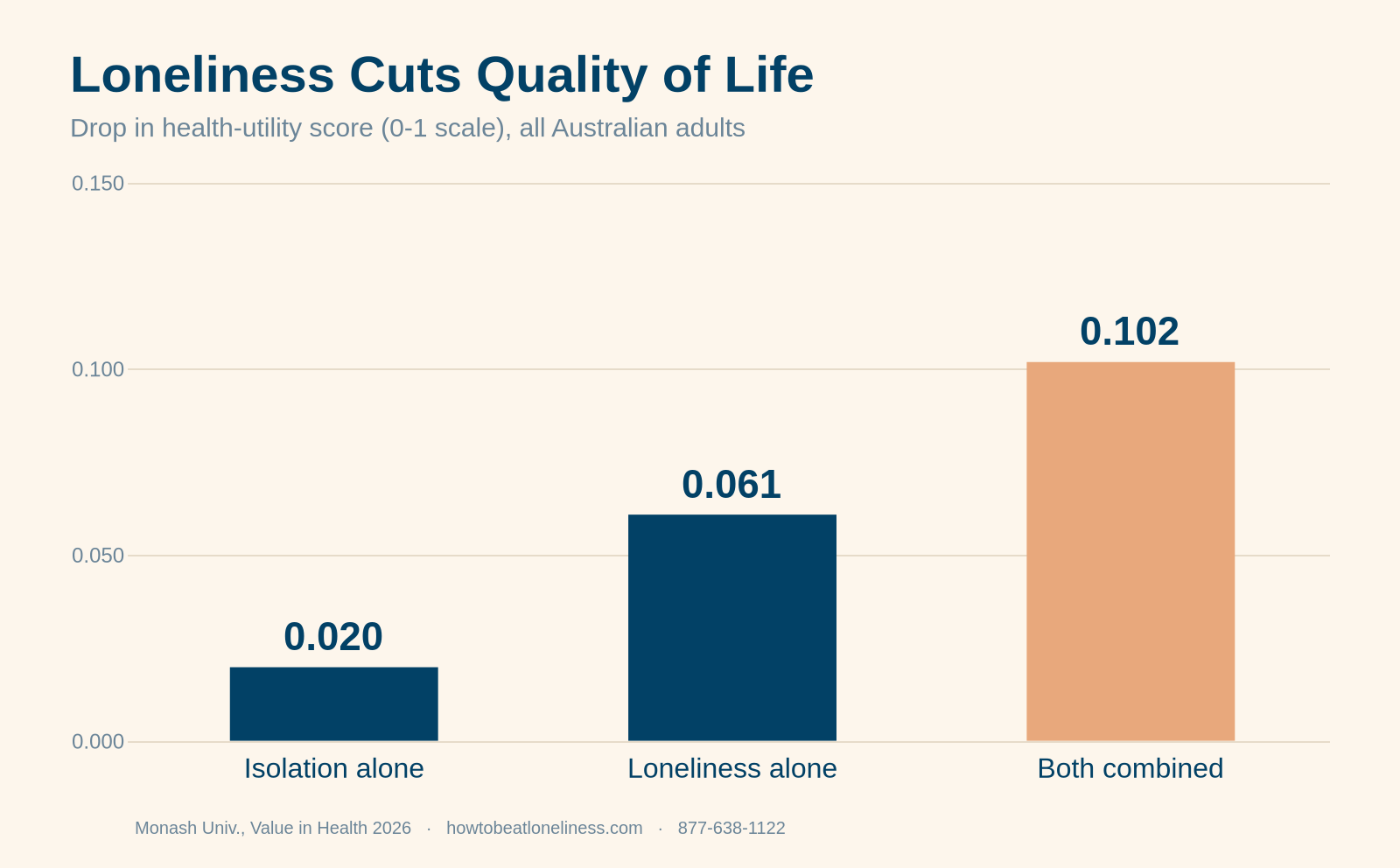
Researchers used a 0-to-1 health-utility scale, where 1.0 is full health and 0.0 is death — the same kind of measure health economists use to compare the real-world impact of any health condition. Across every age group studied, loneliness alone was linked to a 0.061-point drop, social isolation alone to a 0.020-point drop, and experiencing both to a 0.102-point drop — worse than just adding the two effects together.
Senior author Professor Cathy Mihalopoulos said the point of putting a number on it is practical: “These estimates can now be used in economic evaluations to help determine the potential health gains” of programs that reduce loneliness. In plain terms — this isn’t just a feelings problem. It measures the same way a chronic illness would on a health economist’s spreadsheet.
Why this matters even if you’re not 20
We’ve written before about whether young people are actually lonelier than older people — the short answer was yes, and this new study backs that up with a different kind of evidence: not just how often young people feel lonely, but how much it costs their well-being when they do. If you’re a parent, grandparent, or pastor who assumed the lonely person in your life would be gray-haired, this is your sign to check in with the 20-somethings too.
And if you’re the one feeling it — at 22 or 72 — the numbers by age are consistent on one thing: loneliness doesn’t wait for a milestone birthday to start costing you something real.
You don’t need an appointment or a referral to pick up the phone. How To Beat Loneliness is a free line, staffed by real people, built for exactly this — the days the number on a chart matches how you actually feel.
— Landon, How To Beat Loneliness