
Short version: Are young people lonelier than old people? Four separate surveys — Harvard, Cigna, Gallup, and a 142-country Meta-Gallup study — all say yes, and young men score loneliest of all. If you want to talk to a real person today, call 877-638-1122 — free, no script, no upsell.
I’m Landon. Part of my job at How To Beat Loneliness is paying attention to who actually calls our free line — and it’s not who most people picture. Ask someone to describe a lonely person and they’ll usually describe a retiree. The data says that picture is backwards.
Myth: are young people lonelier than old people, or is loneliness mostly an old person’s problem?
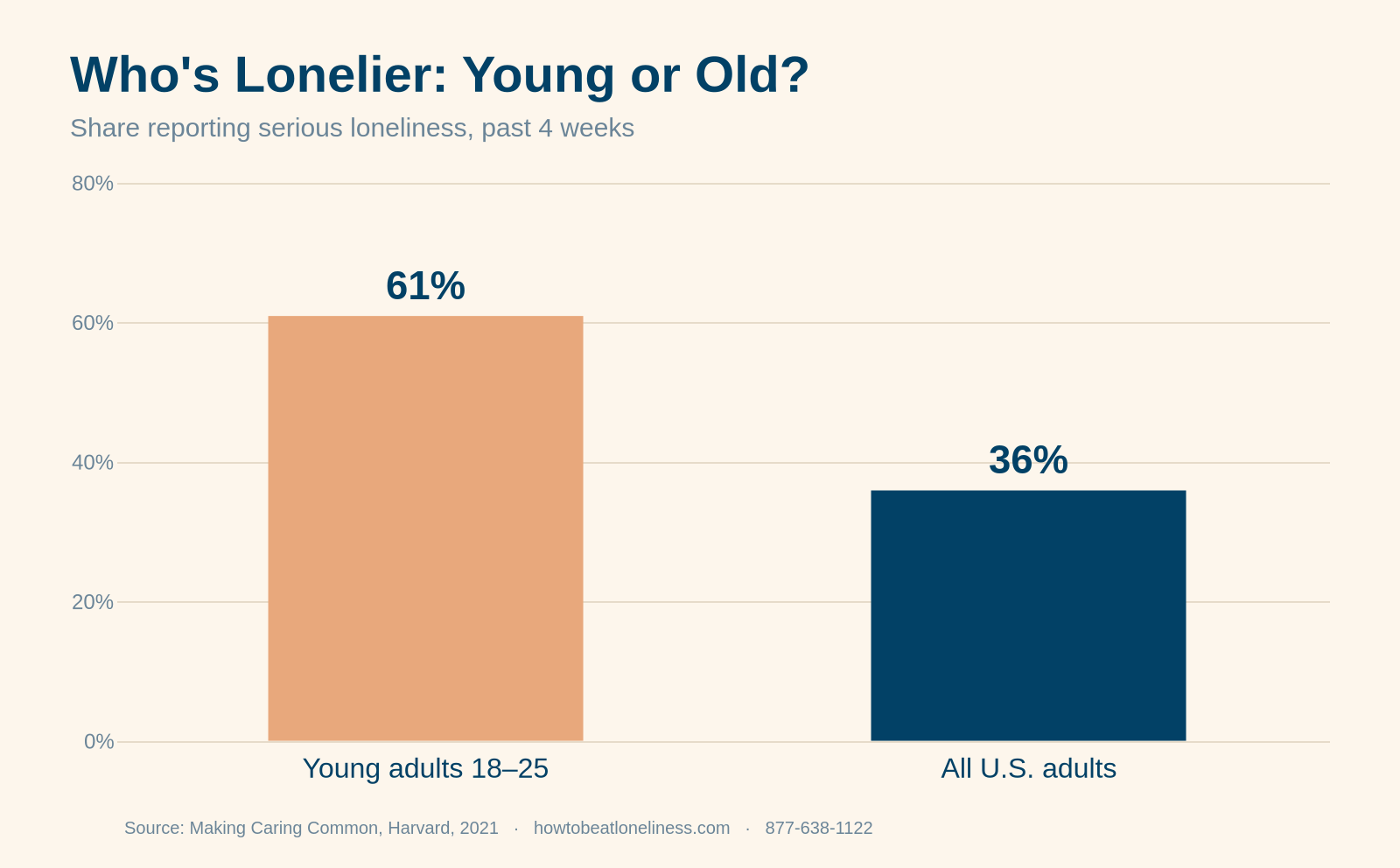
The Making Caring Common project at the Harvard Graduate School of Education surveyed roughly 950 Americans in October 2020 and found that 61% of young adults ages 18–25 reported serious loneliness — feeling lonely frequently or almost all the time in the previous month. Across the whole sample, that number was 36%. Young adults weren’t a little lonelier. They were nearly twice as likely to be seriously lonely as the average American.
Myth: every generation is about equally lonely
Cigna’s U.S. Loneliness Index, built from a 20,000-person survey using the UCLA Loneliness Scale, found Generation Z (then ages 18–22) scored 48.3 — the loneliest of any generation measured, on a scale where the national average was 44. The Greatest Generation, 72 and older, scored lowest at 38.6. Cigna’s own researchers called the result “contrary to what one might expect” — younger adults, not older ones, were the hardest hit.
Myth: this is just an American complaint about “kids these days”
It isn’t local to the U.S. A 2023 survey by Meta and Gallup, covering 142 countries, found adults 19–29 reported loneliness at 27% — the highest of any age group worldwide. Adults 65 and older reported the lowest rate, 17%. The global average was 24%.
Myth: if anyone that age is struggling, it’s young women
Gallup’s most recent World Poll data (2023–2024) found 25% of American men ages 15–34 said they’d felt lonely the day before they were surveyed — seven points above the U.S. average of 18%, and ten points above the 15% average across 28 higher-income countries. Among the nations Gallup measured, only young men in Turkey scored lonelier.

So why does the stereotype stick around?
Probably because the consequences look different at different ages. An older person’s loneliness is more likely to surface as a wellness check or a line in an obituary. A younger person’s loneliness is more likely to look like scrolling a phone alone in a dorm room, a studio apartment, or a car in a parking lot after a shift — quieter, and easier to miss. Quieter doesn’t mean smaller.
What this means if you’re the young person reading this at 1am
You’re not imagining it, and you’re not alone in it — even though “alone” is exactly how it feels. A few things that actually help, based on what callers tell us:
- Put a name to it. “I’m lonely” is a more useful sentence than “something’s wrong with me.”
- Low-stakes beats high-stakes. A short text to one person tonight beats planning the perfect hangout for next month.
- If you want a real human voice and not a feed or a bot, our line is free and nobody’s selling you anything: 877-638-1122. Our full guide to finding someone to talk to when lonely covers more free options too.
- If texting feels easier than talking tonight, here’s a rundown of apps that connect you to an actual person, not a chatbot.
And if you’re the parent, professor, or older relative of someone this age: AARP’s own 2025 research shows loneliness runs high at every adult age, not just late in life — so checking in with the 22-year-old in your life isn’t overreacting. It’s accurate.
It’s not just about who feels lonely most often — it’s about what that loneliness costs. A newer Monash University study found loneliness drags down health-related quality of life more at younger ages than older ones; we broke down the numbers here.
Quick answers
Are young men or young women lonelier? In Gallup’s most recent data, young American men reported higher loneliness (25%) than young American women (18%) — the opposite of the common assumption.
Does loneliness get better with age? The surveys above suggest it often does — Cigna found the oldest group it measured scored lowest, and the Meta-Gallup global data found the same pattern across 142 countries.
— Landon, How To Beat Loneliness
Sources
- Making Caring Common, Harvard Graduate School of Education — “Loneliness in America,” 2021
- CBS News, reporting the Cigna U.S. Loneliness Index, 2018
- UPI, reporting Gallup World Poll data on young men’s loneliness, May 2025
- Reporting on the Meta–Gallup State of Social Connections 142-country survey, 2023