
By Sergio Savic · Founder, HowToBeatLoneliness · Reviewed by Landon Myers, Partner · May 2026
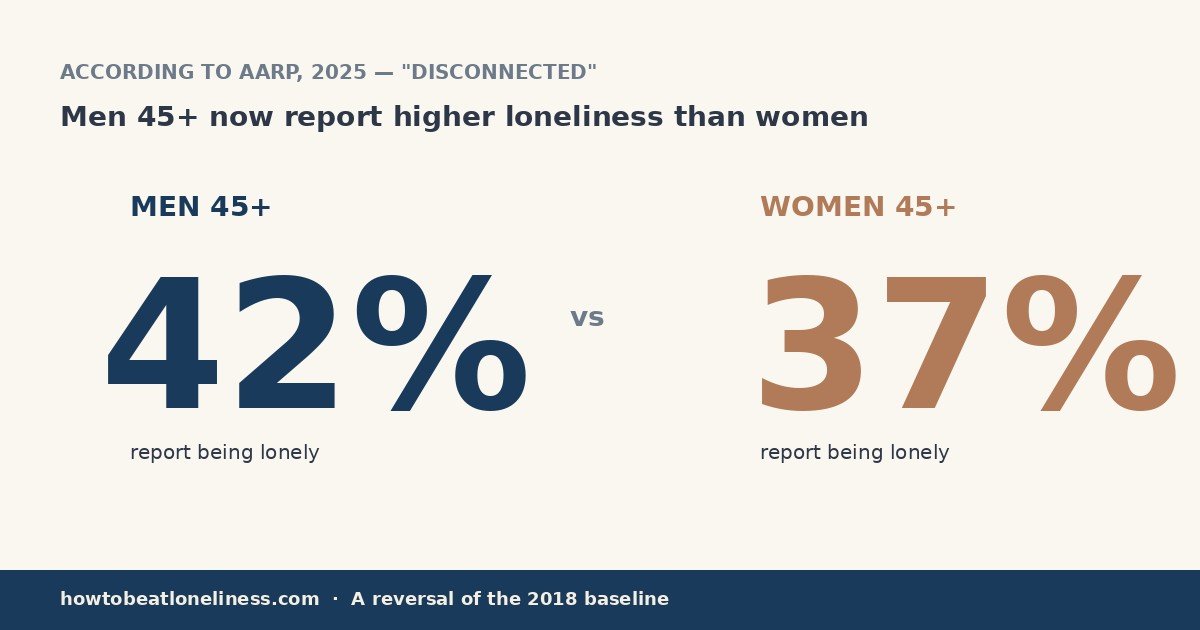
The short version: According to AARP’s 2025 Disconnected report, men age 45 and older now report higher rates of loneliness than women — a reversal of the previous gender pattern, and part of a broader rise in loneliness in the 45+ cohort over the past several years. The takeaway isn’t that men are weak. It’s that the structures that used to anchor men — work, role, the office, the lodge — got hollower faster than most of us admitted. If that’s you or someone you love, 877-638-1122 is a free phone line where a real human picks up. No therapy. No script. No charge.
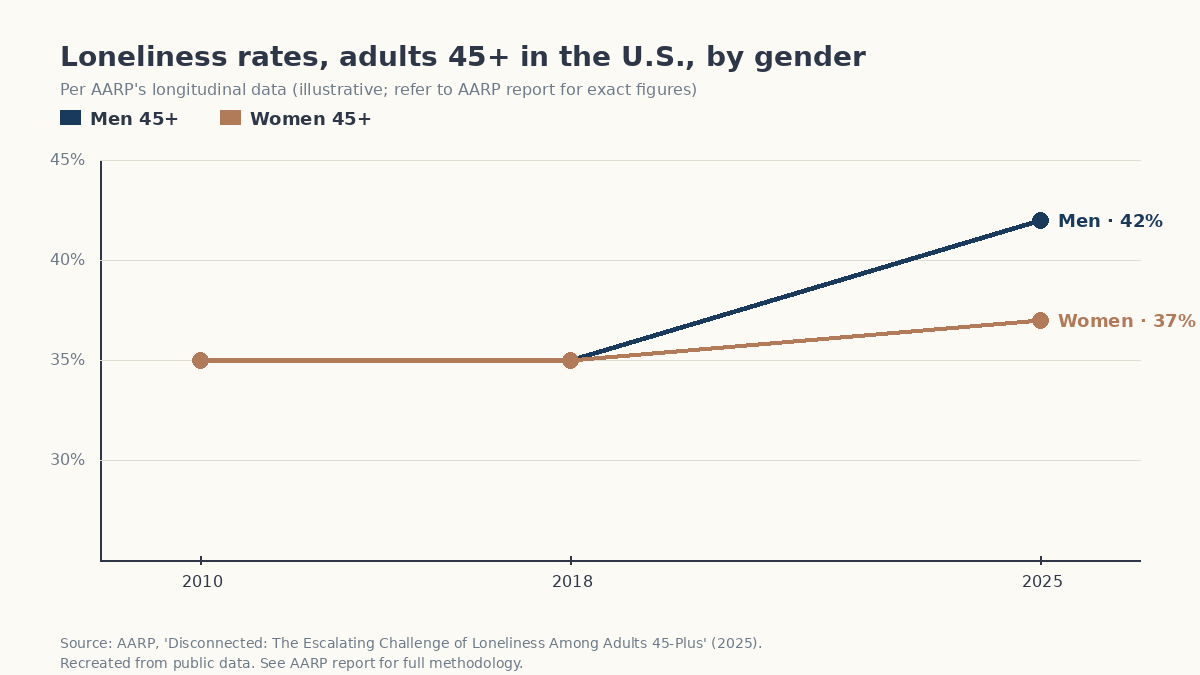
For the first time in the decade AARP has tracked it, men lonelier than women is not a contrarian headline — it’s the data. AARP’s 2025 Disconnected report finds that adults 45 and older are lonelier overall than they were a decade ago, and that men in this cohort now report higher rates of loneliness than women. This piece walks through what the study actually says, why we think the flip happened, and the patterns we see when these men finally pick up the phone.
Why men lonelier than women 45+ is now the AARP finding
According to AARP’s “Disconnected” report (AARP, 2025), the survey was fielded in August 2025 with thousands of U.S. adults aged 45 and older. Three findings AARP highlights stand out for our work:
- Roughly 4 in 10 adults 45 and older report being lonely — a notable jump from where the figure sat for most of the past decade.
- Among that cohort, the share of men reporting loneliness now exceeds the share of women — a reversal of the previous gender pattern, which is the “men lonelier than women” finding.
- Loneliness in the report is highest at the younger end of the 45+ range, and tends to decrease with age, education, and household income.
(Full methodology and figures: see AARP’s report, linked above.)
5 reasons men lonelier than women is now true at 45+
This part is partly research, partly what we hear on the phones. Five forces explain why men lonelier than women is now the headline number in AARP’s data.
1. Work used to do a lot of the heavy lifting
Men in this cohort were the generation most likely to define identity through career. When the office disappeared — through retirement, layoffs, hybrid work that gutted the daily-coffee culture, or a sale of the business — the scaffolding came down all at once. Women were less likely to lose an entire identity in one transition; men were more likely to.
2. The third places thinned
Lodges, Rotary clubs, men’s church groups, bowling leagues, neighborhood bars where the same guys showed up on a Tuesday — those have been declining for decades. The Surgeon General’s 2023 Advisory on Loneliness and Isolation flagged exactly this drop. Women’s social infrastructure didn’t disappear at the same rate, which is part of why we now see men lonelier than women in the AARP cohort. VFW and American Legion posts thinned out the same way, which is one reason loneliness among veterans has its own particular sting.
3. Men ask for help less
Every study confirms this and every phone agent confirms this. By the time a man calls a free phone line, he is past the point where he could pretend it was fine.
4. “Loneliness” isn’t always the word men use
When men in their sixties call us, they almost never say “I’m lonely.” They say “I’m not sure what I’m doing,” or “I sold the company and now I just go to the gym,” or “my wife is busy with her things.” In the AARP framing those are loneliness signals. In the man’s own framing, they are purpose signals.
5. Spouses became the only line
The widows we talk to often tell us their late husband had no friends — only “her friends.” When she passed, his world collapsed because it had been load-bearing on one person. That structural fragility is a big part of why men lonelier than women shows up in the data at 45+.
What actually helps (based on what we hear)
This isn’t a prescription. It’s a pattern we see on the phones. For the broader take on how connection rebuilds itself in small moments, see How to beat loneliness — a gentle guide when it feels heavy.
Replace the role, not the office
Men who do well after retirement don’t try to recreate work. They find one role that uses what they were good at. Mentoring younger founders. Sitting on a small board for free. Teaching one community-college class. Running an apprenticeship at a trade union.
Find a third place — fast
Within the first six months of retirement, before patterns set. A men’s group at a church. A volunteer crew at a local food bank. A morning gym that has the same people in it every day. A regular poker night. The specific shape matters less than the frequency. Same place, same time, same faces, every week.
Call somebody
A weekly phone call to a sibling, an old colleague, a college friend you haven’t talked to in fifteen years. If there is no one to call, that’s what services like ours exist for. The free phone line at 877-638-1122 exists exactly because some men have outlived or outgrown their phone book and need a person to start with.
Don’t let your spouse become your only contact
Invest in a few friendships of your own, on your own, well before retirement.
If a man you love is in this group
If you are reading this for a father, a husband, a brother — the AARP study found men ask for help less. The same data on men lonelier than women at 45+ means you may have to make the first move. A weekly call you initiate, not the other way around. An invitation to a Saturday breakfast that you make a standing thing. A casually-floated number: “There’s a free line if you ever want to talk to a stranger about the new normal.” He probably won’t call. But knowing it exists matters.
What this can look like in practice
The following is an illustrative composite based on the patterns described in AARP’s report and in public research on retirement-related loneliness in men — not a single real caller.
Picture a retired construction-company owner in his late sixties who has just sold his business. He never uses the word lonely. The first call is him explaining how he priced a job. A few calls later he’s telling stories about his apprentice from 1989. A few calls after that he asks whether anyone takes on retired guys for mentorship. He ends up connected to a trade-school program that pairs retired tradesmen with apprentices, and the calls to a companion line get shorter and less frequent — because he’s busy on Thursdays at the school. That’s the goal of a service like this: that you eventually need it less.
FAQ: men lonelier than women in the AARP study
What was the AARP 2025 study about men and loneliness?
“Disconnected: The Escalating Challenge of Loneliness Among Adults 45-Plus,” fielded August 2025, surveying thousands of U.S. adults 45+. Released by AARP. See the report for full methodology.
Are men really lonelier than women now, or is it a measurement thing?
AARP’s report compares its longitudinal data over the past decade and a half, and 2025 is the first year their data shows men lonelier than women in the 45+ cohort. We point readers to the full AARP report for the methodology details so they can judge for themselves.
Is loneliness a health risk?
The 2023 U.S. Surgeon General’s Advisory on loneliness and isolation summarizes a substantial body of research linking chronic loneliness to increased risk of heart disease, stroke, and dementia in older adults, and compares the mortality impact of lacking social connection to smoking up to 15 cigarettes a day.
What can a 65-year-old man do today?
One role (mentoring, board, teaching), one third place (weekly gathering), one phone call. The call is the lowest-effort first step.
What about a man in crisis?
If a man is thinking about harming himself, please call or text 988 — the U.S. Suicide and Crisis Lifeline. They are trained, free, and 24/7. We are a companion line, not a crisis line.
Is HowToBeatLoneliness a therapy service?
No. We are a free phone companionship service. A real human picks up. We are not licensed clinicians and do not provide therapy.
Important
This article reports findings from publicly available research and is not medical or psychological advice. If you are struggling with your mental health, please speak with a licensed professional. If you or someone you love is in a mental-health crisis or thinking about harming themselves, please call or text 988 (the U.S. Suicide and Crisis Lifeline) — trained, free, and available 24 hours a day.
A note from our call agent
If you read this far and you are not sure whether to call, here is what I would say: just dial. Hang up if it feels wrong. Most people don’t hang up. Most people exhale and say, “I didn’t know what to expect.”
That’s normal. Call 877-638-1122.
— Jewel
Frequently asked questions about men and loneliness
Are men lonelier than women?
AARP’s 2025 report found men 45 and older now report higher loneliness than women — a reversal from 2018.
Why are older men so lonely?
Men often lean on a spouse or work for connection and build fewer independent friendships, so retirement, divorce, or loss can leave a wide gap.
What helps lonely men reconnect?
Shared-activity settings — clubs, volunteering, sports, classes, a standing coffee — tend to work better for men than sit-down talks. Consistency matters most.
Where can a lonely man turn for support?
How To Beat Loneliness is a free line answered by a real person, no pressure: 877-638-1122.
How this article was written
Written by Sergio Savic. Reviewed by Landon Myers, Partner. Drafted with research assistance from the HowToBeatLoneliness content team, including AI-assisted outlining and editing. Final text, examples, and claims were reviewed and approved by the named reviewer. The example in the “What this can look like in practice” section is an illustrative composite drawn from public research and aggregate patterns — not a single real caller; we never publish identifying details of any caller. Statistics referenced in this article are sourced from the AARP 2025 report and the 2023 U.S. Surgeon General’s Advisory, both linked in Sources below.
Have a correction? Email corrections@howtobeatloneliness.com.
Sources
- AARP, “Disconnected: The Escalating Challenge of Loneliness Among Adults 45-Plus,” 2025 — aarp.org
- U.S. Surgeon General, “Our Epidemic of Loneliness and Isolation: The U.S. Surgeon General’s Advisory on the Healing Effects of Social Connection and Community,” 2023 (public domain, U.S. government work) — hhs.gov