
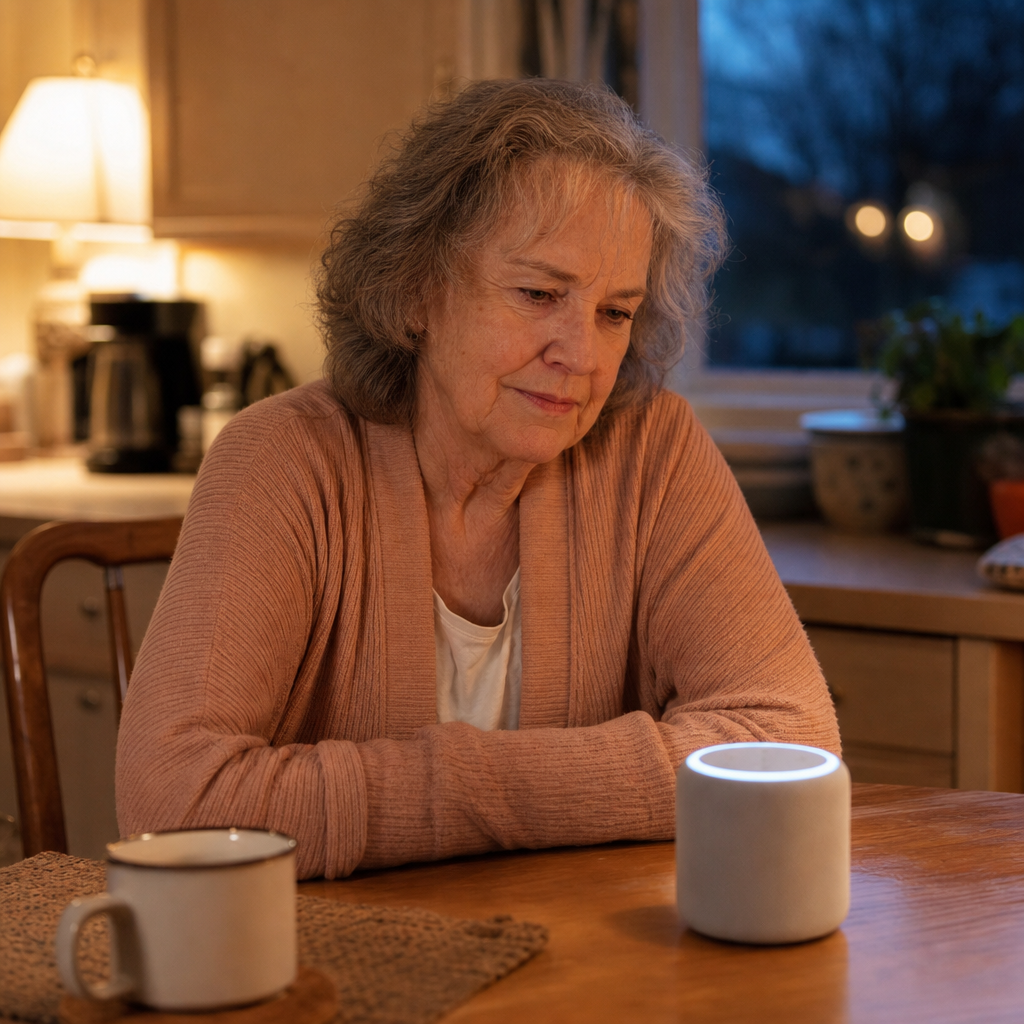
Short version: the research on an AI companion for seniors is better than sceptics expect and thinner than the advertising suggests — two 2026 studies found these devices do reduce loneliness, mostly because the person feels heard, and neither of them measured whether it lasts. If you want a real human conversation about it today, call 877-638-1122 — free, no script, no upsell.
I’m Jewel. I’m one of the people who picks up the phone when you call the free loneliness line at How To Beat Loneliness. I have an obvious bias about talking machines, and I’d rather say so out loud than pretend I don’t — my job is the thing they’re built to imitate.
But a caller’s daughter asked me about this last month, and “I’m biased, don’t bother” is not an answer anyone can use. So I went and read the studies on the AI companion for seniors market instead of arguing with it. Some of what I found surprised me, and one finding in particular has stayed with me. If you’d rather skip the reading and talk to a person, that’s 877-638-1122, free, any day.
Does an AI Companion for Seniors Reduce Loneliness? Two 2026 Studies Say Yes
Yes — and the effect is not small. In a set of five studies published in the Journal of Consumer Research in 2026, Julian De Freitas and colleagues found that using an AI companion eased loneliness on par with interacting with another person, and more than activities like watching videos online. A week-long tracking study in the same paper found the same dip in loneliness showing up again and again after each use.
Two details from that paper matter more than the headline. The first is that people underestimate how much these apps help them — the measured effect was larger than what users predicted for themselves. The second is the mechanism. The researchers tested what was doing the work, and it was not distraction, and it was not simply the relief of saying something out loud. What predicted the drop in loneliness was whether the person felt heard.
Hold on to that, because the second study lands in the same place from a completely different direction.
The Singapore Study: Older Adults Wanted Honesty, Not a Human-Sounding Voice
On 9 September 2026, researchers at the Singapore University of Technology and Design published a study in Innovation in Aging that put 140 community-dwelling older adults, average age around 73, in front of a voice chatbot for about twenty minutes each, then asked what would make them want to use it again.
The strongest predictor was authenticity — whether the thing felt like it was being straight with them. Confidence in using the technology mattered just as much. And here is the part I did not expect: once the researchers accounted for how close people felt to the chatbot, a more humanlike voice predicted less interest in using it. The more it performed at being a person, the less older adults wanted it.
Perceived usefulness did not significantly predict whether people wanted to keep going. Being useful wasn’t the point. Being real about what it was — that was the point.
One more finding from Singapore, and it’s the one that should make anyone selling these devices think carefully: the participants most interested in the chatbot were those in poorer health and with lower life satisfaction. The people with the least already in place wanted it most. That is either the best argument for this technology or the most obvious warning about it, depending on what gets built around it.
What an AI Companion for Seniors Costs, and Where It’s Free
The best-known device in the United States is ElliQ, a small lamp-sized robot that deliberately has no face — it nods, swivels and lights up instead. AARP reported in 2025 that a private lease runs about $60 a month plus a one-time $250 enrollment fee, and that it is available free through state aging agencies in New York, Florida, Michigan, Wisconsin and Washington.
AARP also cited an MIT Media Lab study of 70 older Americans in which companion robots improved personal growth, self-acceptance and overall well-being across eight weeks, and described a case where a user’s repeated reports of feeling unwell prompted the robot to alert her emergency contact — she was treated for sepsis caused by a urinary tract infection. That is a real thing a machine did that a lonely evening otherwise would not have produced.
| Option | Cost | What you actually get | Where it falls short |
|---|---|---|---|
| AI companion device or app | Free to about $60/month | An answer at 3am, every night, without anyone getting tired of you | It doesn’t remember you the way a person does, and nobody notices if you stop |
| How To Beat Loneliness — 877-638-1122 | Free | A real human who listens, no script, no time limit | We’re not clinicians, and we’re not a crisis line |
| 988 Suicide & Crisis Lifeline | Free | A trained crisis counselor, 24/7 | Built for emergencies, not for ordinary company |
| Licensed therapy | Varies; insurance may cover | Clinical care for grief, depression or trauma over months | Cost, waitlists, and not available on a Sunday evening |
What the Research Has Not Shown Yet
Every study above measures something short. The Journal of Consumer Research work tracked a week. The MIT robot study ran eight weeks. The Singapore participants spent twenty minutes. Not one of them followed an older adult through a year of using a companion device to see where they ended up.
The study that might answer that is still running: MIT Media Lab has a one-month investigation of 225 adults aged 65 and over, funded by the Retirement Research Foundation, looking specifically at how using chatbots for social and emotional purposes affects loneliness. No results have been published. Anyone who tells you today that these devices solve loneliness, or that they make it worse, is ahead of the evidence in both directions. We looked specifically at the make-it-worse side — and the safer ways to use one — in can an AI companion make loneliness worse?
What I’d say from the phone line is narrower and I think defensible. Loneliness is not only the absence of a voice in the room. The Surgeon General’s 2023 advisory put the mortality risk of social disconnection on a par with smoking up to fifteen cigarettes a day, and that risk is not really about how many words you exchanged yesterday — it’s about whether anyone would notice if you disappeared. A device answers. It does not notice.
Questions People Ask
Is an AI companion for seniors better than nothing?
On the evidence so far, yes, for the moment you are in. The research shows a real, repeated drop in loneliness after use. What it does not show is that the drop accumulates into a less lonely life, because nobody has measured that yet.
Will my mother feel patronised by one?
The Singapore study suggests the risk is real and the fix is honesty. The more a device performed at sounding human, the less older adults wanted it. The devices that did best were the ones that were straightforwardly what they are.
Can it replace calling her?
No, and the research is the reason I can say that plainly rather than defensively. Feeling heard is what produced the benefit in the strongest study we have — and a person who knows your mother’s history is better at that than a machine meeting her for the first time every day.
What if she just wants someone to talk to today?
Then she can call us. Our line is free, a real person picks up, and there’s no script and no upsell — that’s the whole of it. If you’d like to read what a call is actually like first, we wrote that up in talk to a real person on the phone.
A note from our call agent
If you’ve bought one of these for a parent, I don’t think you’ve done anything wrong. The research is genuinely on your side for the hours when nobody is available, and that’s most hours for a lot of people.
I’d only ask you not to let it close the question. The device will never tell you it’s worried about her. Keep your own standing call in the calendar, and if she wants a second voice on the days you can’t, someone to talk to when lonely is what we’re here for.
— Jewel
Important
We are companions, not clinicians. The phone line at How To Beat Loneliness is staffed by real humans who listen — we don’t diagnose, prescribe, or treat. If you’re working through grief, depression, or a mental-health condition, please pair our conversation with a licensed therapist or your doctor.
If you’re in immediate danger or thinking about hurting yourself, call or text 988 (US Suicide & Crisis Lifeline).
— Jewel, How To Beat Loneliness
Sources
- Sou, Yow, Lau & Ouyang — Factors influencing older adults’ intention to use social chatbots, Innovation in Aging, 2026
- De Freitas, Oğuz-Uğuralp, Uğuralp & Puntoni — AI Companions Reduce Loneliness, Journal of Consumer Research, 2026
- AARP — How AI Companion Robots Are Helping Older Adults, 2025
- MIT Media Lab — Investigating how usage of chatbots for social and emotional purposes affects loneliness in older adults
- U.S. Surgeon General — Our Epidemic of Loneliness and Isolation, 2023