
If this ever tips into crisis, call or text 988 (US Suicide & Crisis Lifeline), free and 24/7. Short version: myths about loneliness talk a lot of people out of calling for help — here are six of the most common ones, checked against the actual research. If you just want to talk to a real person today, call 877-638-1122 — free, no script, no upsell.
I’m Landon. I work on the team at How To Beat Loneliness, and most of what I hear about loneliness from people who’ve never called a line like ours turns out to be wrong in one of a handful of predictable ways.
That matters, because a wrong belief about loneliness is a good reason not to pick up the phone — “that’s not really my problem,” “I should just tough it out,” “men don’t get lonely.” So here are six of the most common myths about loneliness, and what the actual research says instead. If you’d rather skip straight to a real conversation, call 877-638-1122.
Myths About Loneliness #1: It’s an Old Person’s Problem
Myth: loneliness is something that happens to isolated people in their 70s and 80s, and everyone younger is basically fine.
Fact: the World Health Organization’s Commission on Social Connection put global loneliness at roughly 1 in 6 people in its June 2025 report, and found 13-to-29-year-olds lonely at a rate close to older adults — not below it. Closer to home, AARP’s 2025 survey found loneliness among U.S. adults 45+ actually runs highest at the younger end of that range, not the oldest. Age tells you almost nothing about who’s lonely.
Myth #2: A Big Online Following Means You’re Not Lonely
Myth: if you’ve got hundreds of followers, a full group chat, and likes rolling in, loneliness isn’t your issue.
Fact: a 2025 UK study of 1,632 young adults, published in the Annals of the New York Academy of Sciences, found it wasn’t how much time people spent online that tracked with loneliness — it was which platforms. Passive, scroll-and-watch platforms were linked to more loneliness; WhatsApp, where people actually message real friends back and forth, was linked to less. A follower count isn’t the same as someone who’d notice if you went quiet.
Myth #3: Being Alone and Being Lonely Are the Same Thing
Myth: if you live alone, or spend most evenings by yourself, you must be lonely.
Fact: the U.S. Surgeon General’s 2023 advisory draws a clear line between social isolation — how few people are actually around you — and loneliness, the painful gap between the connection you want and the connection you have. Plenty of people who live alone are genuinely content. Plenty of people in a full house feel completely unseen. It’s the gap that matters, not the headcount. (We wrote a longer breakdown of the different kinds in types of loneliness, if you want to put a name to what you’re feeling.)
Myth #4: Loneliness Is Just a Feeling, Not a Real Health Risk
Myth: loneliness is uncomfortable, sure, but it doesn’t actually do anything to your body.
Fact: the same Surgeon General advisory puts the mortality risk of chronic loneliness on par with smoking up to 15 cigarettes a day, with roughly a 29% higher risk of heart disease and a 32% higher risk of stroke tied to social isolation. It behaves like a physical health risk because, biologically, it is one.
Myth #5: Men Don’t Get Lonely — Or at Least, They Don’t Need to Talk About It
Myth: loneliness is mostly a women’s issue; men are fine on their own.
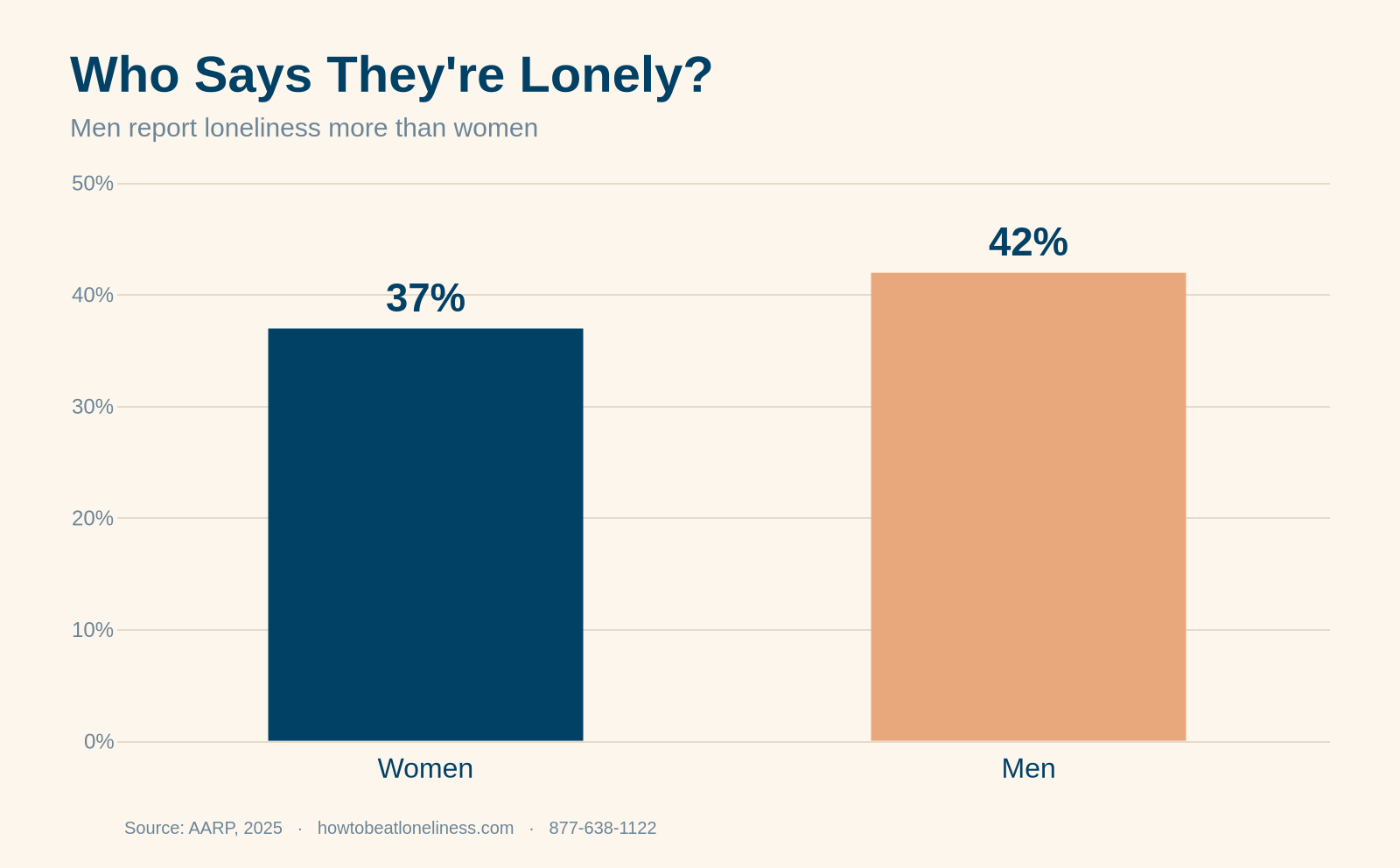
Fact: it’s the opposite. In AARP’s 2025 survey of U.S. adults 45 and older, 42% of men reported feeling lonely, compared with 37% of women. Men are more likely to be the ones quietly carrying it — and less likely to say so out loud.
Myth #6: If It Hasn’t Gone Away By Now, It’s Not Going To
Myth: you’ve been lonely for months, maybe years, so this is just who you are now.
Fact: loneliness doesn’t resolve on its own just by waiting it out — but it also isn’t permanent. The research behind the Surgeon General’s advisory keeps pointing to the same small, repeatable things: a short phone call, a standing plan, someone who checks in. That’s the entire idea behind our own free line — not a fix, just a real person, on an ordinary Tuesday, who picks up.
Important
We are companions, not clinicians. The phone line at How To Beat Loneliness is staffed by real humans who listen — we don’t diagnose, prescribe, or treat. If you’re working through grief, depression, or a mental-health condition, please pair our conversation with a licensed therapist, your doctor, or one of the resources above.
If you’re in immediate danger or thinking about hurting yourself, call or text 988 (US Suicide & Crisis Lifeline).
If any of this sounds familiar, you don’t have to sort it out alone — there are real people ready to listen, starting with our own free line.
— Landon, How To Beat Loneliness
Sources
- World Health Organization — Commission on Social Connection, June 2025
- AARP — Loneliness and Social Connections, 2025
- U.S. Surgeon General — Our Epidemic of Loneliness and Isolation, 2023
- King’s College London — Social media and loneliness (Matthews et al., Annals of the New York Academy of Sciences, 2025)