If you’re in crisis right now — call or text 988 (US Suicide & Crisis Lifeline), available 24/7. This article isn’t a substitute for emergency mental-health support. If you’d just like to talk to a real person about loneliness, our free phone line is open: 877-638-1122.
I’m Sergio. I run How To Beat Loneliness — a free phone line for people who just need to talk. Every year around this time, Jewel tells me the same thing: the calls change the week after the clocks go back. Not because anything in a caller’s life is different — just because the sky outside their window is suddenly, abruptly, dark an hour earlier than the night before — classic loneliness when the clocks fall back. If you want to skip the article and just talk: 877-638-1122.
Loneliness when the clocks fall back: what actually happens on November 1
Daylight saving time ends at 2 a.m. on Sunday, November 1, 2026, when clocks “fall back” one hour. Unlike the slow, week-by-week dimming of autumn, this is a single overnight jump — the sun that set at 6:30 p.m. on Saturday sets around 5:30 p.m. on Sunday. For loneliness when the clocks fall back, that abruptness is the whole problem. Your body and your routine don’t get a gradual runway to adjust; they get a hard cut.
Why the sudden dark hits harder than slow autumn dimming
The National Institute of Mental Health describes a winter pattern of seasonal affective disorder that typically starts in late fall and lasts four to five months — and one of its listed symptoms is “social withdrawal (feeling like ‘hibernating’).” That’s the mechanism behind what Jewel hears on the phones every November: the dark doesn’t just change the thermostat on your mood, it changes how likely you are to leave the house, answer a text, or go to the thing you’d normally go to.
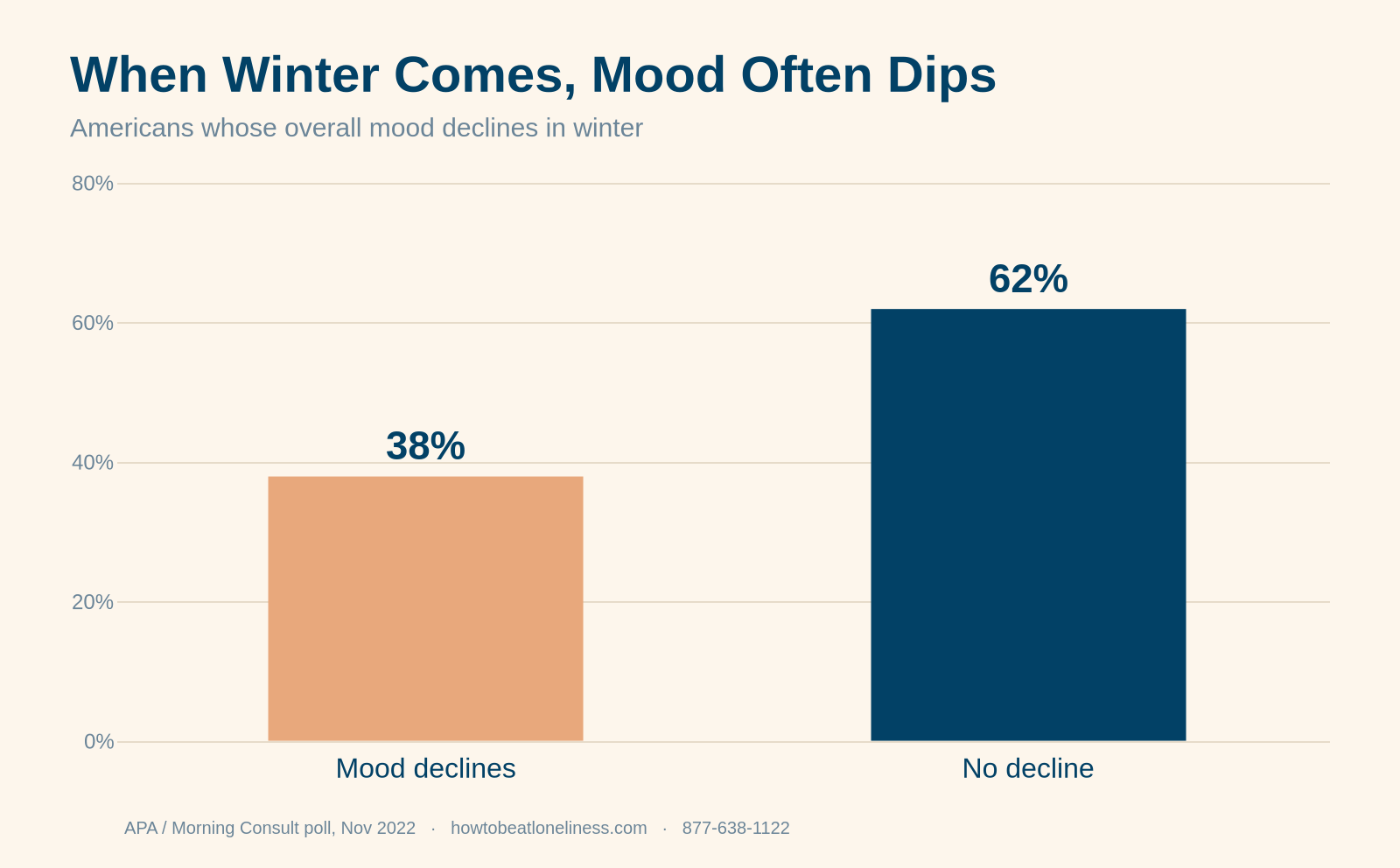
It’s common, not rare. In an American Psychiatric Association poll conducted by Morning Consult, 38% of Americans said their overall mood declines in winter. If you’re one of them, the sudden early dark isn’t a personal failing — it’s a predictable, well-documented seasonal shift, and it’s exactly why the first week of November deserves a plan instead of just white-knuckling it.
Three things that help in the first week
1. Move one thing you already do into daylight. A call, a walk, a grocery run — shift it earlier on your clock for a week or two rather than cutting it. The goal isn’t more activity, it’s keeping the activity you already have in the light.
2. Turn a lamp on before the room goes gray. Waiting until it’s fully dark to turn on a light makes the drop feel steeper than it is. Lighting the room at 4:30 instead of 5:30 is a small, free way to soften the cut.
3. Tell one person the dark is hitting you, out loud. Not a big confession, not a big conversation — just “the early dark is getting to me this week.” Jewel says that single sentence is often what gets someone to actually pick up the phone instead of just thinking about it. Ours is free, every day: 877-638-1122.
Questions people ask us this time of year
Does the time change really affect loneliness, or does it just feel that way? Both are true. The feeling is real, and the mechanism behind it — a sudden drop in evening daylight — is well documented by NIMH as a trigger for seasonal, winter-pattern mood and social withdrawal. For more on what to do when loneliness peaks after dark specifically, see our guide to coping with loneliness at night.
Is there a free number to call if the early dark is getting to me? Yes. Our line is free to call, every day, no script and no upsell: 877-638-1122. If you want a fuller picture of where else to turn, our guide to finding someone to talk to when lonely covers six options side by side.
Important
We are companions, not clinicians. The phone line at How To Beat Loneliness is staffed by real humans who listen — we don’t diagnose, prescribe, or treat. If you’re working through grief, a difficult winter, or a mental-health condition, please pair our conversation with a licensed therapist, your doctor, or one of the resources above.
If you’re in immediate danger or thinking about hurting yourself, call or text 988 (US Suicide & Crisis Lifeline).
Reviewed by Jewel Howard.
— Sergio, How To Beat Loneliness