Short version: New parenthood loneliness statistics show most parents feel isolated, burned out, and short on support — and mothers feel it most of all. If you want a real person to talk to about it today, call 877-638-1122 — free, no script, no upsell.
I’m Landon. I help run How To Beat Loneliness — a free phone line for anyone who just needs to talk, including the new parents who call us more than you’d think. A few numbers crossed my desk this week that explain why.
The short version of the parenthood loneliness statistics: most new parents feel more isolated than they expected to, a third have nobody to lean on, and almost everyone wants more connection than they’re getting. If you’d rather skip the article and just talk, the line is open: 877-638-1122.
Parenthood loneliness statistics: how many feel it
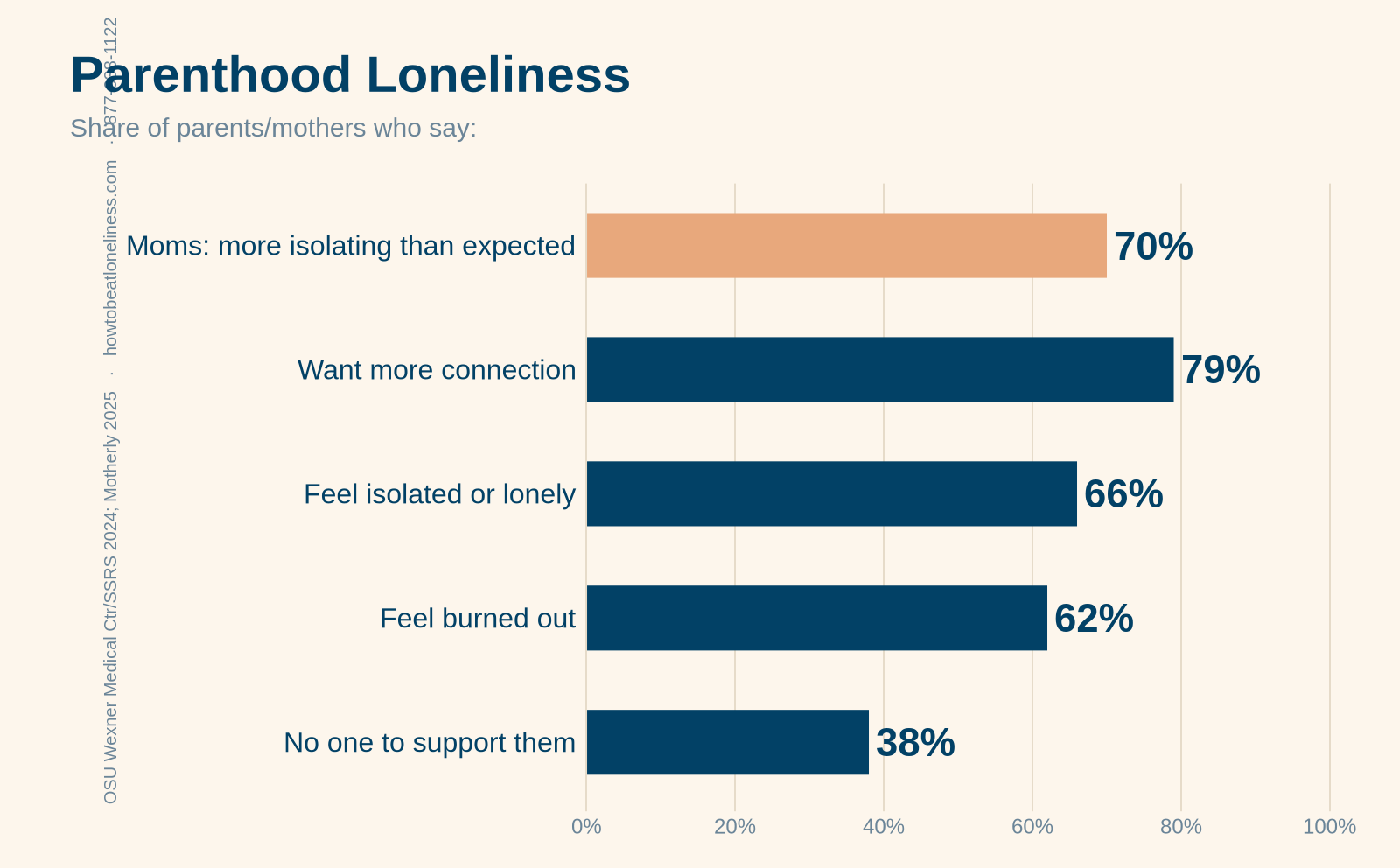
66% of parents say the demands of parenthood sometimes or frequently feel isolating and lonely, according to a 2024 national survey of 1,005 parents conducted for the Ohio State University Wexner Medical Center. That’s two out of every three parents you know — the one at pickup, the one in the group chat who always seems fine.
Burnout and loneliness overlap
62% of the same survey’s respondents said they feel burned out by their parenting responsibilities. Loneliness and burnout tend to arrive together: the exhaustion that keeps a parent from reaching out is the same exhaustion that made reaching out necessary in the first place.
Too many parents have no one to turn to
38% of parents say they have no one to support them in their parenting role at all — not a partner, not a parent, not a friend they can call at 9pm with a crying baby and no idea what to do next.
Most parents want more connection
79% of parents in the same survey said they’d value a way to connect with other parents outside of work and home. The want is there. What’s missing is usually just an easy first step — a call, a group, a familiar face at the same park bench on Tuesdays.
Mothers feel it most of all
Motherly’s 2025 State of Motherhood Survey, with more than 2,000 mothers responding, found that 70% said motherhood is more isolating than they expected it to be going in. Nobody warns you about the isolating part in the baby books.
Why new parents end up isolated
It’s rarely one big thing. Friendships built around a 9-to-5 don’t survive a 2am feeding schedule. Family is often a flight away instead of a drive. The people who’d normally check in assume someone else already did. None of it is anyone’s fault — it’s just how the math of early parenthood tends to work out, and it’s why the parenthood loneliness statistics above keep showing up year after year. It’s often sharper still for a parent doing this alone — see single parent loneliness for what actually helps there.
What actually helps
None of this means anything is wrong with you if you feel it. A new-parent playgroup at the library, a pediatrician’s waiting-room bulletin board, a neighbor you wave to but have never actually talked to — any of those can be the start. So can a free call to a real person who isn’t going to tell you to try yoga. If you want to talk right now, or just hear another adult voice between 2am feedings, that’s what How To Beat Loneliness is for. We’re not therapists and we don’t pretend to be — we’re someone to talk to when you need one.
— Landon, How To Beat Loneliness