If you’re thinking about suicide or self-harm right now, call or text 988, the Suicide & Crisis Lifeline — free, 24/7. Short version: World Mental Health Day loneliness numbers are bigger than most people realize — the World Health Organization says loneliness is linked to roughly 100 deaths every hour, worldwide. If you just want a real conversation today, call 877-638-1122 — free, no script, no upsell.
I’m Sergio, the founder of How To Beat Loneliness. Every October, World Mental Health Day comes around — it’s October 10 this year, with the global theme “Lived Experiences Heard: Real Voices, Real Change” — and loneliness almost never makes the list of things people talk about that day. It should. Here’s what the actual research says, and what you can do about it today at 877-638-1122.
World Mental Health Day loneliness, by the numbers: 1 in 6
One in six people worldwide are affected by loneliness or social disconnection, according to a landmark 2025 report from the WHO Commission on Social Connection — the first global accounting of its kind. The same report links loneliness and social isolation to more than 871,000 deaths a year, or roughly 100 every hour, through pathways like heart disease, stroke, and a weakened immune system. That is not a mood. It is a measurable health risk, and it is why a day built around mental health should have room for it.
It isn’t just an old-age problem
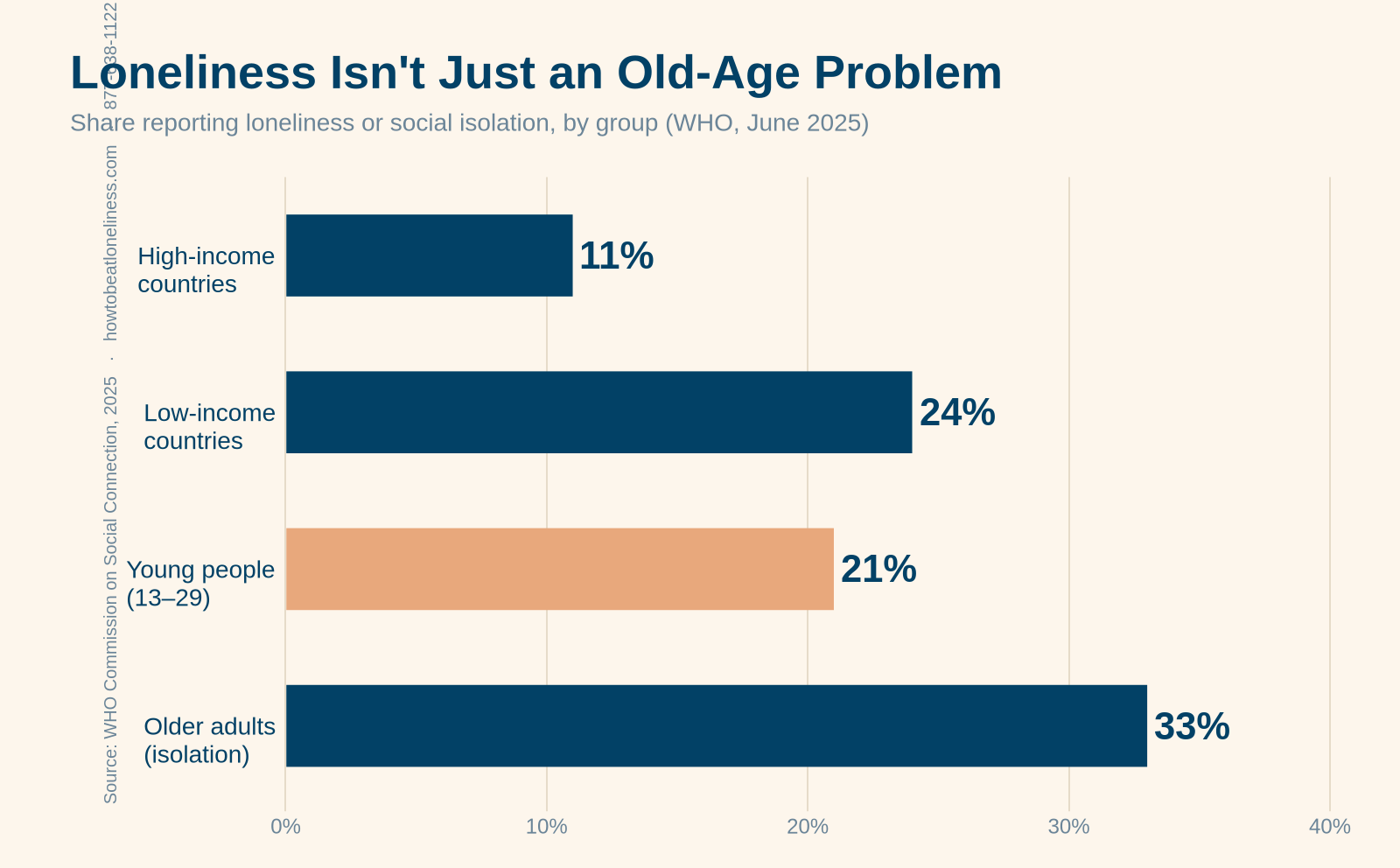
The same WHO report found that 17 to 21% of young people aged 13 to 29 report feeling lonely, with the highest rates among teenagers — on par with, and in some places higher than, rates among older adults. Separately, up to 1 in 3 older adults experience social isolation. We wrote about that surprising overlap in more depth in are young people lonelier than old people. Loneliness doesn’t wait for retirement, and it doesn’t ask how old you are.
Where you live changes the odds
About 24% of people in low-income countries report feeling lonely, roughly twice the 11% rate in high-income countries, the WHO report found. Money doesn’t erase loneliness — plenty of well-off people call our line — but it clearly changes the baseline risk, likely through things like safer neighborhoods, more community infrastructure, and less financial strain on relationships.
What actually helps, starting today
You don’t need a diagnosis or a special occasion to do something about this. If you want a real human conversation right now, that’s exactly what our free line is for — see someone to talk to when lonely for what that actually sounds like. If today is about someone else, a check-in text, a shared activity, or just asking “do you want to talk” covers more ground than people expect.
Important
We are companions, not clinicians. The phone line at How To Beat Loneliness is staffed by real humans who listen — we don’t diagnose, prescribe, or treat. If you’re working through a mental-health condition, please pair our conversation with your doctor, a licensed professional, or the 988 Lifeline in a crisis. Reviewed by Jewel Howard, How To Beat Loneliness.
— Sergio, How To Beat Loneliness