

What is a warmline? It’s a free, confidential phone line you call when you’re lonely, low, or just want a voice — before anything becomes an emergency. How To Beat Loneliness runs a free line like this at 877-638-1122, where a real, caring person answers. If you’re in crisis right now, or thinking of harming yourself, call or text 988 (the U.S. Suicide & Crisis Lifeline) instead — it’s free and answered 24/7.
I’m Sergio, and I started How To Beat Loneliness after noticing a strange gap in how we do support in this country. There’s a lot of help for emergencies, and almost none for the ordinary Tuesday when the house is too quiet. A warmline lives in that gap. Most people have never heard the word — which is a shame, because it describes exactly the thing they’ve been looking for.
What Is a Warmline, in Plain English?
A warmline is a free, confidential phone line for people who are struggling but not in immediate danger. You call because you’re lonely, anxious, grieving, restless, or you simply haven’t spoken to anyone in three days. Nobody asks you to prove it’s bad enough.
The name is deliberate. A hotline implies heat — urgency, sirens, the worst night of your life. A warmline is the temperature below that. As NAMI (the National Alliance on Mental Illness) puts it, warmlines exist to offer emotional support early, in a way that can keep a hard stretch from turning into a crisis at all.
The other defining feature: warmlines are usually peer-run. The person who picks up isn’t a clinician reading from an assessment script. They’re someone who has lived through their own hard season and volunteered to sit with yours. There’s no diagnosis, no file opened on you, no pressure toward any particular outcome.
Warmline vs. Hotline vs. 988 — What’s Actually Different
People mix these up constantly, and the confusion has a real cost: it stops someone from calling anything at all, because they’re afraid they’ll dial the wrong number and waste a stranger’s time on an emergency line. Here’s the honest breakdown.
| Type of line | Cost | Call it when… | Who answers |
|---|---|---|---|
| Warmline | Free | You’re lonely, low, or need to talk — no emergency | A trained peer volunteer |
| How To Beat Loneliness (companion line) | Free | The evening went quiet and you want a real voice | A real person, never AI |
| 988 Suicide & Crisis Lifeline | Free | You’re in danger or thinking of self-harm | A trained crisis counselor, 24/7 |
| Therapy | $$–$$$ | You want ongoing treatment for a condition | A licensed clinician |
Our free line is a close cousin of a warmline rather than a textbook one. We’re a companion line: we don’t do mental-health peer counseling, we do conversation. But the spirit is identical — free, confidential, no crisis required, and a human being on the other end. If you’d rather see the full landscape of numbers, we’ve listed them in is there a hotline for loneliness.
Why So Many People Need a Line Like This
The demand isn’t marginal. In the University of Michigan National Poll on Healthy Aging, the share of adults aged 50–80 who reported a lack of companionship “some of the time” or “often” was 33.9% in 2018, spiked to 41.4% in 2020, and settled back to 33.4% in 2024.
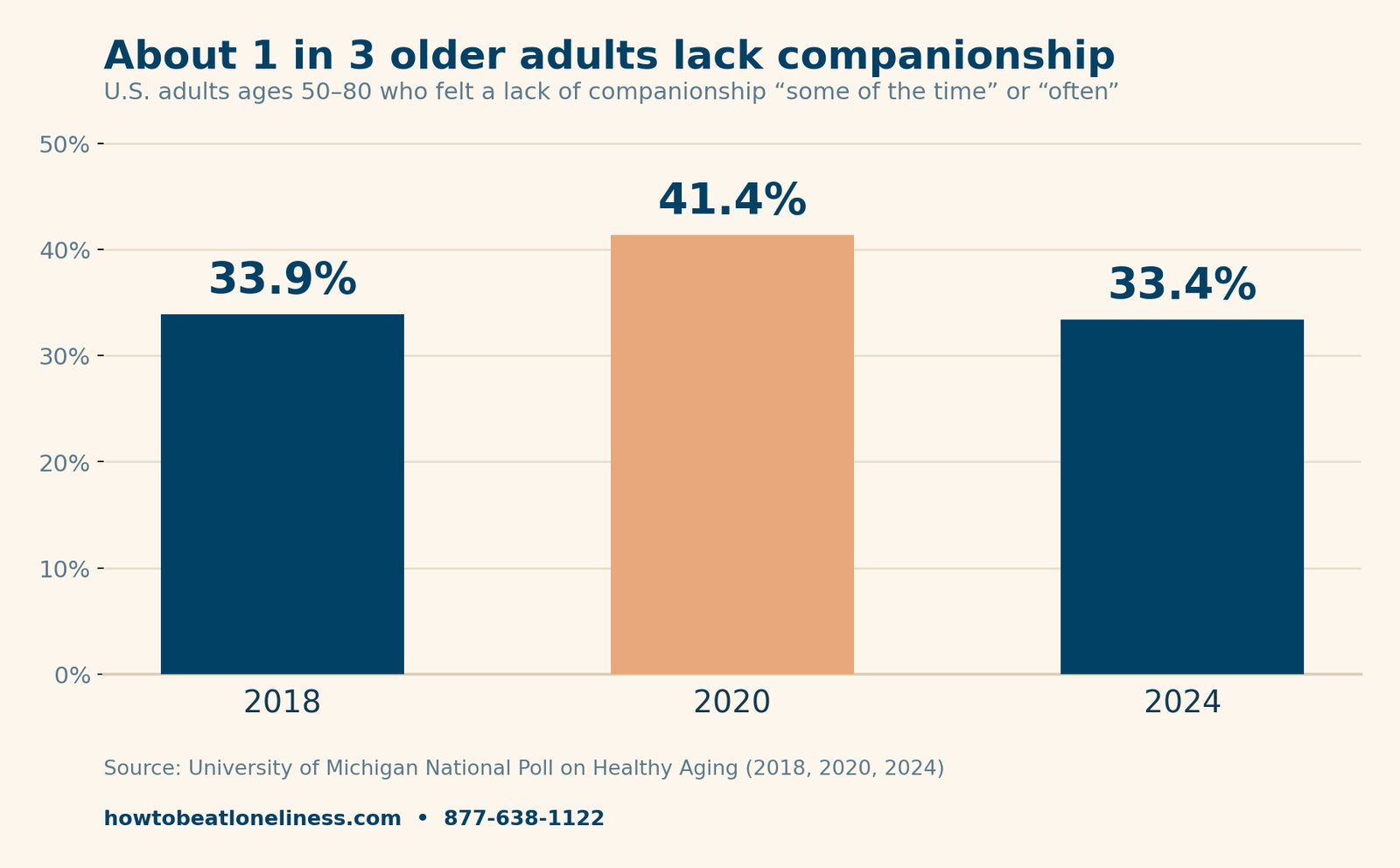
Read that last bar again. A third of older adults, in an ordinary year, with no pandemic to blame. Those people don’t need an ambulance. They need someone to pick up the phone.
The consensus report from the National Academies, published via the National Center for Biotechnology Information, puts hard numbers on the same problem: roughly 24% of community-dwelling adults 65 and older are socially isolated, and 43% of adults over 60 report feeling lonely. And this isn’t only a mood question — the National Institute on Aging links social isolation and loneliness to higher risk of heart disease, depression, and cognitive decline.
6 Things Worth Knowing Before You Call
1. You don’t need a reason
This is the one people can’t quite believe. There’s no threshold, no intake question that decides whether your Tuesday qualifies. “I just wanted to talk to somebody” is a complete and sufficient reason.
2. Peers, not clinicians
Warmline volunteers are people in recovery or with lived experience, which is precisely the point. NAMI describes the model as consensual and non-coercive — nobody is assessing you for admission anywhere.
3. Most run limited hours
This is the practical catch. Because warmlines are volunteer-staffed and often locally funded, many operate evenings or partial days rather than around the clock. Check the hours before you’re depending on them at 3 a.m. — 988 is the number that never closes.
4. Many are state-specific
Plenty of warmlines only take calls from residents of their own state, since that’s who funds them. The national warmline directory and NAMI’s own list are the fastest way to find one near you.
5. It’s confidential
You don’t have to give your last name. Callers tell us this matters more than anything else on the list — the freedom to say the true thing to someone who will never run into you at the grocery store.
6. The first ten seconds are the worst
Almost everyone hesitates before dialing, and almost nobody regrets it afterward. Once someone else is helping carry the conversation, the hard part is already behind you. If reaching out is the wall you keep hitting, we wrote about that too: how to reach out when lonely.
What Happens When You Call Our Free Line
Someone says hello. That’s the whole opening ceremony. There’s no menu, no hold music, no form. You talk about whatever you called about — the move, the diagnosis, the grandkids who don’t call, the fact that nothing is wrong and it’s still hard. When you’re ready to hang up, you hang up, and nobody asks you to book anything.
Real people answer at 877-638-1122. Never an AI, never a script, never a bill. If you want the longer version of why this line exists at all, it’s in our founder’s note about the free loneliness phone line.
Important
We are companions, not clinicians. The free line at How To Beat Loneliness is answered by real people who listen — we don’t diagnose, prescribe, or treat. If what you’re carrying is heavier than loneliness, please pair a conversation with us with care from your doctor or a licensed therapist. And in a crisis, or if you’re thinking about harming yourself, call or text 988 (the U.S. Suicide & Crisis Lifeline) right away — it’s free and answered 24/7.
A Note From the Founder
If you came here looking up what a warmline is, my guess is you weren’t researching vocabulary. You were checking whether a thing like that exists — whether it’s allowed to call someone when nothing is technically wrong. It exists, and it is. Ours is free, and the number doesn’t change: 877-638-1122.
— Sergio, How To Beat Loneliness
Frequently Asked Questions About Warmlines
What is a warmline?
A warmline is a free, confidential phone line for people who are lonely or struggling but not in immediate danger. It’s usually staffed by trained peer volunteers, and you don’t need a crisis or a reason to call. How To Beat Loneliness runs a free companion line at 877-638-1122.
What’s the difference between a warmline and a hotline?
A hotline like 988 is built for emergencies and is answered around the clock by trained crisis counselors. A warmline is for everything below that — loneliness, anxiety, a hard week — and is usually answered by peer volunteers during set hours.
Are warmlines really free?
Yes. Warmlines are free and confidential, and so is our line at 877-638-1122. There’s no fee, no insurance question, and no upsell to a paid service at the end of the call.
Can I call a warmline if I’m just lonely?
Yes — that’s exactly what they’re for. About a third of adults aged 50 to 80 report a lack of companionship, and almost none of them are in crisis. Being lonely is reason enough to pick up the phone.
Warmlines are one kind of answer. For the full set, see our guide to someone to talk to when lonely.
Sources
- NAMI — Warmlines, Helplines, and Crisis Lines Offer the Help You Need When You Need It
- University of Michigan National Poll on Healthy Aging — Loneliness and Health
- National Academies — Social Isolation and Loneliness in Older Adults (Summary)
- National Institute on Aging — Loneliness and Social Isolation: Tips for Staying Connected
- Warmline.org — National Warmline Directory