
By Sergio Savic · Founder, HowToBeatLoneliness · Reviewed by Jewel Howard, Phone Companion · Updated May 2026
The short version: If you or an elderly parent want someone to talk to — not a therapist, not a robot, not a survey — there is a free phone line where a real person answers. The number is 877-638-1122. The call costs nothing. There is no script, no pressure, no sales. You can call once or you can call every Tuesday at 10 a.m. Whatever helps.
Free phone calls for elderly are exactly what they sound like: you dial a U.S. toll-free number and a real, paid human picks up. No therapy. No AI. No charge. This guide walks through how it works, who answers, how to set up a recurring call for a parent, and how it differs from a crisis line, therapy, and the AI chat apps that have started showing up in this space.
What this guide on free phone calls for elderly covers
- What “free phone calls for elderly” actually means in 2026
- How HowToBeatLoneliness works, step by step
- Who answers when you call (and who doesn’t)
- How to set up a regular call for an elderly parent
- How this is different from a crisis line, a therapist, and an AI chatbot
- What the call sounds like (an illustrative example)
- How to start
What “free phone calls for elderly” actually means
There are several services in the United States that offer free phone calls for elderly adults who feel isolated. Some are run by national nonprofits, some by retirement homes, some by churches, and some — like us — by small teams who answer the phone themselves.
What they all have in common is this: you do not pay. There is no copay, no membership, no signup fee. You call a number and a real person says hello. Paid options exist as well, and it helps to know what the money actually buys you before you decide — we laid the two side by side in our guide to companionship services for seniors.
The differences show up in who answers, how long they can talk, and what happens next. Some lines use volunteers who rotate. Some use AI bots dressed up to sound friendly. Some hand you off after five minutes. We don’t do any of those things. (If you want the broader picture on why a real conversation matters, see How to beat loneliness — a gentle guide when it feels heavy.)
How HowToBeatLoneliness works, step by step
- You dial 877-638-1122 from any U.S. phone, mobile or landline. Toll-free.
- A real person picks up. That person works for us, is paid for their time, and was trained for this kind of conversation. Right now, most calls go to our first companion phone agent, working from Boise. As we grow, more humans will join the line; none of them will be AI.
- You talk for as long as you want. There is no five-minute cap. If you call at 9 a.m. and want to chat for forty minutes about your garden, that is what we do.
- You decide what comes next. Some people call once and that is enough. Some want a standing call every week. Some want a daily three-minute check-in. If you’d like to see how the options compare, we wrote a plain rundown of daily check-in calls for seniors. We can set any of these up before you hang up.
- There is no upsell, ever. We don’t sell you supplements, we don’t ask for donations during the call, and we don’t move you onto a paid tier mid-conversation. The free phone calls for elderly are the whole offer.
Who answers — and who doesn’t
Who answers: Real humans. Right now that means our first companion phone agent in Boise, with more agents being hired through our partnership network of churches, retirement homes, and community organizations. Every agent is trained on the same thing: listen first, talk second, and never pretend to be something you are not.
Who does not answer:
- No AI. No chatbot, no voice synthesizer, no GPT-something pretending to be a person. This is a bright line.
- No telemarketers. We never call you back to sell anything.
- No therapists. This is not therapy. We are companions, not clinicians.
- No crisis counselors. If you are in crisis — if you are thinking about harming yourself — please call or text 988 (the U.S. Suicide and Crisis Lifeline). They are trained for that. We are not.
7 things to know before you call
If you are about to dial in for the first time, or you’re setting up free phone calls for elderly parents, these are the seven things callers tell us they wish they’d known on day one.
- You don’t need a reason to call. “I just wanted someone to talk to” is enough.
- You can talk about anything. The weather. A grandchild. A late spouse. Whatever’s on your mind.
- You can hang up anytime. No guilt, no follow-up.
- You can set up a standing weekly call. Same day, same time, same companion.
- You can ask for a short check-in instead. Three minutes works for many people.
- Your name is the only thing we ask for. No surveys, no forms.
- The call is free, forever. No “first call free, then…” — the free phone line is the entire offer.
How to set up a regular call for an elderly parent
If you are reading this for a parent — Mom in another state, Dad who lives alone since your stepmother passed — here is the simplest setup for free phone calls for elderly family members:
- Have a 30-second conversation with them first. Just: “Would you like someone to call you every Tuesday at 10 a.m. to chat? It’s free.” Most older adults say yes when it is framed as a friendly chat, not as “you seem lonely.”
- Call us together the first time, if it helps. You can put your parent on the phone and we’ll take it from there.
- Set a recurring time. Once your parent has a regular slot, we honor it. If we are running late, we let them know.
- Step back. After the first call or two, your parent owns the relationship with their companion.
For families who want a structured daily check-in (a three-minute “how are you today” call every weekday morning), we can do that too. Just ask when you call in. (If the person you’re calling for is a father or husband, you may also want to read Men 45+ are now lonelier than women — AARP’s 2025 data on the gender flip and what helps.)
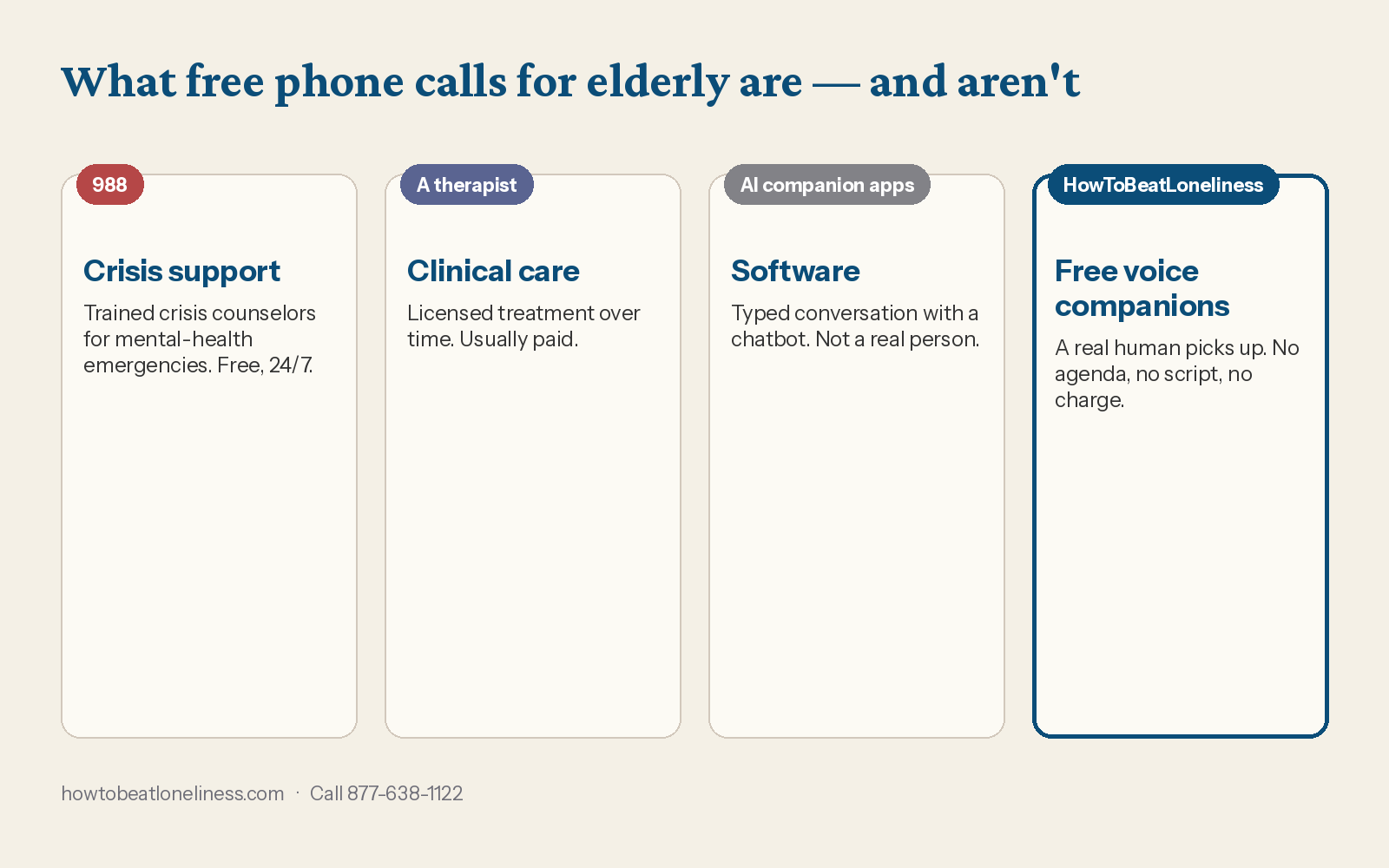
How this differs from a crisis line, therapy, and AI chatbots
| Service | What it is | When it fits |
|---|---|---|
| 988 — Suicide and Crisis Lifeline | Trained counselors for mental-health crises | You are in danger or thinking about harming yourself. Always free, 24/7. |
| A therapist | Licensed clinical care | You want diagnosis, treatment, or long-term mental-health work. |
| AI chat companion apps | Software that imitates a friend | You want to type at a screen anytime. Not a real person. |
| Free phone calls for elderly (us) | A real human, on the phone, for company | You want to talk to a person, no agenda, no script, no charge. |
What the call actually sounds like
The following is an illustrative composite based on the kinds of patterns described in public research on social isolation among older widows — not a single real caller.
Imagine an older woman in her late seventies who lost her husband a couple of years ago and now lives alone in a small house. The first few calls, most of what she wants to talk about is him — what he was like, what he would have said about the price of eggs, the small jokes. A few calls in, the present starts edging in: her tomato plants, her neighbor’s dog, what she’s making for dinner. A couple more calls and she mentions she struck up a small friendship at the library, and they’re going for coffee on Thursday. The calls don’t go away — but they get shorter and lighter.
There’s no protocol that produces that arc. There’s just a person on a phone who picks up at the same time every week.
How to start
The simplest way is to call 877-638-1122 right now. If a real person doesn’t pick up on the first ring, they will within a minute — they call back if anything keeps them. The call is free.
If you would rather hear from us first, leave a voicemail with your name and a good time to call. We will return it within the same day, from the same number.
If you are setting this up for a parent and want to talk through it with one of us before they call, just say so when you ring through.
Can You Set Up Free Calls for a Parent Who Lives Far Away?
Yes. Distance doesn’t matter: any U.S. phone can reach the free line at 877-638-1122, and family in another state can arrange a standing weekly call or a short daily check-in for an elderly parent. The first call can happen together on speakerphone so the voice feels familiar.
This is the most common setup we see: an adult child in one state, a parent in another. Agree on a time with your parent, make the first call together, and the standing slot is kept from there. You don’t need to manage it afterward — your parent owns the relationship, and you can ask them about it the way you’d ask about any friend.
Important
This article is for general information and is not medical or psychological advice. We are not licensed clinicians. If you are struggling with your mental health, please speak with a licensed professional. If you are in a mental-health crisis or thinking about harming yourself, please call or text 988 (the U.S. Suicide and Crisis Lifeline) — trained, free, and available 24 hours a day.
FAQ: free phone calls for elderly
Are free phone calls for elderly really free?
Yes. There is no fee, no copay, no donation prompt, no membership. The toll-free number does not cost you airtime either. We fund the free line through a separate, paid coaching tier that adult children sometimes use; the two sides of the business do not mix.
Who is on the other end of the phone?
A trained, paid human. Right now, most calls go to our first companion phone agent in Boise. None of our companions are AI, ever.
How long can I talk?
As long as you want. There is no cap on a single call.
What if I just want a quick daily check-in?
We do that too. Many adult children set up a three-minute weekday check-in for an elderly parent.
Are you a therapy service?
No. We are companions, not clinicians. If something on the call sounds like it needs a professional, we will gently say so and help find the right person.
What if I am in a mental-health crisis?
Please call or text 988 — the U.S. Suicide and Crisis Lifeline. They are trained, free, and available 24/7.
How do I cancel or pause my standing call?
Just tell us during a call, or leave a voicemail saying so. We pause it the same day.
A note from our call agent
If you read this far and you are not sure whether to call, here is what I would say: just dial. Hang up if it feels wrong. Most people don’t hang up. Most people exhale and say, “I didn’t know what to expect.”
That’s normal. Call 877-638-1122.
— Jewel
Frequently asked questions about free phone calls for the elderly
Are there free phone calls for lonely elderly people?
Yes — How To Beat Loneliness offers free calls where a real person talks with lonely seniors: 877-638-1122, no fee and no sign-up.
Who answers the calls?
Real, trained humans — not AI and not telemarketers — there simply to listen and keep company.
Is this a medical or crisis service?
No. It is friendly companionship, not therapy or emergency care. In a crisis, call or text 988.
How does an older person start?
Just call 877-638-1122, or a family member can call together the first time to help them get comfortable.
Related reading: check-in calls for seniors — 7 caring options · who to call when you’re lonely
How this article was written
Written by Sergio Savic. Reviewed by Jewel Howard, our first phone companion. Drafted with research assistance from the HowToBeatLoneliness content team, including AI-assisted outlining and editing. Final text, examples, and claims were reviewed and approved by the named reviewer. The composite example in the “What the call actually sounds like” section is illustrative — drawn from public research on social isolation in older widows — not a single real caller; we never publish identifying details of any caller. Statistics cited in this article are sourced from AARP’s 2025 “Disconnected” study and the 2023 U.S. Surgeon General’s Advisory on Loneliness and Isolation. Images are licensed via Canva Pro or owned by HowToBeatLoneliness; photographs of identified people are published with their permission.
Have a correction? Email corrections@howtobeatloneliness.com.