
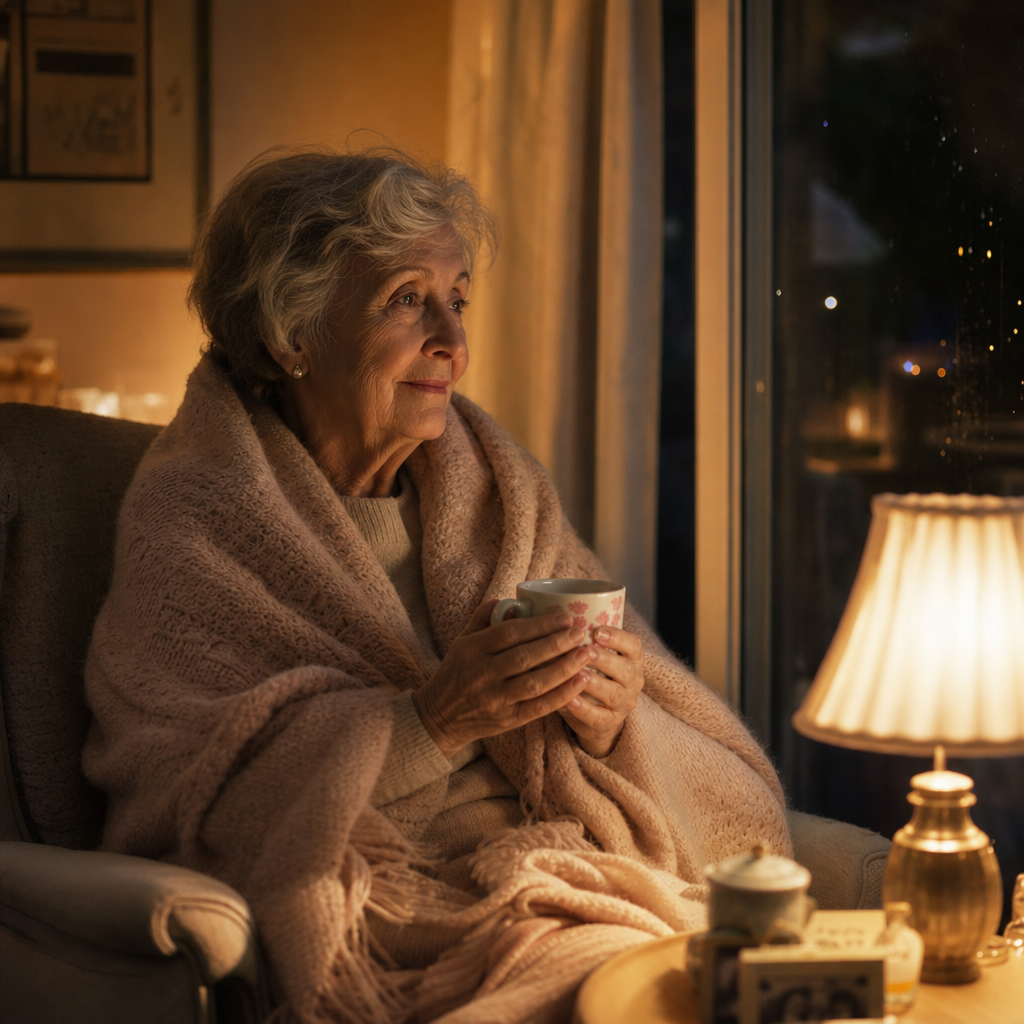
The short version: loneliness and sleep are tied together in the research — lonely older adults are about 75% more likely to sleep badly, and the problem is broken, restless sleep rather than short sleep. If tonight is one of those nights, How To Beat Loneliness runs a free phone line at 877-638-1122. A real person picks up, and a ten-minute conversation before bed is a surprisingly good sleep aid.
I’m Jewel. I answer the free loneliness line at How To Beat Loneliness, and a lot of my calls come in after ten at night. People apologize for the hour. They tell me they’ve been lying there for two hours, then got up, then made tea, then stared at the ceiling some more. I used to think that was just what nights are like when you live alone. Then I went and read the research on loneliness and sleep, and it turns out my callers are not imagining it. Here are the facts, in plain English, and what you can do with them. The number, if you’d rather just call, is 877-638-1122.
Five things the research says about loneliness and sleep
1. Lonely older adults are 75% more likely to sleep badly
A 2022 review in Geriatric Nursing pulled together 16 studies covering 23,485 older adults. When the authors combined the results, lonely older adults had 1.75 times the odds of poor sleep quality compared with people who were not lonely. The authors’ conclusion was blunt: if you want to fix an older person’s sleep, reducing their loneliness should be part of the plan.
2. It’s broken sleep, not short sleep
This one surprised me. A 2020 meta-analysis of 27 studies found loneliness was linked to sleep disturbance — waking up, tossing, feeling unrested — but not to how many hours people slept. Lonely people aren’t necessarily sleeping less. They’re sleeping worse. That matches what I hear: “I was in bed for nine hours and I feel like I never slept.”
3. Even people who are never alone sleep worse when they feel lonely
Researchers at the University of Chicago studied 95 members of a Hutterite community in South Dakota — people who live, eat, and work communally and are almost never by themselves. They wore sleep monitors. The lonelier a person felt, the more fragmented their sleep was, even after accounting for age, sex, weight, sleep apnea risk, and mood. Nobody in that study was isolated. The feeling was enough.
4. The next day pays for it
In a King’s College London study of more than 2,000 British young adults, lonelier people were 24% more likely to feel tired and have trouble concentrating during the day. The researchers titled their paper “Sleeping with one eye open,” and that phrase is the best description I’ve found for what my callers describe. (Yes, the study was on young adults. The pattern shows up at every age the researchers have looked at.)
5. It runs in a loop
The 2020 meta-analysis authors were careful to say that which comes first over time is still unclear. From the phone, it looks like both. A lonely evening makes for a restless night; a restless night makes you too tired and too flat to call anyone the next day; and so the next evening is lonely too. The loop is the enemy. You don’t have to fix all of it — you just have to break it somewhere.
| Study | Who they looked at | What they found about loneliness and sleep |
|---|---|---|
| Geriatric Nursing, 2022 meta-analysis | 23,485 older adults across 16 studies | Lonely older adults had 1.75× the odds of poor sleep quality |
| Health Psychology Open, 2020 meta-analysis | 27 studies, all ages | Loneliness linked to disturbed sleep (r = .28), not to shorter sleep |
| Sleep, 2011 (University of Chicago) | 95 Hutterite adults living communally | Higher loneliness = more fragmented sleep on wrist monitors, even with no isolation |
| Psychological Medicine, 2017 (King’s College London) | 2,232 young adults in England and Wales | Lonelier people 24% more likely to be tired and unfocused the next day |
Sources are linked in full at the bottom of this article.
Why a lonely brain won’t switch off
The King’s College researchers noticed something telling: the link between loneliness and poor sleep was strongest in people who had been exposed to violence in the past. Their explanation is that sleep problems in lonely people are about feeling unsafe. For most of human history, sleeping alone meant sleeping unguarded. Part of your brain still believes that. When you feel cut off from other people, it keeps one eye open all night, whether or not there’s anything to watch for.
That’s why the fix isn’t a better pillow. It’s the feeling, going into the night, that somebody is out there and knows you exist. Which is also why I get so many calls at 10:30 p.m.
What actually helps you sleep when you’re lonely
Put a voice at the end of the day. A short, warm conversation in the hour before bed tells the watchful part of your brain it can stand down. It can be a friend, a sibling, or the free line at 877-638-1122 — we’re happy to be the last voice you hear before you turn the light off. Our page on feeling lonely at night has more on the late hours specifically.
Don’t fight the 2 a.m. wake-up in bed. The National Institute on Aging’s advice is simple: if you can’t fall back asleep after a while, get up and do something quiet in dim light until you’re sleepy. Callers who use our line at 2 a.m. often say the same thing — twenty minutes of ordinary talk, and the ceiling stops being so interesting. We wrote a whole playbook on how to cope with loneliness at night.
Keep the daytime side of the loop moving. One phone call, one errand with a human at the other end, one “how are you” that you actually wait for the answer to. The research says the sleep problem is a loneliness problem wearing pajamas, so the daytime connection counts double. The bigger guide on how to beat loneliness is where to start, and if you don’t have anyone to call, someone to talk to when lonely is the shortest path to a voice.
Tell your doctor if it’s every night. Loneliness makes sleep worse, but so do sleep apnea, pain, some medications, and depression. If you’re waking up unrested most nights, bring it up at your next appointment — and yes, you can bring up the loneliness too. Here’s how to talk to your doctor about loneliness without feeling silly about it.
Free. A real person answers. Any hour is a fine hour.
Important
We are companions, not clinicians. This article summarizes published research on loneliness and sleep; it is not medical advice. Ongoing insomnia, loud snoring with pauses in breathing, or sleep problems alongside low mood deserve a conversation with your doctor. If you are having thoughts of ending your life, call or text 988 in the U.S. right now. Our line is for the ordinary, lonely, can’t-switch-off kind of night.
Frequently asked questions
Does loneliness cause insomnia?
Loneliness is strongly linked to poor, broken sleep. A 2022 meta-analysis of 23,485 older adults found lonely people had 1.75 times the odds of poor sleep quality. Researchers have not yet settled which comes first over time, and other causes such as sleep apnea, pain, and depression can be involved too.
Why do I wake up at night when I feel lonely?
Researchers believe lonely people sleep as if they are unguarded. A 2017 King’s College London study found the link between loneliness and poor sleep was strongest in people who had experienced violence, which supports the idea that a lonely brain stays alert through the night because it feels unsafe.
Do lonely people sleep fewer hours?
Usually not. A 2020 meta-analysis of 27 studies found loneliness was linked to disturbed, unrefreshing sleep but not to shorter sleep. Lonely people tend to spend a normal amount of time in bed and wake up feeling as if they never slept.
Is there someone I can call at night when I cannot sleep and feel lonely?
Yes. How To Beat Loneliness answers a free phone line at 877-638-1122 where a real person talks with you. Many callers use it in the hour before bed or during a 2 a.m. wake-up. If you are in crisis, call or text 988 first.
— Jewel, How To Beat Loneliness
Sources
- The association between loneliness and sleep quality among older adults: A systematic review and meta-analysis, Geriatric Nursing (2022)
- Griffin et al., Loneliness and sleep: A systematic review and meta-analysis, Health Psychology Open (2020)
- Kurina et al., Loneliness Is Associated with Sleep Fragmentation in a Communal Society, Sleep (2011)
- King’s College London, Loneliness in young adults linked to poor sleep quality (2017), on Matthews et al., Psychological Medicine
- National Institute on Aging, A Good Night’s Sleep