Short version: A new September 2026 study from Tulane University found that loneliness and social isolation cost nearly six disease-free years — with men losing almost twice as many years of mental health as women. It’s one more reminder that reaching out isn’t optional; it’s vital. Call us free at 877-638-1122 — we’re companions, we listen, and we’re here.
I’m Sergio. I started How To Beat Loneliness because I’d seen too many people slip into isolation in ways they couldn’t pull out of alone — and I’d felt it myself. So when a new study comes out putting a number on what how many years does loneliness take off your life, I pay attention.
And this one’s a wake-up call. Published in September 2026 in Nature Communications, Tulane University’s Lu Qi and team tracked 277,489 U.S. adults ages 40–69 — all initially free of seven major chronic conditions — and measured how loneliness and isolation affected disease-free life expectancy.
The answer: nearly six years.
How Many Years Does Loneliness Cost?
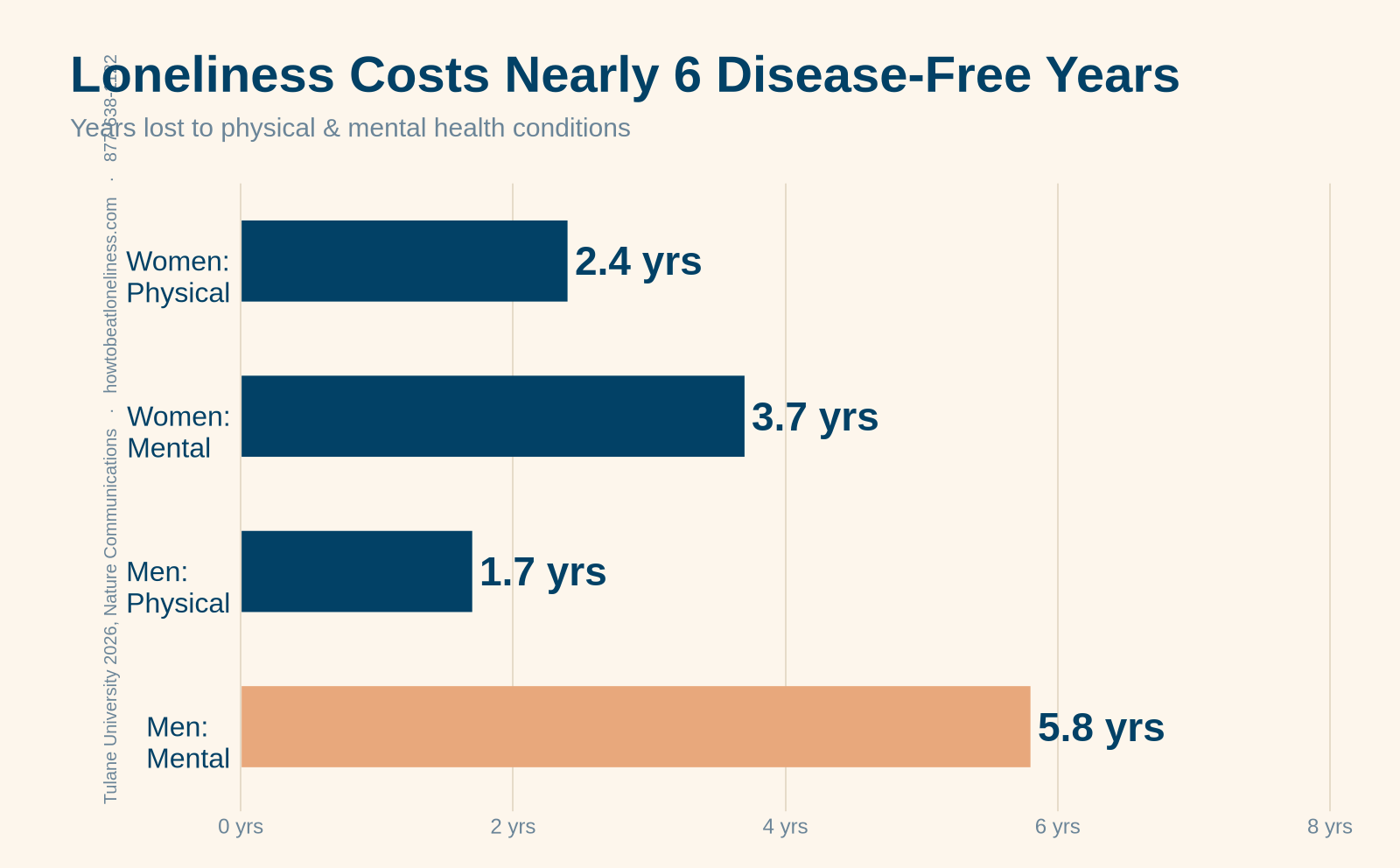
Here’s what the Tulane study found. People dealing with both loneliness and social isolation lost, on average, close to six disease-free years. The study broke it down by gender, and the results show something we’re only starting to understand:
- Women lost 2.4 years free from physical disease and 3.7 years free from mental disorders.
- Men lost 1.7 years free from physical disease and 5.8 years free from mental disorders — almost double what women lost to mental health conditions.
That gap matters. Men report loneliness at higher rates than women (42% vs 37%, per AARP’s 2025 survey), and this study suggests the mental-health toll lands harder on men, too.
What “Disease-Free Years” Actually Means
The study wasn’t measuring lifespan — it was tracking disease-free life expectancy from age 50. That’s how many years you’re expected to live without a diagnosis of diabetes, heart disease, lung disease, dementia, cancer, depression, or anxiety.
Losing six of those years doesn’t mean you die six years earlier. It means six fewer years of feeling well, staying independent, and living without chronic illness. Those are the years that matter — the ones where you’re still yourself.
And here’s the part that gives me hope: “A healthier lifestyle measurably narrowed the loss of disease-free years linked to social isolation,” the researchers found. Lifestyle changes didn’t erase the mental-health risks from loneliness alone, but they helped.
Why This Number Matters More Than Statistics Usually Do
We’ve known for years that loneliness is bad for you. The U.S. Surgeon General’s 2023 advisory laid it out: loneliness raises heart disease risk by 29%, stroke by 32%, and dementia by 50%. The mortality risk is comparable to smoking up to 15 cigarettes a day.
But “raises your risk” is abstract. Six years is concrete.
Six years is watching your grandkids grow up. Six years is retiring healthy enough to travel. Six years is the difference between living well and spending a decade managing conditions that didn’t have to start when they did.
What You Can Do This Week
If you’re reading this and you’re lonely, the most important thing I can tell you is: one phone call today is worth more than six perfect plans you never start. Call us at 877-638-1122. We’re free. We’re human. We listen. No judgment, no scripts, just a real person who knows what it’s like to need to talk and have nowhere to go.
If you’re reading this because you’re worried about someone else — a parent, a neighbor, a friend who’s been quiet — hand them that number. Tell them you saw it and thought of them. That’s not intrusive; it’s lifesaving.
Feeling lonely right now? You can call someone today — free.
Call 877-638-1122We’re real people. We’re here. It’s completely free.
Sources
- Lu Qi et al., Nature Communications (2026). DOI: 10.1038/s41467-026-74498-8
- U.S. Surgeon General’s Advisory on Our Epidemic of Loneliness and Isolation (2023)
- AARP Disconnected: The Escalating Challenge of Loneliness Among Adults 45-Plus (2025)
— Sergio, How To Beat Loneliness