
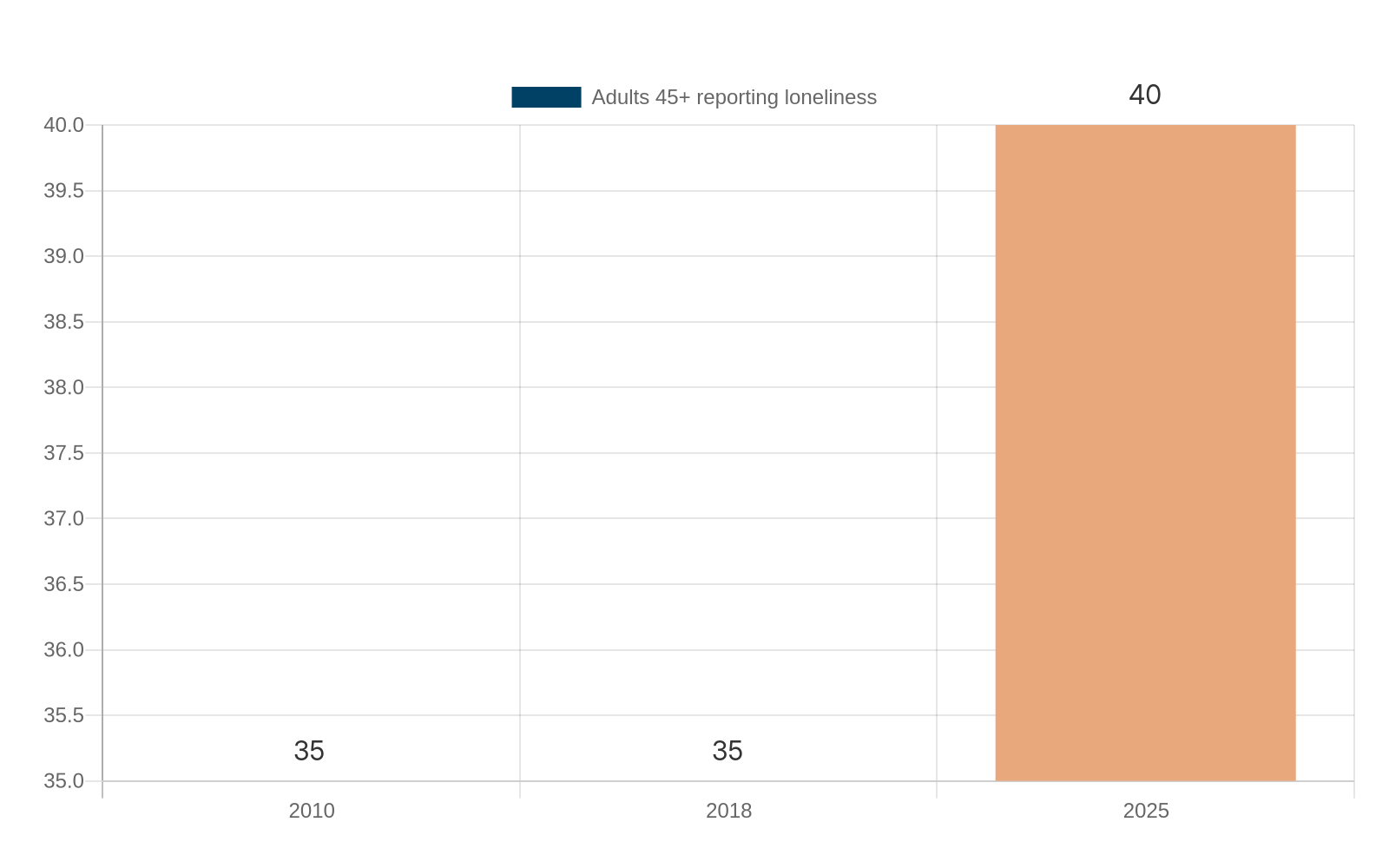
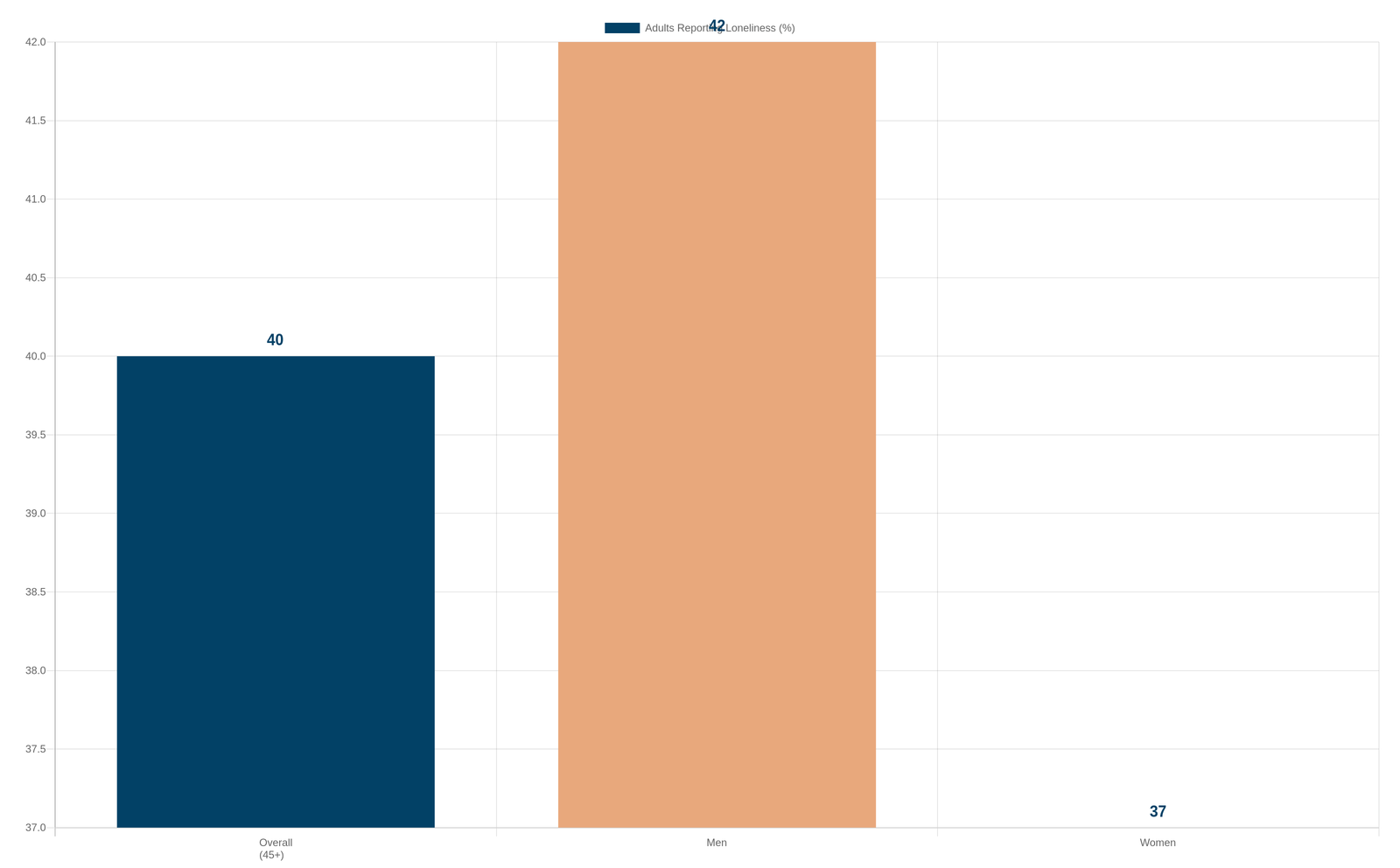
Short version: How common is loneliness in older adults? AARP’s 2025 study found 40% of adults 45 and older report being lonely — up from 35% in 2010 and 2018. Men report higher rates (42%) than women (37%), and lonely adults spend nearly 2 more hours alone each day.
If you’re one of them, our free line is open: 877-638-1122. A real person picks up.
I talk to people on our free loneliness line every day, and one question comes up over and over: Am I the only one who feels this way?
No. You’re not. Here are the numbers that show how common loneliness in older adults really is.
40% of adults 45+ are lonely — and the rate is rising
40%. That’s the share of U.S. adults aged 45 and older who reported being lonely in AARP’s 2025 study of 3,276 people. The survey, conducted in partnership with Ipsos in August 2025, found loneliness has climbed from 35% in both 2010 and 2018.
If you’re 45 or older, two out of every five people in your age group feel the same way you do. That’s not rare. That’s common.
42% of men vs. 37% of women
42% of men aged 45+ report loneliness, compared to 37% of women in the same age range. The AARP study found this gender gap reverses the 2018 findings, when men and women reported equal rates.
The reasons aren’t fully mapped, but men in this age range are less likely to maintain close friendships after retirement, and they’re less likely to reach out when they’re struggling.
7.3 hours alone per day
7.3 hours. That’s how much time lonely adults aged 45+ spend alone each day on average, according to the AARP findings. The overall average for adults 45+ is 5.6 hours — nearly two hours less.
Those extra hours add up. Over a week, that’s 14 additional hours of solitude. Over a year, it’s more than 600 hours — the equivalent of 25 full days alone.
1 in 4 of adults 65+ live alone
26% of adults aged 65 and older live in one-person households, according to Pew Research Center’s December 2025 analysis of U.S. Census data. Living alone doesn’t automatically mean loneliness — but it’s a risk factor the National Institute on Aging lists explicitly.
When you live alone, the structure that once prompted daily conversation — a partner asking how your day went, kids needing dinner — disappears. The silence fills in.
Nearly half have limited social resources
Nearly 50% of lonely adults in the AARP study reported having limited social resources and a desire for stronger connections. They’re not choosing solitude. They want connection and don’t know where to find it.
That’s the group our free line was built for: 877-638-1122. You don’t need a crisis. You just need someone to talk to.
Loneliness peaks at the younger end of 45+
The AARP study found that adults at the younger end of the 45+ spectrum — those in their late 40s and 50s — experience the highest loneliness rates. Loneliness decreases with age, education level, and household income.
This challenges the stereotype that loneliness only affects the very old. People in their 40s and 50s — still working, still raising families — are feeling it acutely.
What the numbers mean for you
These aren’t just statistics. They’re millions of people — your neighbors, your siblings, maybe you — who spend too many hours alone and want that to change.
The numbers tell us how common loneliness in older adults is, and they tell us something else: you’re not broken for feeling this way. The problem isn’t you. The problem is isolation, and there are real ways to address it.
One of those ways is our free loneliness line. We’re companions, not clinicians. You can call just to talk: 877-638-1122.
— Jewel, How To Beat Loneliness