
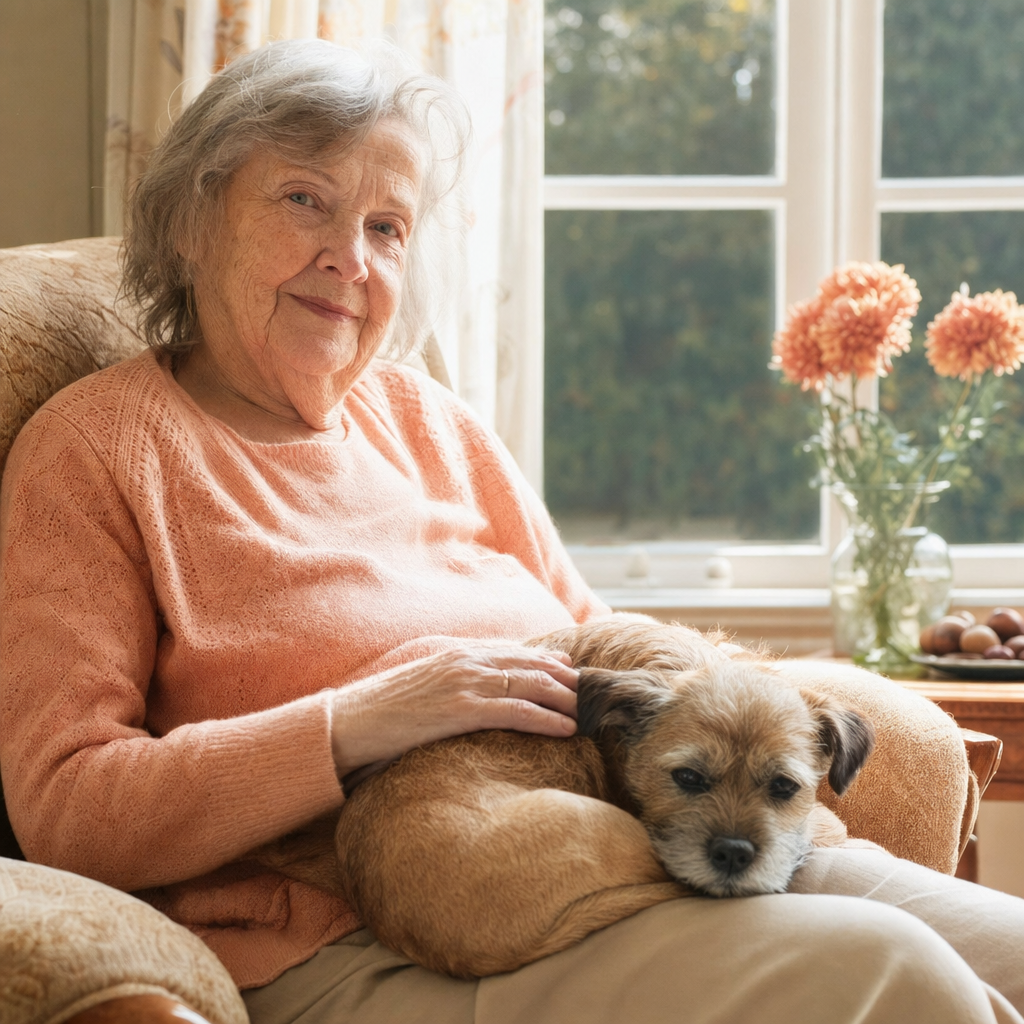
I’m Jewel, and I answer the free line at How To Beat Loneliness. Callers ask me a version of this question all the time — do pets help with loneliness, or did I just imagine that the house feels easier since the dog showed up? You didn’t imagine it. If you’ve landed here because your pet is gone rather than newly arrived, we wrote about that separately — being lonely after losing a pet is its own kind of quiet. And if you’d rather talk it through with a real person, the line is free — 877-638-1122.
The short version: do pets help with loneliness? Yes — the research says pets measurably help, especially for people over 50 and especially for people living alone. Below are seven facts, every one with a source — plus the one honest thing a pet can’t do.
Do Pets Help With Loneliness? Here’s What the Research Says
The question do pets help with loneliness has actually been studied, polled, and measured. The numbers below come from the University of Michigan’s National Poll on Healthy Aging, the Human Animal Bond Research Institute (HABRI), and research highlighted by the National Council on Aging. No invented stats, no wishful thinking — just what the data actually shows.
1. More than half of older adults already share their home with a pet
According to the University of Michigan National Poll on Healthy Aging, 57% of adults aged 50 to 80 have at least one pet — up from 55% in 2018. If you’re thinking about getting one, you’d be in very good company.
2. Four in five pet owners say their pet makes them feel less lonely
A national survey by HABRI and Mars Petcare found that 80% of pet owners say their pet makes them feel less lonely. And 85% of people — owners and non-owners alike — believe interacting with a companion animal can help reduce loneliness.
3. Living alone? A pet cuts the odds of feeling lonely by about a third
This one matters most for the people who call us. In a study of more than 800 older adults living alone, cited in HABRI’s research on social isolation, pet owners were 36% less likely to report loneliness than non-owners. Same houses, same quiet evenings — different odds.
4. Pets are social bridges, not just company at home
In the Michigan poll, 70% of pet owners over 50 said their pet connects them with other people. The HABRI survey backs it up — 54% said their pet helps them connect, and 51% said their pet helps them feel less shy. A dog turns a silent walk into three small conversations.

5. A pet gives the day a purpose — and that number is growing
83% of pet owners aged 50 to 80 say their pet gives them a sense of purpose — up from 73% in 2018, per the Michigan poll. Somebody needs breakfast at seven. Somebody needs a walk at four. That structure is quietly powerful on the days when nothing else is asking anything of you.
6. The calm is physical, not imaginary
63% of older pet owners say their pet helps reduce stress. And research highlighted by the National Council on Aging, citing the National Institutes of Health, links time with pets to lower blood pressure and reduced stress hormones. Petting the cat isn’t a small thing — your body registers it.
7. The honest one: a pet costs real money — and it isn’t a cure
The same Michigan poll flagged that pet costs genuinely strain some older adults’ budgets — food, vet bills, the surprise ones. And even in a country full of pets, about one in three older adults still reports lacking companionship. A pet helps with loneliness. It doesn’t finish the job alone.
Should You Get a Pet to Help With Loneliness?
If the facts above have you eyeing the shelter website, a few honest pointers from callers who’ve done it: match the animal to your energy and your budget. A senior cat or a calm older dog fits a quiet routine far better than a puppy with Olympic-level energy. Many shelters reduce adoption fees for older adults, and fostering first is a low-commitment way to see how a pet actually changes your days before you sign up for fifteen years of them.
One more gentle nudge — the people who ask me do pets help with loneliness usually aren’t really asking about pets. They’re asking whether the quiet can change. It can. Sometimes it starts with four paws, and sometimes it starts with one phone call.
What a Pet Can’t Do
Here’s the part I tell callers, gently: the dog can’t ask how your day was. The answer to do pets help with loneliness is a real yes — but the research keeps landing on the same pairing. Pets work best alongside human connection, not instead of it.
So keep the cat. Walk the dog. And add one human thread — a hobby that puts you near people, a call to an old friend, or ten minutes on the phone with someone who genuinely wants to hear about your beagle. If you’re curious what that’s like, I wrote about what happens when you call a loneliness line — no script, no fee, just a real person.
A Note From Our Call Agent
So — do pets help with loneliness? You’ve seen the numbers, and you’ve maybe felt the answer in a purr on your lap. If you’ve got a warm animal beside you right now, I’m glad — truly. And if the house is still too quiet anyway, that’s not a failure, it’s just the part a pet can’t reach. Call us when you’d like a human voice in the mix. We’d love to hear the dog barking in the background.
— Jewel, How To Beat Loneliness
Frequently asked questions about pets and loneliness
Do pets really help with loneliness?
Yes, for many people. Pets offer companionship, routine, touch, and a reason to get up; surveys find most older pet owners say their animal helps them feel less lonely.
What kind of pet is best for a lonely person?
The best pet matches your energy and mobility — dogs add walks and social contact, while cats and small animals are lower-maintenance. Fit the animal to your life, not the other way around.
Can a pet replace human connection?
No. A pet eases loneliness but is not a substitute for people. Pair the companionship of an animal with regular human contact.
What if I cannot keep a pet but feel lonely?
You can still talk to a real person for free — How To Beat Loneliness answers at 877-638-1122, any day.
Sources
- University of Michigan National Poll on Healthy Aging — Pets Can Help Older Adults’ Health and Well-Being, but May Strain Budgets Too
- HABRI & Mars Petcare — New Effort Highlights Potential Impact of Pets on Social Isolation and Loneliness
- HABRI — Research on Social Isolation & Loneliness
- National Council on Aging — 4 Ways Pets Boost Our Physical Health as We Age
- National Poll on Healthy Aging — Findings on Loneliness Among Older Adults