
Short version: the research on technology and loneliness is more mixed than the headlines suggest — most adults 45+ now use some kind of tech to stay in touch, but for people who are already lonely it doesn’t reliably close the gap, and a real share say it makes things worse. If you’d rather skip straight to a real voice, call 877-638-1122 — free, no script, no upsell.
I’m Sergio. I run How To Beat Loneliness — a free phone line for people who just need to talk. A new AARP survey landed on my desk this week with numbers on technology and loneliness that didn’t match the story I expected going in, so I pulled the real figures instead of the headline. If you want to skip the article and just talk: 877-638-1122.
What AARP’s Newest Numbers Show About Technology and Loneliness
These five figures come from AARP’s survey of 3,276 U.S. adults 45 and older, fielded in August 2025 and updated this October — not from guesswork.
40% of adults 45+ are lonely — up from 35%
AARP’s latest numbers put loneliness among U.S. adults 45 and older at 40%, up from 35% in both 2010 and 2018. That’s the backdrop every other number below sits inside — loneliness isn’t shrinking, and it’s climbing at the same time more people than ever are carrying a smartphone.
57% say technology helps them stay connected
A majority of adults 45+ — 57% — say they use technology to stay connected to other people, and that group is more likely to report having close friends than people who don’t use it that way. For someone already socially engaged, a text thread or a video call genuinely substitutes for some in-person contact.
24% of lonely adults say technology actually shrinks their circle
The same survey found that 24% of lonely adults — nearly one in four — say technology leads to fewer friendships, not more. Technology seems to amplify whatever direction someone is already moving in: it helps people add to a circle that already exists, and it can quietly replace effort for people whose circle is already thin.

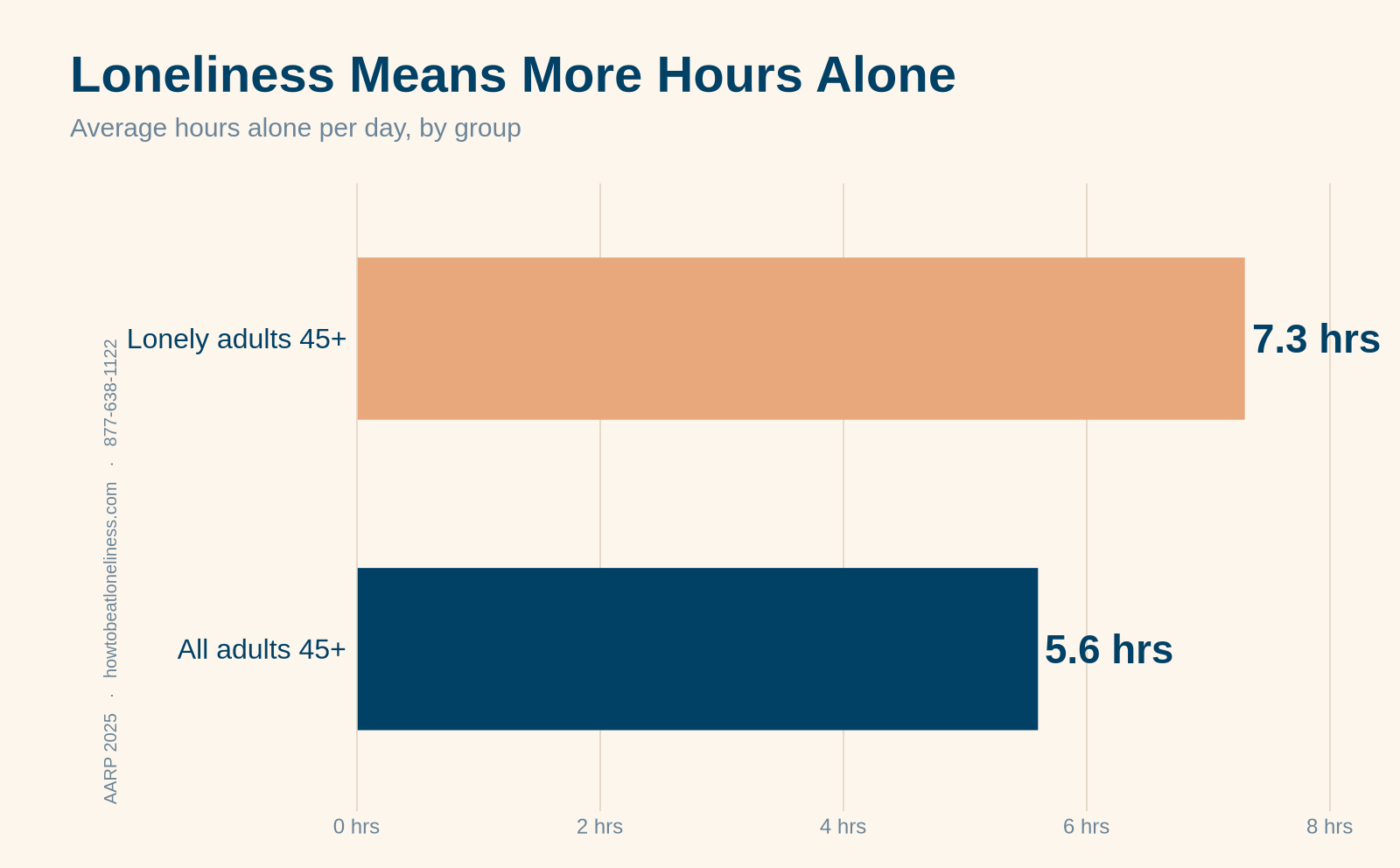
Lonely adults spend 7.3 hours alone a day — 1.7 more than everyone else
Lonely adults 45+ spend about 7.3 hours alone on an average day, compared with 5.6 hours for the full 45+ population. That’s roughly two extra hours a day that a phone, a feed, or a streaming queue is being asked to fill — and the numbers above suggest it mostly isn’t.
Nearly 1 in 4 lonely adults are open to AI companionship
About a quarter of lonely adults say they’re interested in emerging AI technologies for companionship. Interest and benefit aren’t the same thing, though — a separate Stanford-linked study found AI companion apps can make loneliness worse for heavy users with small support networks. We’ve looked at that trade-off in full in Can an AI Companion Make Your Loneliness Worse?, and at the honest case for AI companions for seniors when they’re used carefully.
So Does Technology Help or Hurt?
Put the five numbers together and a pattern holds: technology helps people who already have people. It rarely builds a new connection from nothing for someone who’s already isolated — and for a real share of lonely adults, it quietly becomes the thing standing in place of a phone call that never happens. None of that makes a phone, a tablet, or even an AI app bad. It just means the device isn’t the fix by itself.
What Actually Works Instead
If you’re lonely and a screen hasn’t closed the gap, the research above points back to the oldest fix there is: a real conversation with a real person, on a schedule you can count on. That’s the whole idea behind our free line — no app, no algorithm deciding who you talk to, just someone who picks up. Call 877-638-1122 any time, or if you want to see every option first, here’s everywhere you can turn to talk to someone.
— Sergio, How To Beat Loneliness