
Short version: A new nine-year study of 10,823 adults found that loneliness swings and heart risk go together — people whose loneliness came and went had a higher heart-disease risk than people whose loneliness stayed constantly high. If that sounds like your pattern, our free line is open any time: 877-638-1122, no charge, no script.
I’m Sergio. I run How To Beat Loneliness — a free phone line for people who just need to talk. A study crossed my desk this week that surprised me enough to write about today, because it flips something I had assumed was obvious. If you’d rather skip the article and just talk: 877-638-1122.
What the loneliness swings and heart risk study actually found
Researchers followed 10,823 adults age 45 and older in China for nine years — 2011 to 2020 — as part of the China Health and Retirement Longitudinal Study, tracking how their social isolation and loneliness moved over time and then checking who went on to develop cardiovascular disease. The study, published in Archives of Public Health, excluded anyone who already had heart disease at the start, then sorted everyone into five patterns based on how their isolation and loneliness changed across the nine years. There were 2,589 new cases of heart disease by the end.
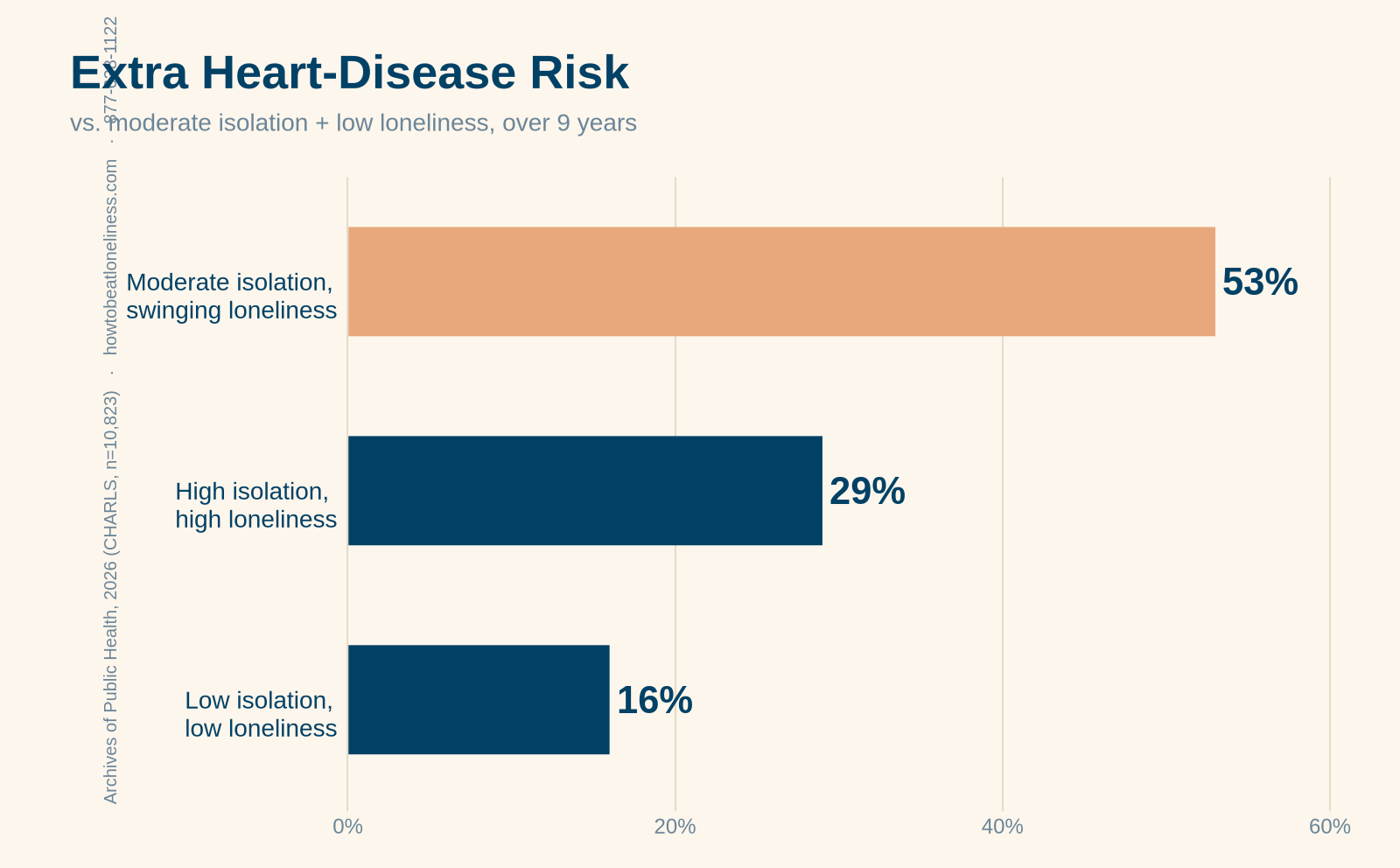
- Moderate isolation, loneliness that came and went: 53% higher heart-disease risk — the highest of any pattern in the study.
- High isolation, loneliness that stayed high the whole nine years: 29% higher risk.
- Low isolation, loneliness that stayed low the whole time: 16% higher risk — though the authors note this group also smoked, drank, and carried excess weight more often, which may explain part of it.
- High isolation, loneliness that stayed low: no meaningful difference from the comparison group.
Why would on-and-off loneliness matter more than loneliness that’s just high?
The researchers don’t fully know, and a study like this — observational, tracking patterns rather than running an experiment — can’t prove cause and effect. But one honest possibility: a body that keeps swinging in and out of connection may stay in a low hum of stress response that never gets the chance to settle, while a body in one steady state, even a lonely one, adapts to it. It’s a bit like why losing and regaining weight repeatedly can be harder on the body than staying at one steady number.
What this means if your loneliness comes and goes
This doesn’t mean one lonely week is a medical emergency. But it’s a real reason not to wait for loneliness to become constant before you take it seriously — the in-between weeks seem to count too. For the fuller picture on loneliness and the heart, including what the U.S. Surgeon General’s 2023 advisory says about loneliness and cardiovascular risk generally, see our guide on loneliness and heart disease. And if today happens to be one of the weeks it’s creeping back in, the line is free, it’s 24 hours, and nobody there will ask you to explain why you’re calling.
This article reports findings from one observational study and isn’t medical advice. If you’re worried about your heart or your mental health, please talk with your doctor — we are companions, not clinicians.
— Sergio, How To Beat Loneliness
Sources
- Liu, Z., Sun, X., Li, Y.,, et al., “Patterns of social isolation and loneliness and cardiovascular disease risk,” Archives of Public Health, 2026
- News-Medical, “A nine-year study reveals a pattern linking loneliness to heart risk,” Oct 21, 2026
- U.S. Surgeon General, “Our Epidemic of Loneliness and Isolation,” 2023