

If you’re in crisis right now — call or text 988 (US Suicide & Crisis Lifeline), available 24/7. This article isn’t a substitute for emergency mental-health support. Short version on how to deal with loneliness as a man: name it without the shame, pick one structured group instead of trying to “open up,” and protect the transitions (retirement, divorce, loss) that hit men hardest. If you’d rather just talk to a real person today: call 877-638-1122 — free, no script, no upsell.
I’m Jewel. I’m one of the people who answers the phone at How To Beat Loneliness, and a good share of the men who call don’t lead with “I’m lonely.” They lead with something else — a divorce, a retirement that didn’t feel like freedom, a quiet house after a funeral — and the loneliness comes out sideways. If you’re trying to figure out how to deal with loneliness as a man, especially past 50, here’s what the research and our own calls actually point to, not the generic “open up more” advice.
Why loneliness hits men differently
AARP’s December 2025 loneliness survey found 42% of men report feeling lonely, versus 37% of women — a reversal of the old assumption that loneliness is mostly a women’s problem. The gap isn’t about whether men have a close friend. Pew Research’s January 2025 study found men and women are about equally likely to have at least one. It’s about what that friendship can carry: only 38% of men said they’d be extremely or very likely to turn to a friend for emotional support, versus 54% of women, and men with close friends contact them less often.
Dr. Robert Garfield, a University of Pennsylvania doctor and author of Breaking the Male Code, put it this way in a November 2025 AARP piece: “Loneliness isn’t just a function of the outside world but how a man holds and communicates the emotions that come up.” The same article quotes Dr. Jeremy Nobel of Harvard’s T.H. Chan School of Public Health, who works with isolated older men and says many simply have “a limited skill set” for making close friends — not because they don’t want connection, but because almost nothing in how boys are raised teaches it.
The gap isn’t a character flaw — it’s structural
The same AARP December 2025 survey, cited in AARP’s Gen X men friendship study, found men are less likely to be in the rooms where friendships actually form in the first place: only 19% of men belong to a local community organization or club, versus 24% of women; 30% of men volunteer at least once a year, versus 37% of women; and 32% of men attend religious services monthly, versus 39% of women. Ninety-five percent of men say friends are essential to a happy life — they’re just statistically less likely to be somewhere that builds them.
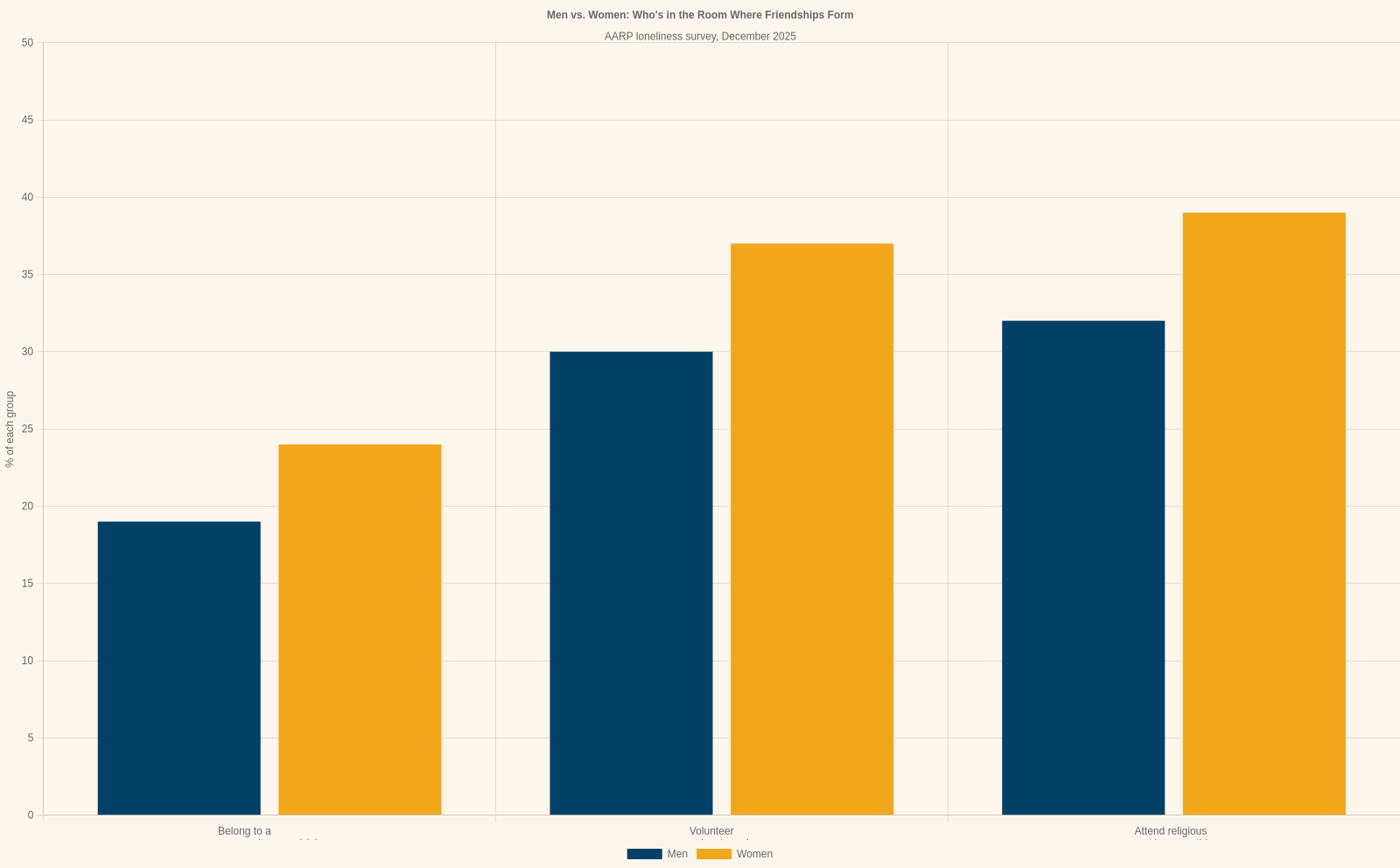
That’s the actual lever. Not “be more open” — show up somewhere on a schedule, because the structure does the social work for you.
6 things that actually help
1. Name it without the stigma
A 2022 UK study of 72 men aged 65–95 living alone (Health & Social Care in the Community, Willis & Vickery) found most kept their loneliness private out of embarrassment, a belief no one would be interested, or not wanting to burden their adult kids. Fathers in the study felt loneliness simply didn’t fit the role they thought they had to play. Saying the plain sentence to yourself — “I’m lonely, and that’s a normal response to what changed, not a failure” — is the first thing that has to happen before any of the rest works.
2. Pick one structured group instead of trying to “open up”
Men’s Sheds, league bowling, Rotary or Lions clubs, the American Legion or VFW, or a Meetup built around a hobby all work the same way: you show up for the activity, and the friendship happens as a side effect, not a performance. We put together a full list with costs and how to start in Clubs for Lonely Men: 5 Free Groups Worth Joining.
3. Protect the one friendship you already have
Since most men already have at least one close friend, the highest-leverage move might not be making a new one — it’s calling the one you have more than once a quarter. We went deeper on the numbers behind this in Men Have No Close Friends: The Real Numbers.
4. Watch the big transitions
In the Willis & Vickery study, bereavement was the single most common trigger for loneliness, named by over a third of the men interviewed — followed by divorce, long-term illness, and retirement. If you’re heading into or just through one of these, that’s exactly the window to add structure on purpose, not wait and see how you feel. If divorce is the transition, Loneliness After Divorce — Why It Hits So Hard, and What Helps walks through it directly.
5. Let short-term coping be a bridge, not an endpoint
The same study found men commonly leaned on keeping busy, watching TV, listening to music, or other solo distractions to get through a hard stretch. Those are fine for a bad night — researchers found they didn’t build real connection on their own. Use them to get through today, then still make the call or show up to the group tomorrow.
6. Talk to a real person today, free
You don’t need a crisis, or a reason that sounds big enough. Our line is free, staffed by real people, and open for exactly this.
If this is more than loneliness
One number is worth saying plainly: men over 75 have the highest suicide rate of any U.S. age group — about 41 deaths per 100,000, nearly eight times the rate for women the same age, per CDC data cited in the AARP reporting above. Loneliness and that risk are connected, which is exactly why this isn’t something to just wait out alone.
We are companions, not clinicians. The phone line at How To Beat Loneliness is staffed by real humans who listen — we don’t diagnose, prescribe, or treat. If you’re working through grief, a mental-health condition, or something that feels bigger than one hard stretch, please pair our conversation with a licensed professional, your doctor, or 988.
If you’re in immediate danger or thinking about hurting yourself, call or text 988 (US Suicide & Crisis Lifeline).
Questions men ask us about this
Is it normal for loneliness to show up as irritability or restlessness instead of sadness?
Yes. Several of the men in the Willis & Vickery study described “getting on with it” rather than naming any emotion at all — loneliness showed up as restlessness, overbusyness, or short temper more often than tears. The feeling doesn’t have to look a certain way to count.
What if I don’t want to join a group?
Start smaller: one phone call to the one friend you already have, on a repeat schedule — same day every other week, so it doesn’t rely on either of you remembering to reach out.
Does retirement really make this worse?
Often, yes — a UCLA doctor who specializes in older adults’ wellbeing, quoted in the AARP reporting, notes that retirement-linked loneliness is frequently temporary, but it’s exactly the window where men lose the built-in daily contact a job provided, so it’s worth replacing deliberately rather than waiting for it to resolve on its own.
Reviewed by Landon, How To Beat Loneliness.
— Jewel, How To Beat Loneliness
Sources
- AARP, “Why Older Men Struggle With Loneliness,” November 8, 2025 (cites CDC suicide data)
- AARP Gen X men friendship study, citing AARP loneliness survey, December 2025
- Pew Research Center, “Men, Women and Social Connections,” January 16, 2025
- Willis, P., & Vickery, A. (2022). Loneliness, coping practices and masculinities in later life. Health & Social Care in the Community, 30(5), e2874–e2883.