Short version: Solitude vs loneliness isn’t just a mood — new research says one tends to help you and the other tends to hurt you, and the difference comes down to whether you chose it. If being alone has stopped feeling like your choice, call 877-638-1122 — free, no script, no upsell.
I’m Jewel. I’m one of the people who picks up the phone when you call the free loneliness line at How To Beat Loneliness. A lot of callers ask me some version of the same question — is it bad that I like being alone? — and a lot of others call because the alone time that used to feel fine now feels unbearable. Those are two very different things, and the research on solitude vs loneliness backs that up with real numbers.
Here’s what seven studies and surveys actually found when researchers looked closely at people who choose to be alone versus people who feel stuck being alone. The short answer: it isn’t the hours that matter, it’s whether you picked them. If you’d rather skip to a real conversation, call 877-638-1122 — it’s free.
What the solitude vs loneliness research actually found
These seven numbers come from peer-reviewed psychology journals and one national survey — not from guesswork.
56% say alone time is vital to their mental health
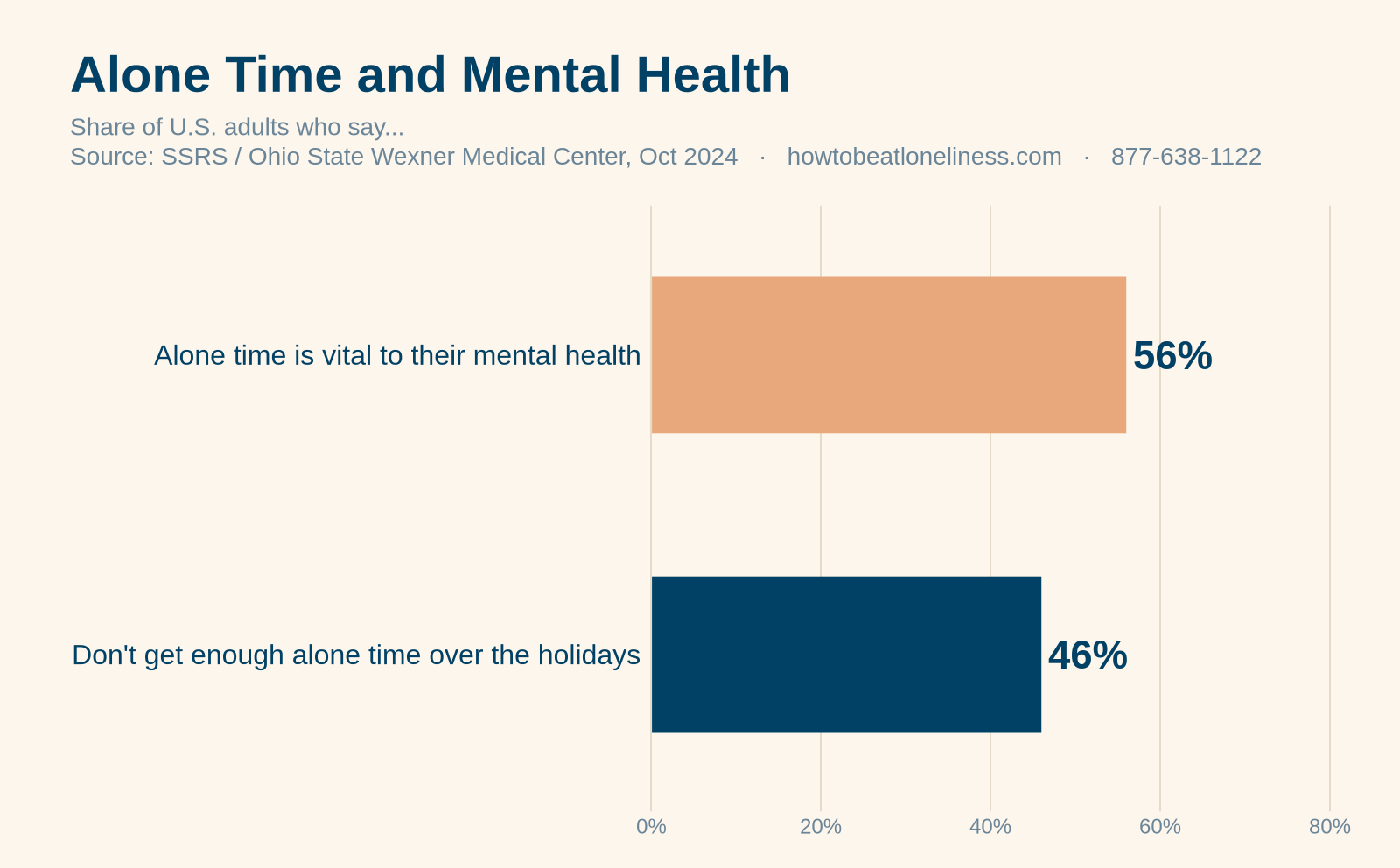
In an October 2024 survey of 1,004 U.S. adults conducted by SSRS for Ohio State University’s Wexner Medical Center, 56% said having enough alone time is very important to their mental health. That’s a majority — wanting solitude isn’t a fringe preference, it’s something most people say they need.
46% say they don’t get enough of it — especially around the holidays
The same survey found 46% of Americans say they don’t get the alone time they need, and the gap widens around the holidays, when family obligations and social calendars crowd it out. Needing solitude and being denied it are two different kinds of stress.
News stories are 10 times more likely to call being alone “harmful” than “beneficial”
A February 2025 University of Michigan study published in Nature Communications (Rodriguez & Kross) analyzed 144 U.S. news articles from 2020–2022 and found they were ten times more likely to frame being alone as harmful rather than beneficial. The actual research doesn’t support that lopsided a picture — the coverage does.
Your beliefs about solitude change how lonely you actually feel
That same Michigan study followed people across nine countries on six continents and found something more useful than a media critique: people who believed solitude was harmful felt lonelier after time alone, while people who saw solitude positively felt less lonely and reported more positive feelings in the exact same situations — alone. The belief, not just the hours, shaped the experience.
Chosen alone time feels good; obligated alone time doesn’t
Researchers Dwight Tse, Jennifer Lay and Jeanne Nakamura tracked 283 adults through 8,769 real-time phone check-ins (Social Psychological and Personality Science, 2022). Solitary activities people chose were linked to better in-the-moment feelings. Solitary activities people felt stuck doing — out of obligation or because there was no other option — were linked to lower well-being when they happened often.
Older adults handle solitude better than younger adults
The same research line found older adults coped with being alone better than younger adults did — the opposite of the “lonely old age” stereotype that shows up in so much loneliness coverage.
Solo volunteering, 5+ hours a week, still builds real connection
A 2022 Research on Aging study (Mann, Boeder, Tse, Graham & Nakamura) followed adults 60 and older who volunteered at least five hours a week. Volunteer work done alone was linked to more positive mood and a stronger sense of connection to others than other solitary activities — alone, but still plugged in.
So what’s the real difference between solitude and loneliness?
Put the seven numbers together and one line runs through all of them: solitude you choose tends to help you; loneliness that’s forced on you tends to hurt you. Same hours alone, opposite outcome, depending on whether you picked them and how you think about them.
That’s genuinely good news if you’re someone who likes your own company — reading, gardening, a long drive with no one talking, a Saturday with no plans. Liking solitude isn’t a problem to fix. It’s one of the healthiest things a person can want.
When solitude turns into loneliness — and what actually helps
The harder moment is when alone time stops being a choice. Maybe your friends moved, your spouse died, your hours changed, or your body can’t get you out of the house the way it used to. That’s not solitude anymore — that’s loneliness wearing solitude’s clothes, and the research above says it carries real health risk. If that’s where you are, or you’re starting to wonder, a free, no-pressure phone call can be the first “no” to loneliness in a long time: 877-638-1122. If what you’re feeling is heavier than that, 988 (Suicide & Crisis Lifeline) is free and answers 24/7.
If solitude really is your thing and you just want to do more of it well, we put together ten hobbies that honor your need for alone time. If you live alone and want to make sure it stays solitude instead of sliding into loneliness, here’s our founder’s honest guide to that. And if you’re past the point of sorting it out alone, here’s everywhere you can turn to talk to someone — starting with us.
— Jewel, How To Beat Loneliness
Sources
- SSRS / Ohio State University Wexner Medical Center — national survey on alone time and mental health, 2024
- University of Michigan — Rodriguez & Kross, “How people think about being alone shapes their experience of loneliness,” Nature Communications, 2025
- Society for Personality and Social Psychology — Tse, Lay, Weinstein & Nguyen, “Who Enjoys Solitude,” Character & Context Blog, 2023