
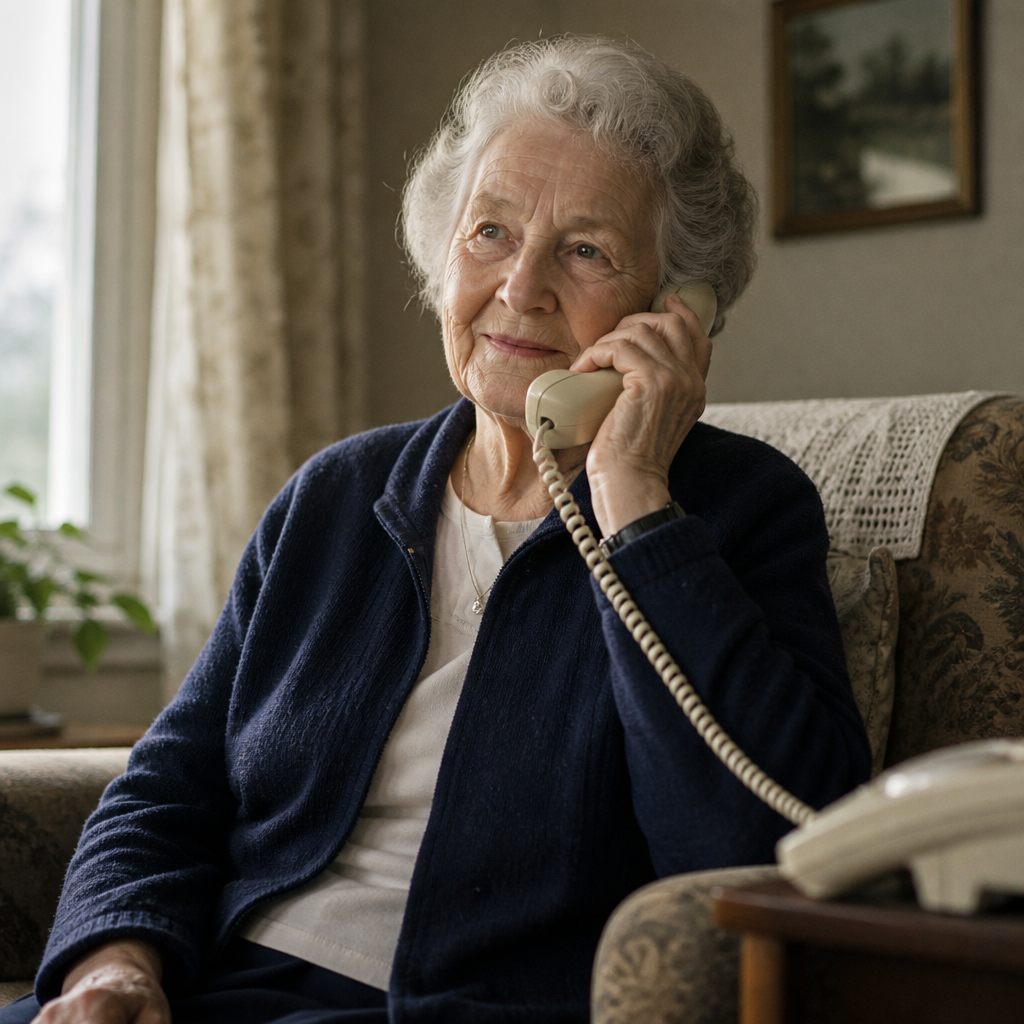
The short version: There is no official rule, but the one calling program researchers actually tested phoned people 2 to 5 times a week for under ten minutes — so if you are asking how often should you call your elderly parent, short and predictable beats long and rare. And if the real problem is that your own phone never rings, How To Beat Loneliness answers a free line at 877-638-1122, where a real person picks up.
I’m Jewel, and I answer that free line. A fair number of the people who call me are not the lonely parent — they are the son or the daughter, and they open with some version of the same worry: am I calling enough? Nobody wants to say out loud that they have been rationing their own mother. So let me take the guilt out of it and give you what the research says, because how often should you call your elderly parent turns out to have a better-evidenced answer than most questions in this field.
How often should you call your elderly parent? Two to five times a week
Two to five short calls a week is the frequency that has actually been tested and shown to reduce loneliness. In a randomized clinical trial published in JAMA Psychiatry in 2021, 240 older adults receiving Meals on Wheels services were called by briefly trained laypeople — daily for the first five days, then between two and five days a week depending on what the person wanted. Calls were aimed at under ten minutes.
After four weeks, loneliness had fallen measurably in the group getting calls. On the UCLA Loneliness Scale, scores improved by an average of 1.1 points from a starting point of 6.5, an effect size of 0.48 — and depression and anxiety scores dropped too.
Sit with the size of that ask for a second. Under ten minutes. A few days a week. Delivered by callers between the ages of 17 and 23 who had been trained for about an hour. Whatever you were imagining the bar to be, it is lower than that.

Most families call less than they think they do
Pew Research Center surveyed adults in the United States, Germany and Italy about family contact. Among Americans with a living parent aged 65 or older, 35 percent said they were in touch at least once a day. Among Americans whose parents were under 65, the figure was 42 percent.
That gap is small, and it goes the wrong way. Contact drops off slightly at exactly the age when a parent’s own social world is usually shrinking — when the friends start dying, the driving stops, and the days stop having anything in them that requires showing up.
The telephone is still how it happens, by the way. In that same survey, 94 percent of American adults in monthly contact with a parent said they typically use the phone. Not video. Not messages. The phone.
Why the length of the call barely matters
Frequency helps, but the quality of the conversation does more. A 2025 study of daily social interaction found that it was the quality of people’s interactions, not the quantity, that tracked with loneliness — and reviews of the wider literature keep landing in the same place.
This is why the forty-minute Sunday call can leave everybody flat. If it is mostly logistics — the prescription, the insurance letter, whether the gutters got done — it is an administrative meeting with a person you love. Nothing in the research suggests that gets banked as connection.
What the tested program trained its young callers to do was almost embarrassingly simple: let the other person choose the subject, ask about it, and stay interested. That is the whole technique. If you want the longer version of this, we wrote it out in how to help an elderly parent who is lonely.
A phone call is not a substitute for showing up
Here is the finding I would not want to leave out, because it complicates the cheerful version of this article. Research on older Americans found that people whose in-person contact decreased had higher loneliness — and increasing remote contact did not offset that loss.
So calls are not a currency you can pay a visit off with. If you live four states away and always will, that is simply your situation and calling often is the right thing to do. But if you live twenty minutes away and have been calling instead of driving, the research is not on your side, and I think you probably already knew that.
What to do when you honestly cannot call more
Most people asking this question are not neglectful. They are working, raising somebody, and often unwell themselves. The useful move is not more guilt — it is more people in the rotation.
- Give the call a fixed slot. Tuesday and Friday at six is worth more than “whenever I get a minute”, because your parent can look forward to it. Anticipation is part of what a call gives somebody.
- Split the week with a sibling. Two people calling twice each lands inside the tested range without either of you carrying it alone. Say the days out loud so nobody assumes the other one did it.
- Ask about the past, not the day. “What did you do today” is a hard question for someone whose day was quiet, and it can feel like a test. “What was your mother like at my age” is not.
- Call the Eldercare Locator at 800-677-1116. It is free, staffed weekdays, and connects you to your parent’s local Area Agency on Aging, which knows the telephone reassurance and friendly visitor programs in that county. Many run daily check-in calls for seniors at no charge.
- Let somebody else be the conversation. Our line exists for exactly this. Your parent can call 877-638-1122 for free and talk to a real person about anything at all, on a day you cannot get to the phone.
Who to call for what
| What you need | Where to call | Cost |
|---|---|---|
| Your parent just wants someone to talk to | How To Beat Loneliness — 877-638-1122 | Free |
| A regular check-in call in their own town | Eldercare Locator — 800-677-1116 | Free referral |
| Peer support for you, the one doing the calling | Your local Area Agency on Aging caregiver program | Usually free |
| You think your parent may be in crisis | 988 Suicide & Crisis Lifeline — call or text 988 | Free, 24/7 |
Frequently asked questions
How often should you call your elderly parent?
Two to five times a week is the frequency with actual evidence behind it. In a randomized trial published in JAMA Psychiatry, 240 older adults were called two to five days a week for under ten minutes each time, and after four weeks their loneliness, depression and anxiety scores had all improved compared with a group who got no calls. Daily is lovely if you can manage it, but a few short calls a week is the tested standard, not a compromise.
Is a long call once a week better than short calls several times a week?
Several short ones appear to be better. The program that reduced loneliness aimed at calls under ten minutes spread across the week, and research on daily interaction finds that the quality of contact predicts loneliness more strongly than the quantity. A long weekly call also carries a hidden cost: six days with nothing to look forward to.
What if my parent says not to call so much because they are fine?
Take it at face value in words and not in substance. Many older adults were raised to refuse help and to avoid being a burden, and “I’m fine, don’t fuss” is often the polite form of that training rather than a request. Keep the call short enough that it costs them nothing to accept, and let the standing time do the work.
Do phone calls actually help, or does it have to be a visit?
Calls genuinely help, and they also do not fully replace visits. The telephone trial showed a real drop in loneliness in four weeks, while separate research on older U.S. adults found that people whose in-person contact fell became lonelier, and more remote contact did not make up the difference. If you can visit, visit; if you cannot, calling often is still worth doing.
Who can call my parent when I cannot?
The Eldercare Locator at 800-677-1116 will connect you to your parent’s Area Agency on Aging, which keeps the local list of free telephone reassurance and friendly visitor programs. How To Beat Loneliness also answers a free line at 877-638-1122 that your parent can call themselves, with no appointment, no crisis required and nothing to sign up for.
Important
We are companions, not clinicians. Everything above describes averages across groups of people, not a prediction about your mother or your father, and a phone call is not a treatment for depression. If your parent sounds hopeless, or says anything about not wanting to be here, call or text 988 — the Suicide & Crisis Lifeline, free and staffed around the clock. Their doctor should hear about it too.
One last thought
The number of calls is the easy part of this question, and it is not really what people are asking me. What they are asking is whether they are a good son or a good daughter. I cannot answer that one, and neither can a study.
But I can tell you that the people on the other end of my line almost never count the calls. They remember that somebody asked them a question and then waited for the whole answer. Twice a week, ten minutes, on a day they can name — that is not the least you can do. According to the only trial anybody has run on it, that is the thing that works.
And if you are reading this from the other side of it — if you are the parent whose phone has gone quiet — I wrote something for you too, about what it means when your adult children never call. Our wider guide on how to beat loneliness is a good place to start as well.
— Jewel, How To Beat Loneliness. Call us at 877-638-1122. It is free, and someone will pick up.
Sources
- Kahlon et al. — Effect of Layperson-Delivered, Empathy-Focused Program of Telephone Calls on Loneliness, Depression, and Anxiety: A Randomized Clinical Trial, JAMA Psychiatry (2021)
- Dell Medical School, University of Texas at Austin — summary of the telephone-call trial
- Pew Research Center — Keeping in Touch Across Generations, Family Support in Graying Societies
- Better Together: Social Contact and Loneliness Among U.S. Older Adults — The Journals of Gerontology: Series B
- Quality over Quantity: The Association Between Daily Social Interactions and Loneliness (2025)
- National Institute on Aging — Loneliness and social isolation: tips for staying connected
- Eldercare Locator — Administration for Community Living / USAging