
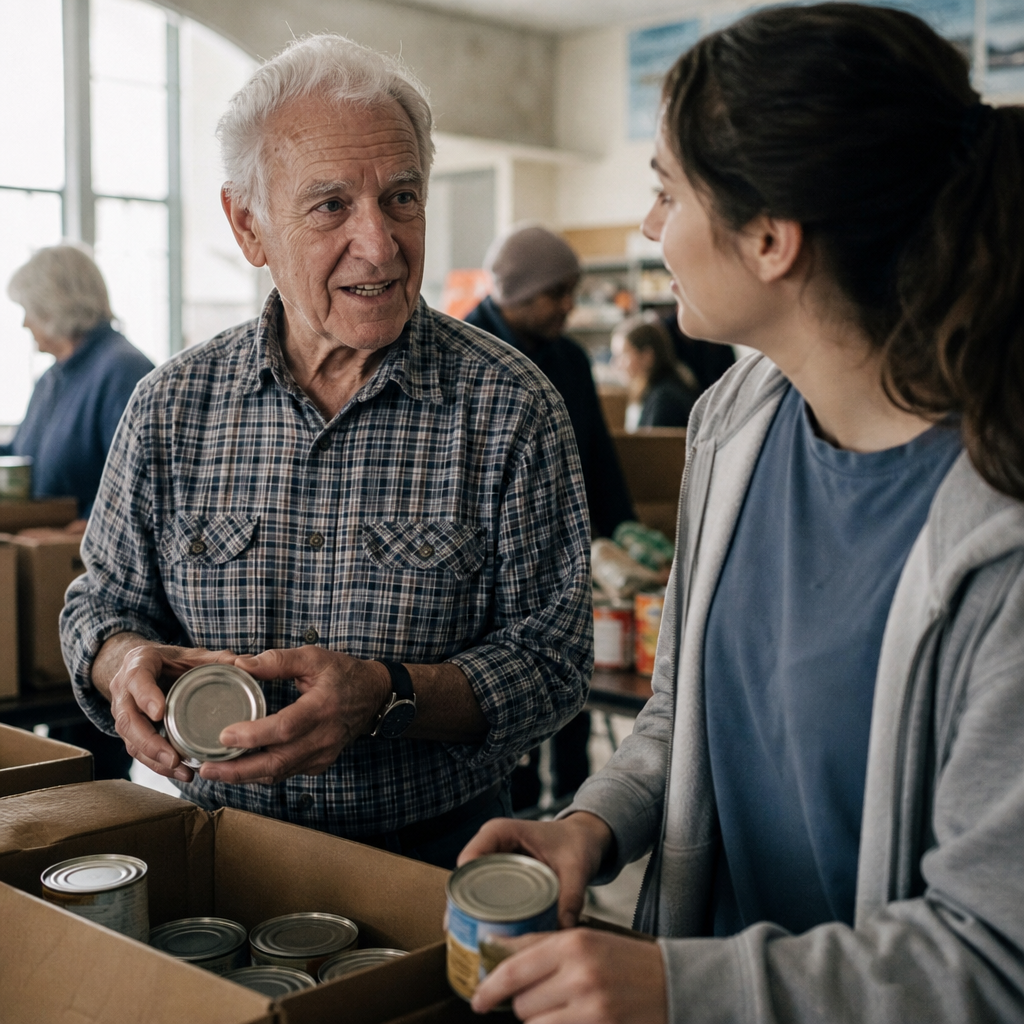
The short version: Does volunteering help with loneliness? Yes — and the evidence now comes from a randomized trial rather than a hopeful assumption. If what you want first is simply to talk to somebody, How To Beat Loneliness answers a free phone line at 877-638-1122, and a real person picks up. Below is what researchers actually measured, including the number of hours a week that turned out to matter.
I’m Landon, and I work at How To Beat Loneliness, where we answer a free phone line. “You should volunteer” is the advice almost everyone gives a lonely person, usually right before changing the subject. It lands like a brush-off — as if the problem were idleness. So I went and read the studies, because I wanted to know whether does volunteering help with loneliness is a real finding or just something people say. It turns out to be one of the better-tested pieces of advice in this whole field, with one condition attached that nobody mentions.
Does volunteering help with loneliness? What the trial found
Yes. In a dual randomized controlled trial published in The Lancet Healthy Longevity, 375 lonely adults aged 50 to 70 were randomly assigned either to volunteer or to a comparison group. The volunteers were trained to deliver telephone support to lonely older adults living alone, roughly two hours a week. After six months, the volunteers’ own loneliness had dropped significantly, with medium-to-large effect sizes on two standard measures — the UCLA Loneliness Scale and the De Jong Gierveld scale.
Read that once more, because it is easy to skim past. The people who got less lonely were the ones giving the support. They signed up as the helper and came out the other end measurably better off themselves.
That design matters. Most of what we know about loneliness comes from surveys, which can only tell you that lonely people volunteer less — and that could just as easily mean loneliness stops you from volunteering. Randomly assigning people removes that ambiguity. This is closer to proof than this field usually gets.

The condition nobody mentions: two hours a week
Here is the part I would put on a sign. When the same trial checked back at twelve months, the benefit was still there — but only for the people who had kept volunteering more than two hours a week. Those who tapered off did not hold onto the gain.
Two hours is a Tuesday morning. It is not a second career, and that is encouraging. But it is also not one afternoon in December. Loneliness responds to rhythm, not to gestures, and this is the clearest number I have seen putting a figure on that.
It also reframes what you are choosing. You are not choosing a good deed. You are choosing a standing appointment where people expect you — which, if you have read our piece on hobbies for lonely adults, is the same mechanism doing the work there.
What volunteers themselves report
AmeriCorps Seniors, the federal service program for adults 55 and over, publishes what its own volunteers say after a year. Among volunteers who had felt a lack of companionship before they started, 88 percent reported fewer feelings of isolation afterward. Eighty-four percent reported their health was stable or improving.
Self-reported numbers from a program describing its own volunteers are weaker evidence than a trial, and I would not lean on them alone. But they point the same direction as the trial does, from a completely different angle, which is the most you can usually ask of two independent sources.
What happens when people stop
A 2025 analysis of the German Ageing Survey followed 6,628 adults aged 65 and older across two survey waves, comparing 188 people who started volunteering with 307 who stopped. Those who began volunteering reported decreased loneliness over the period.
The stopping half is the part I think about. People give up volunteer roles for entirely reasonable reasons — a knee, a diagnosis, a spouse who needs more help, a car that finally has to go. Nobody treats that as a loss worth naming, and then the quiet arrives a few months later and seems to have come from nowhere.
If that is roughly your story, the useful move is not to force your way back into the same role. It is to replace the slot with something you can actually sustain. A phone shift counts. Many programs are entirely telephone-based now, which is why they still work for people who are homebound and lonely.
Where to actually start this week
- Start with the federal front door. AmeriCorps Seniors runs the Senior Companion Program for adults 55 and over, and its Pathfinder tool searches openings near you. Some programs pay a modest stipend to qualified low-income volunteers, which removes the “I can’t afford the gas” problem people rarely say out loud.
- Call the Eldercare Locator. One free number — 800-677-1116, weekdays 8am to 9pm Eastern — routes you to your county’s Area Agency on Aging, which keeps the local lists for friendly-visitor and telephone-reassurance programs. Ask to volunteer, not just to receive.
- Pick something with a fixed time. “Whenever you need me” produces no schedule and no expectation, and the schedule is the active ingredient. Tuesday at ten is better than four flexible hours.
- Choose talking over sorting, if you get the choice. The trial that worked was people making phone calls to other people. Stuffing envelopes in a quiet room is a fine thing to do and a poor treatment for loneliness.
- Give it eight weeks before you judge it. The measured benefit showed up at six months, not week two. The first few shifts of anything new mostly feel awkward, and that is not a verdict.
And if none of this is where you are today — if the honest answer is that you just want someone to talk to when lonely before you take on anything at all — that is what our line is for. For the wider picture, our main guide on how to beat loneliness is the place to start.
Who to call for what
| What you want | Where to call | Cost |
|---|---|---|
| Just someone to talk to, today | How To Beat Loneliness — 877-638-1122 | Free |
| A volunteer role if you are 55 or older | AmeriCorps Seniors Pathfinder — americorps.gov | Free (stipend for some) |
| Local visiting and phone programs | Eldercare Locator — 800-677-1116 | Free referral |
| You are in crisis or thinking of harming yourself | 988 Suicide & Crisis Lifeline — call or text 988 | Free, 24/7 |
Frequently asked questions
Does volunteering help with loneliness, or does it just keep you busy?
It does more than fill time. In a dual randomized controlled trial published in The Lancet Healthy Longevity, 375 lonely adults aged 50 to 70 were randomly assigned to volunteer or to a comparison group, and after six months the volunteers’ own loneliness had fallen significantly, with medium-to-large effect sizes. Because people were assigned at random, the result is not simply less lonely people choosing to volunteer.
How many hours a week does it take?
About two. Volunteers in the trial committed to roughly two hours a week for six months. At the twelve-month follow-up, the benefit persisted only among those still volunteering more than two hours a week, so consistency appears to matter more than intensity.
What kind of volunteering works best for loneliness?
The role tested in the trial was telephone-based support for other lonely older adults, so conversation was the task itself. Roles built around talking to people on a regular schedule match the evidence more closely than solitary tasks do, though any regular commitment gives you a place where you are expected.
Where do I find volunteer work if I am over 65?
AmeriCorps Seniors accepts volunteers aged 55 and over and lists openings through its Pathfinder tool, with a modest stipend available to qualified low-income volunteers in some programs. The Eldercare Locator at 800-677-1116 connects you to your county’s Area Agency on Aging, which knows the local friendly-visitor and telephone programs.
What if I am too tired or unwell to volunteer right now?
Then start with a conversation instead. How To Beat Loneliness answers a free line at 877-638-1122 where a real person picks up, with no crisis required and nothing to sign up for. Many volunteer roles are now entirely telephone-based, so they remain open later on even if leaving the house stays difficult.
Important
We are companions, not clinicians. The findings above describe averages across groups of people, not a prediction about any one person, and volunteering is not a treatment for depression. If the loneliness has hardened into hopelessness, or you are having thoughts of hurting yourself, call or text 988 — the Suicide & Crisis Lifeline, free and staffed around the clock. That is the right door for that, and using it is not an overreaction.
One last thought
What strikes me about all of this is the direction it runs. We spend a great deal of effort trying to get lonely people to receive help, and the strongest result in the literature came from asking them to give some.
That is not a lecture about attitude. It is a practical finding about where to spend two hours. And if this week those two hours are beyond you, the line is free, it is open, and you do not need a reason to use it.
— Landon, How To Beat Loneliness. Call us at 877-638-1122. It is free, and someone will pick up.
Sources
- The effects of volunteering on loneliness among lonely older adults: the HEAL-HOA dual randomised controlled trial — The Lancet Healthy Longevity
- AmeriCorps Seniors — Senior Companion Program (volunteer benefits and eligibility)
- Richardson et al. — The Association Between the Onset and Ending of Volunteering on Loneliness and Perceived Social Isolation Among Older Adults, Brain and Behavior (2025)
- National Institute on Aging — Loneliness and social isolation: tips for staying connected
- Eldercare Locator — Administration for Community Living / USAging