
The short version: a friendship line for seniors is a phone line you can call just to talk — no crisis required, no appointment, no bill. How To Beat Loneliness runs a free one at 877-638-1122, answered by a real person. The best-known line in the country, the Institute on Aging Friendship Line, answers 24/7 at 888-670-1360. (If you’re in crisis right now, call or text 988, the Suicide & Crisis Lifeline — that line is built for emergencies. These are for everything else.)
People find these lines in strange ways. A pamphlet at the pharmacy. A number scribbled on the back of a church bulletin. A daughter in another state who did the Googling. Whatever brought you here, the practical question is usually the same: does anyone actually pick up, and what does it cost? Below are seven straight facts about the friendship line for seniors model, where the numbers come from, and what happens after you dial. Worth knowing too that most people over 50 have never heard of the crisis line sitting alongside these — we looked at 988 for older adults separately.
What a friendship line for seniors actually is
It’s a warmline, not a hotline. A hotline exists for emergencies. A warmline exists for the ordinary weight of a quiet week — grief that hasn’t gone anywhere, a house that got too big, a Tuesday afternoon with nothing in it. Same telephone, entirely different job. If the distinction is new to you, we wrote a fuller explanation of what a warmline is and when to use one.
7 facts about the friendship line for seniors
1. It’s older than the internet
The Institute on Aging launched the Friendship Line in 1973, founded by Dr. Patrick Arbore. That’s more than fifty years of people picking up a phone for the sole purpose of listening to an older adult — decades before anyone used the word epidemic about loneliness.
2. You don’t have to be in crisis to call
The Institute on Aging says this plainly on its own page: you don’t have to be in crisis to call. Sometimes just having someone to talk to makes the difference. We say the same thing at 877-638-1122, and we mean it the same way. Wanting a conversation is a complete reason.
3. It handles more than 11,000 calls a month
The Friendship Line responds to over 11,000 calls every month, in eight languages — English, Spanish, Cantonese, Mandarin, Korean, Tagalog, Vietnamese and Russian, each with its own toll-free number. If you’ve ever wondered whether you’d be the only person calling a line like this: you’d be roughly the 11,000th that month. If you’re passing this number to someone else rather than calling for yourself, it’s worth reading what to say to a lonely friend before you hand it over.
4. It’s accredited, which is rarer than it sounds
The Institute on Aging describes it as the nation’s only accredited 24-hour toll-free emotional support line built specifically for older adults, accredited by the American Association of Suicidology and run as part of the organization’s Center for Elderly Suicide Prevention and Grief-Related Services. Trained staff and volunteers answer, whether it’s 2 p.m. or 2 a.m.
5. It can call you
Outbound check-in calls are part of the program. You fill out an intake form and someone starts calling you on a regular schedule. That flips the hardest part of the whole thing — the dialing — off your plate. Several organizations do this now, and we compared the options in our piece on check-in calls for seniors.
6. It’s focused on California — here’s what to do elsewhere
This is the fact most articles skip. The Institute on Aging describes the Friendship Line as a senior emotional support line serving California, and its funders are California agencies. The toll-free number is answered around the clock, but the program is built around that state. If you’re in Ohio or Georgia or Idaho and you want a line with no geography attached, ours has none: 877-638-1122, free, answered by a person, anywhere in the country.
7. The need behind these lines isn’t small
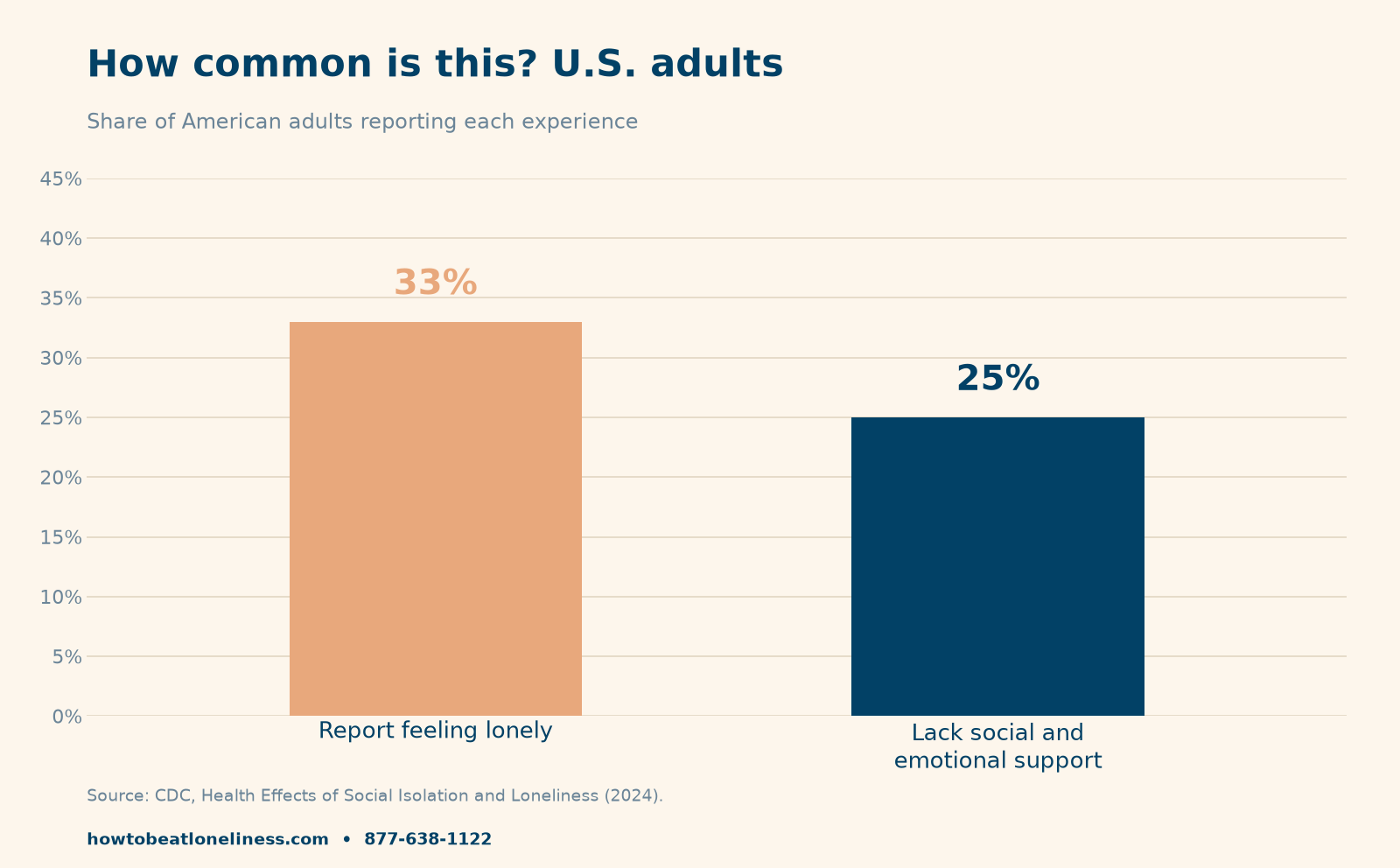
The CDC reports that about one in three U.S. adults say they feel lonely, and about one in four say they don’t have the social and emotional support they need. In 2023 the U.S. Surgeon General issued a formal advisory calling social disconnection a public health problem on the scale of smoking. Lines like these exist because the arithmetic demanded them.
How the free lines compare
| Line | Cost | When it fits | Worth knowing |
|---|---|---|---|
| How To Beat Loneliness — 877-638-1122 | Free | You want a real conversation, anywhere in the U.S. | Companions, not clinicians — we don’t diagnose or treat |
| IOA Friendship Line — 888-670-1360 | Free | Adults 60+, adults with disabilities, caregivers | 24/7, eight languages, built around California |
| 988 Suicide & Crisis Lifeline | Free | Active crisis, thoughts of self-harm | Built for emergencies, not for a slow afternoon |
| Therapy | $$ — $$$ | Ongoing treatment for a diagnosed condition | Waitlists are long; a warmline can fill the gap |
What actually happens when you call
Someone says hello. That’s the whole opening ceremony. There’s no intake questionnaire, no menu, no assessment of whether your reason is serious enough. Most calls start with something small — the weather, a doctor’s appointment, a name you haven’t said out loud in a while — and go wherever they go. Some run four minutes. Some run forty. Nobody is timing you, and nobody is going to sell you anything at the end. If you’d like the longer version, our founder wrote about why we started a free loneliness phone line, and our main guide covers how to beat loneliness more broadly.
Frequently asked questions
What is the friendship line number for seniors?
The Institute on Aging Friendship Line is 888-670-1360, answered 24 hours a day. How To Beat Loneliness answers a free line at 877-638-1122 for anyone in the U.S. who simply wants to talk.
Is a friendship line for seniors really free?
Yes. Both numbers are toll-free. There’s no fee, no subscription, no insurance to check and nothing to sign up for.
Do I have to be a senior to call?
The Institute on Aging line is designed for adults 60 and older, adults living with disabilities, and caregivers. Our line has no age requirement at all — if you’re lonely, you qualify.
Can someone call me instead?
Yes. The Friendship Line offers scheduled outreach calls through an intake form, and several other organizations run regular check-in call programs for older adults.
Important
We are companions, not clinicians. The phone line at How To Beat Loneliness is staffed by real humans who listen — we don’t diagnose, prescribe, or treat. If you’re working through grief, depression, or a mental-health condition, please pair our conversation with a licensed therapist, your doctor, or the 988 Lifeline in a crisis.
One more thing
Fifty-plus years ago somebody decided that a phone ringing in an empty house was a public health problem worth answering. They were right, and the line is still open. So is ours: 877-638-1122, free, a person on the other end. You don’t need a reason. You just need the number.
— Landon, How To Beat Loneliness
One group carries an even sharper version of this gap: LGBTQ+ elders are far more likely to live alone and far less likely to have a partner or nearby kids to call on. We broke down loneliness among LGBTQ elders in its own real numbers — a friendship line like this one is often the only call available.